
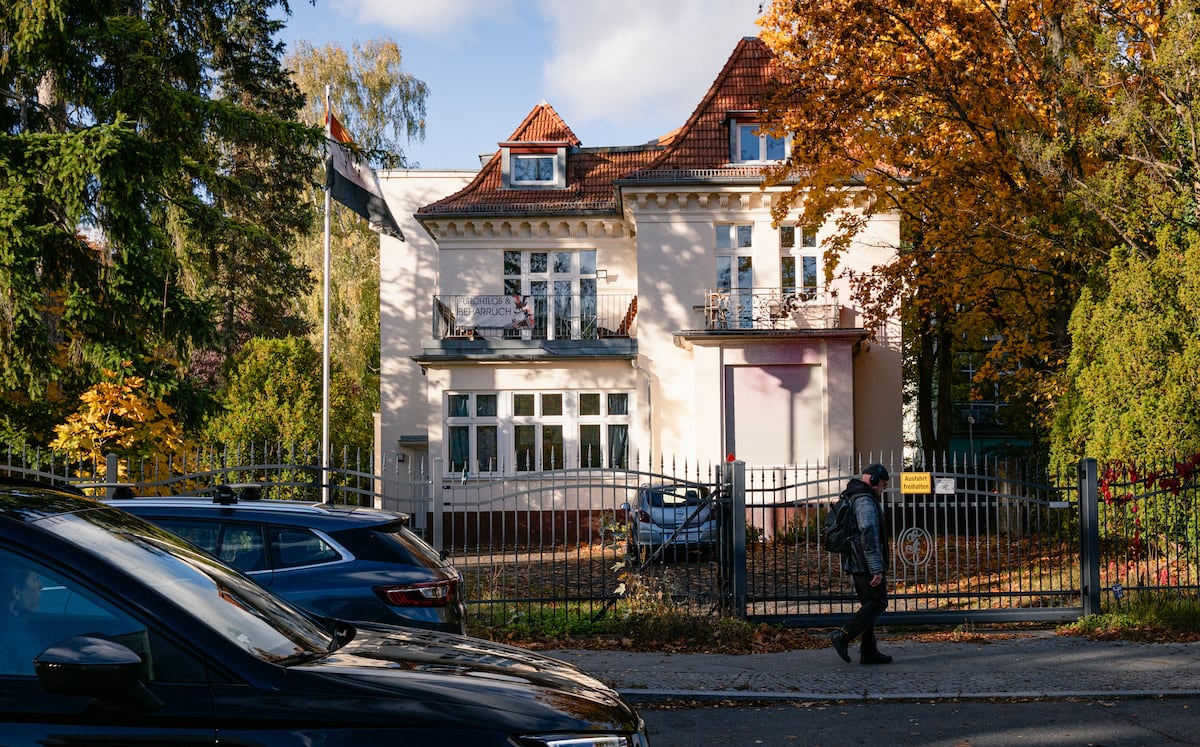
Two Alternativ für Deutschland (AfD) city councillors fought a duel with swords on October 17. Matthias Büschges, head of the AfD municipal group in Cologne, and Jeremy Fanosch, a councillor in Düsseldorf, met at the Burschenschaft student fraternity headquarters in the latter city. Accompanied by their sponsors and companions, Bürschges and Fanosch tried to settle a personal dispute with saber blows. Both politicians are Alte Herren (Old Gentlemen) of the Deutsche Burschenschaft, the organization that groups together these nationalist fraternities, which trace their roots to the 19th century. Dozens of AfD politicians have passed through them.The two councillors clashed at the party congress in July in the state of North Rhine-Westphalia. News agency DPA and the Frankfurter Allgemeine Zeitung reported that Büschges supports the continuation of Martin Vincentz as state party chair. Fanosch, by contrast, backs the appointment of Matthias Helferisch as the new chair because he considers Vincentz too moderate.“It’s a private matter but I think we were able to resolve the issue that divided us,” Büschges told DPA after the duel.Germany has a long tradition of student fraternities. Many CDU politicians, including Chancellor Friedrich Merz, have been part of these groups. But Merz, like many other Christian-democratic politicians, belonged to fraternities with Christian values. The burschenschaften are nationalist, all-male fraternities that do not allow foreigners to join. They are closed to outsiders, traditionally base their identity on national pride and, since the 20th century, on the far right. Some of these associations have been monitored by Germany’s intelligence services for their radicalism.The Burschenschaft Germania Halle in the city of Mainz has been under investigation since 2024 for “unconstitutional” activities, specifically racist comments published in the Deutsche Burschenschaft’s magazine.The left-wing party Die Linke submitted a question to the government in December 2025 about intelligence-service oversight of these fraternities. The executive replied that these associations are not investigated simply for being fraternities of a certain ideology but that investigations focus mainly on actions by specific members.“Honor, Freedom, and Fatherland” is the common motto of the burschenschaften, coined by the first of these fraternities in Jena in 1815. The Federal Agency for Civic Education, an agency under the Interior Ministry, estimates there are 120 such nationalist associations, with 1,300 students and 10,000 Old Gentlemen. That government agency classifies these fraternities as far-right. In Blaues Land, journalist Olaf Sundermeyer’s book on the AfD, fewer active associations are counted: 63 burschenschaften between Germany and Austria.Notable membersSeveral notable Germans were members of the burschenschaften. Composer Robert Schumann, philosopher Friedrich Nietzsche, and sociologist Max Weber are some examples. From the 20th century, with the rise of National Socialism, they became marked by ties to the far right.“Are you a male German student? Get active with us!” That was the main message on the Deutsche Burschenschaft information stand at the Seitenwechsel fair in Halle, the most important political and literary event of the German far right, held on November 7 and 8. “We need students who are German patriots and who break with the ‘woke’ spirit, who reject gender ideology, mass migration, and other left-wing projects,” read the leaflet being distributed at the fair.Martin Kohler, a deputy and one of AfD’s young ideologues, says in Blaues Land that the Gothia fraternity in Berlin is the party’s largest recruitment pool. Kohler himself lived there and is an alumnus of the residence hall. A dozen of his senior officials were members of the fraternity.Sundermeyer explains Gothia’s greater influence by its location at the center of Germany’s political power and because, between Berlin and neighbouring Potsdam (capital of the state of Brandenburg), it sits in a major university hub where the AfD is firmly established.Gothia’s building is an old villa in a residential Berlin neighbourhood. Only the flag with Gothia’s distinctive colours marks the place. Its members wear those colours on their uniforms. The style of those uniforms, from haircuts to clothing, is often similar to that of far-right youth groups.Gothia exemplifies the secrecy of what happens behind closed doors. Weekly Der Spiegel discovered in 2024 that the management of the residence hall is the responsibility of the Union of Former Gothians, whose president is former CDU leader Peter Kurth. He would be responsible for organizing conferences at the residence featuring far-right representatives.Kurth was head of Germany’s recycling industry employers’ association but was removed after his ties to Gothia were revealed. The last event posted publicly on the fraternity’s social media, in November 2025, was a lecture by Marvin Neumann, who was head of Young Alternative, which had been AfD’s youth organization until it was dissolved in 2025 because the Federal Office for the Protection of the Constitution, Germany’s intelligence service, considered it violated democratic principles. A ban was only a matter of time. Neumann was sidelined from the party for being too radical.Kurth is mentioned as a possible member of a future state government in Saxony-Anhalt. AfD swept the regional elections in September and is negotiating support from defecting CDU deputies and the nationalist-left BSW party to form the first far-right government in Germany since Nazism.AfD founded a new youth wing in 2025, Generation Germany. It has also launched a party training school. Sundermeyer, one of the leading experts on Germany’s radical right, believes these new structures will not replace the fraternities: “The burschenschaften will grow in influence in Germany, following Austria’s example, where they have significant influence in the FPÖ [Freedom Party].” That Austrian far-right formation is the model AfD is following to develop its school for future leaders.Germany’s most famous scarGermany’s most famous scar, in fact, belongs to an Austrian. It is a long mark on the cheek of Daniel Tapp, the right-hand man of AfD co-leader Alice Weidel. Tapp is Austrian and told EL PAÍS that his scar is the result of a duel. He is a member of Burschenschaft Germania in Trier, Germany, and of Burschenschaft Libertas in Vienna.“Duel scars are considered a sign of bravery and a symbol of the strong bond among burschenschaft members,” the Federal Agency for Civic Education says.Their best-known way of settling disagreements is with sabers, but Tapp stresses these fraternities are also a kind of democracy school, which explains their success as a pool of AfD leaders: “Students acquire the democratic tools that allow them to participate actively in political parties.” Weidel’s spokesperson points primarily to the Convent, a term used in the burschenschaften, derived from Latin, referring to their internal debating system.“Members of the fraternity learn that democratic decisions are based on a balance of interests without losing sight of shared fundamental values,” Tapp says. “They learn and apply the basics of parliamentarism, which gives them an advantage when joining political parties and holding public office.”“It’s true that in the burschenschaften members learn to handle political debate, to argue, and to reason,” Sundermeyer confirms. Students attracted to these fraternities are nationalists who, until the AfD’s emergence, had no platform to enter politics. The previous far-right German party, the NPD, was marginal and membership carried social stigma.“Before the AfD existed, these young people had no way to participate actively in a political party in Germany without suffering social ostracism, as was the case with the NPD,” Sundermeyer says. “That has changed since the AfD, which distances itself from historical fascism as a far-right party, achieved political success.”Sign up for our weekly newsletter to get more English-language news coverage from EL PAÍS USA Edition
Nationalism and sword duels: The student fraternities that serve as AfD’s recruitment pool
Full Article
Original Source
Read the full article at English →KhanList aggregates and links to publicly available news content. We do not host full articles from third-party sources. Always verify important information with original sources.