
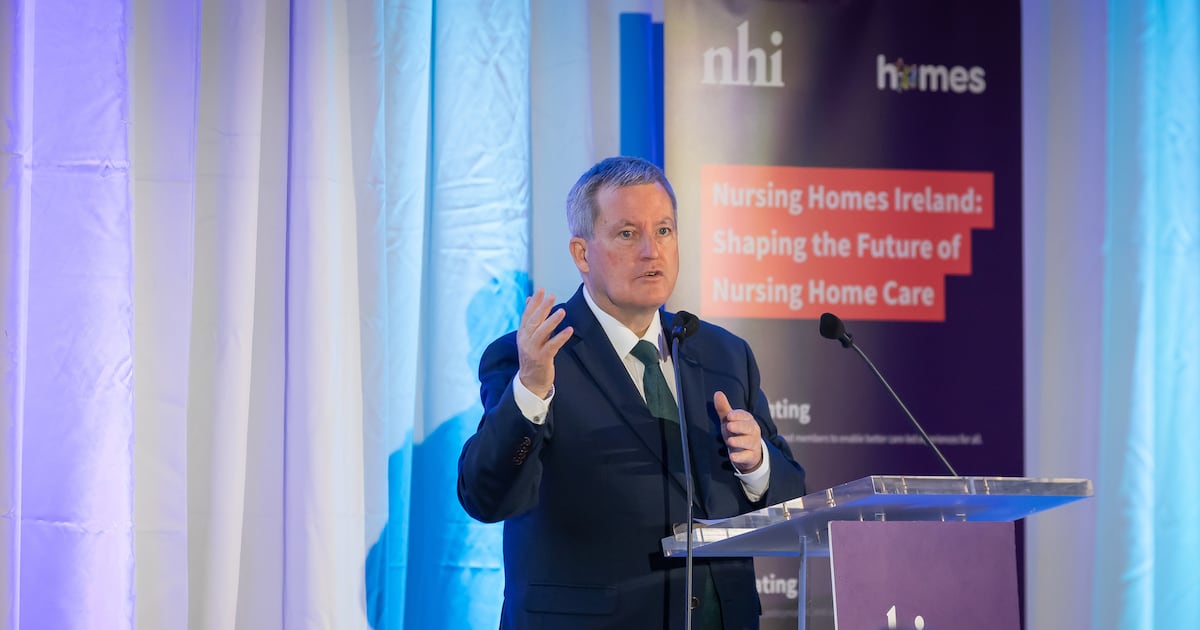
Growing demand, higher expectations for care and a funding model some providers say was making it harder to provide nursing homes where they were needed were among the issues concerning leaders and more than 500 delegates at the Nursing Homes Ireland (NHI) annual conference in Kilkenny.Earlier on Thursday, the body that represents voluntary and private providers called on the Government to begin what it called a national dialogue on ageing, with Irish nursing homes already operating at 95 per cent occupancy and demand set to grow. Ireland was “sleepwalking into one of the biggest social and healthcare challenges in its history”, NHI chief executive Tadhg Daly said. “We know exactly what is coming, yet we are still not planning with the ambition and scale required.”By 2045, the Department of Health estimates, the number of people aged 85 and above will have grown by 162 per cent. By 2030, it says, more than one million people in Ireland will be above the age of 65.READ MOREProjections from the Economic and Social Research Institute suggest that 1,000 additional nursing home beds will be required every year until 2040 to satisfy demand in Ireland.Vicky McDwyer, the managing director at Esker Lodge in Cavan, said occupancy in that part of the country was closer to 98 per cent. A family-owned nursing home that has been open for nearly 25 years, Esker Lodge has 70 residents and provides both general and dementia-specific care. McDwyer said it was “incredible how different it is” running a nursing home today versus two-and-a-half decades ago. Increased costs, availability of workforce, tightening of the market and increased regulation have all contributed to that change.Vicky McDwyer, the managing director at Esker Lodge, Cavan, says carers' work should be recognised properly “Expectations are increasing [too],” McDwyer said, “which I think is a great thing. We’re all going to get old, so if everybody’s expectations are increasing and we’re delivering in the sector, that’s a good news story.”Another challenge, she said, was interacting with the State. From September 2025 to last April, McDwyer said she had “11 State-related deadlines” to meet. These, she said, could relate to a Health and Safety Authority inspection, a Workplace Relations Commission inspection and a gender pay report.“There are lots of good aspects to regulation,” she said, but the high volume of work involved had put a strain on the business. Meanwhile, the funding model for nursing homes was “an active disincentive” for the private sector to create the additional capacity required, Daly said.It was more difficult to build facilities in “areas where they’re most needed”, he said, evidenced by the number of closures in the west of the country, where Fair Deal rates were lower compared to urban areas.“We’re seeing a few reopening, a few that had closed, thankfully, which is good,” Daly said. “But in terms of new developments and newbuilds in the areas where they’re most needed, it isn’t happening and, without being overly negative, I don’t see it happening in the short term unless we take corrective action around the funding model.”Tadhg Daly, right, welcomes Minister of State for Older People Kieran O'Donnell to the conference Daly called for a restructure of the pricing system within the Nursing Homes Support Scheme, commonly referred to as Fair Deal. The Government programme provides financial support for people in long-term nursing home care. The State pays substantially higher average weekly rates to public nursing homes, which make up around 20 per cent of the market. “Rather than getting fixated on even the number of beds or the provider of beds, we need to have a more macro view of the world,” Daly said. “It’s not about who provides them; it’s about the location as much as anything else.” He offered an example of what he saw as an issue with Fair Deal, in the form of an NHI member and voluntary nursing home that had been run by a religious order in Roscrea, Co Tipperary. This year, he said, it was taken over by the HSE, and the upshot was an increase of 95 per cent in the weekly Fair Deal rate the facility received from the State.NHI wrote to Taoiseach Micheál Martin on Thursday, urging the Government to begin a “national dialogue on ageing” involving health and social care providers, older people’s organisations, community groups and civic society. Daly said the narrative around the rising number of older people “can be quite ageist” as speculation around the costs associated with the demographic shift lacks appropriate compassion. Minister of State for Older People Kieran O’Donnell, who attended the conference, said the opening of public nursing homes was a “key focus” for the year, with nine set to open in total. But providers see challenges beyond building, too. “I feel very strongly that we don’t recognise the importance of the work that carers do,” McDwyer said. “I don’t think there’s enough done to professionalise it, and give people the opportunity to have a professional qualification the way an occupational therapist or a speech-and-language therapist does.“These are really dedicated, hard-working people in the community, who turn up every day. Sometimes it’s wonderful, sometimes it’s challenging, but they’re not getting properly rewarded. “I would like to see additional funding go to dealing with that gap.”
Nation ‘sleepwalking into biggest social and healthcare challenge’, nursing homes warn
Full Article
Original Source
Read the full article at Irishtimes →KhanList aggregates and links to publicly available news content. We do not host full articles from third-party sources. Always verify important information with original sources.