
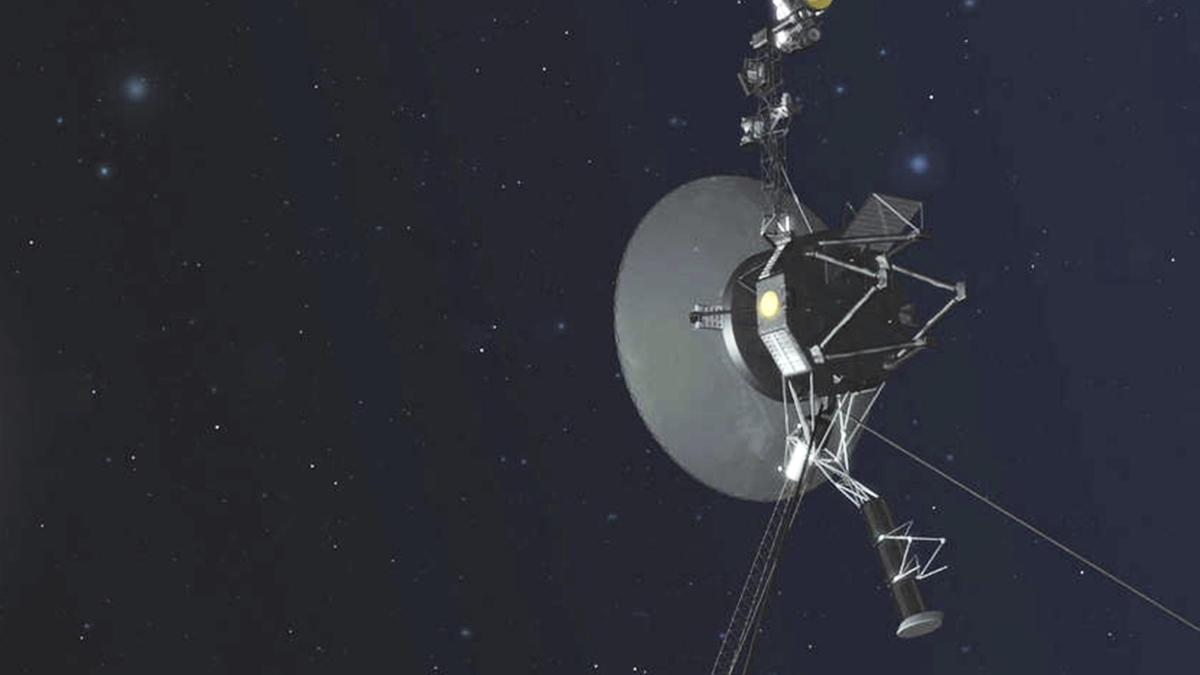
NASA’s Voyager 1 is set to cross a historic threshold in space exploration as it is about to become humanity’s first object to reach one light-day from Earth. The iconic probe, which has travelled farther from Earth than any other human-made object since its launch in 1977, is expected to cross the landmark on Wednesday (November 18, 2026) at 5:16:07 a.m. EST (3:46:07 p.m. IST), according to NASA.Infographics: Voyager I’s 49-year journey into the voidHaving spent 49 years, two months and 11 days hurtling through the cosmos, Voyager 1 continues to push the boundaries of human space exploration.What does one light-day mean?One light-day is a staggering measure of distance, rather than a measure of time. It represents the exact space that light, which travels at roughly 186,000 miles (300,000 kilometres) per second, covers in a full 24-hour period.For Voyager 1, this is equivalent to more than 16 billion miles away from Earth.When Voyager 1 reaches that incredible milestone on November 18, its radio signals will take precisely 24 hours travelling at the speed of light to reach Earth — in other words, one light-day.Sunlight takes just over eight minutes to reach Earth, and over four hours and 10 minutes to reach Neptune. From November 18, any radio command sent from NASA’s Deep Space Network to Voyager 1 will take a full 24 hours to arrive, requiring another 24 hours for the spacecraft’s response to return.Humanity’s farthest aircraftLaunched on September 2, 1977, Voyager 1 was originally designed for a four-year mission to study Jupiter and Saturn. Its trajectory eventually allowed it to overtake its twin, Voyager 2, which was launched 16 days earlier. According to NASA, Voyager 2 is expected to reach the one-light-day distance from Earth in November 2035.The two spacecrafts were launched to explore the outer planets, with Voyager 1 taking a trajectory that eventually carried it towards interstellar space. It became the first spacecraft that entered the interstellar space in August 2012 and has continued transmitting information from beyond the solar system. Today, it speeds onward at roughly 38,000 miles per hour.In 1990, Voyager 1 captured the most distant image of Earth, known as the iconic “Pale Blue Dot,” while venturing farther than any other human-made object beyond Neptune.NASA said Voyager 1 is currently travelling in the direction of a star known as AC +79 3888, or Gliese 445, located more than 17 light-years from Earth in the constellation Ursa Minor.How NASA is keeping the ageing spacecraft alive?Powered by decaying plutonium generators, Voyager 1 loses a small amount of electrical power every year. With this plutonium supply continually depleting, both probes lose about 4 watts of power each year.To extend its lifespan, engineers at NASA’s Jet Propulsion Laboratory have systematically shut down non-essential heaters and science instruments, including turning off another instrument earlier this year to conserve energy.The mission team, now a small crew assisted by retired original engineers, sends commands once a week. Despite age-related glitches, such as the recent communication disruption in October 2026, Voyager 1 continues to be resilient.As John Casani, the mission’s original project manager, put it, “We didn’t design them to last 30 years or 40 years, we designed them not to fail.”NASA’s global celebrationTo mark the historic moment, NASA has invited people worldwide to participate in “Shine Bright for Voyager’s Light-Day.”NASA urged people from all corners to grab their phones or a flashlight to create a wave of golden light after sunset on Tuesday (November 17), using Morse code to spell the letters V-G-R, Voyager’s call sign, into the night sky.
NASA’s Voyager 1 reaches one light-day from Earth on November 18: What does it mean?
Full Article
Original Source
Read the full article at Thehindu →KhanList aggregates and links to publicly available news content. We do not host full articles from third-party sources. Always verify important information with original sources.