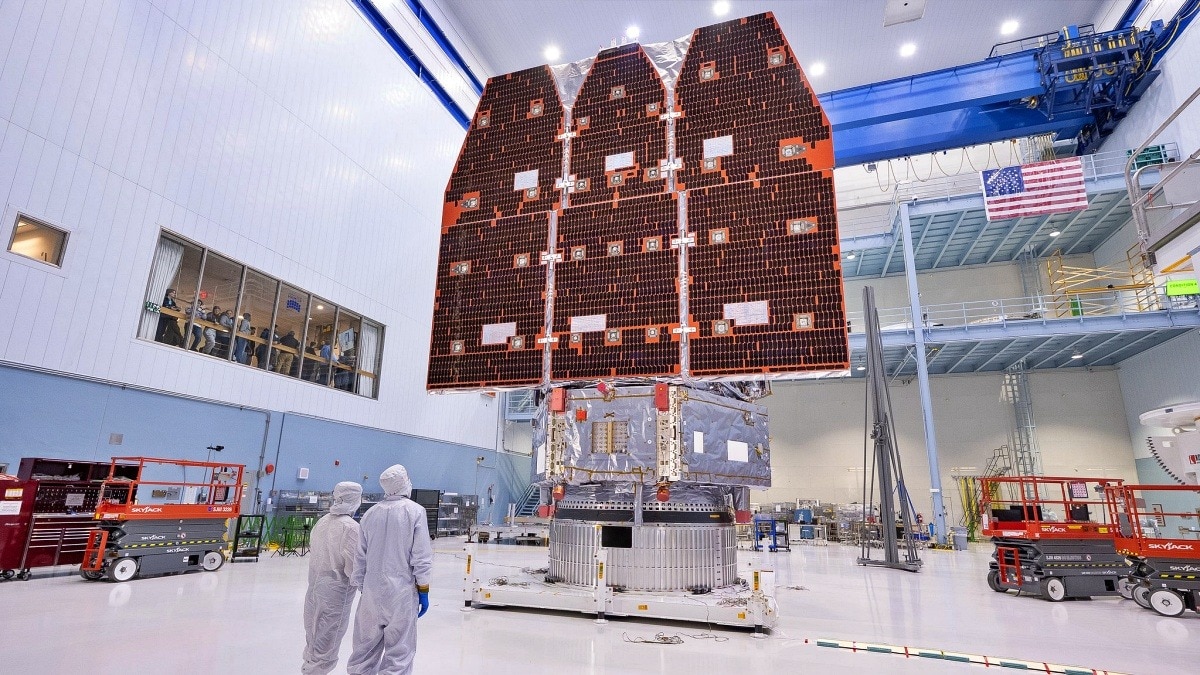
After launch, Roman will travel to the Sun-Earth Lagrange point 2, about 1.5 million km from Earth, where it will conduct its observations.One of Roman’s defining features is its ability to capture images so large and detailed that they cannot be displayed on a single screen. (Photo: Nasa)Nasa’s Nancy Grace Roman Space Telescope has entered one of the most important stages of its journey to space, with engineers now connecting the observatory to hardware that will eventually carry it into orbit.The latest update from Nasa, released this week, said teams at the Kennedy Space Center in Florida had begun integration operations with SpaceX hardware ahead of the telescope’s planned launch later this month.The telescope is now nine months ahead of its earlier schedule. A view of the Nancy Grace Roman Telescope sitting at Nasa's space centre. (Photo: Nasa) ROMAN TAKES ANOTHER STEP TOWARDS LAUNCHThe telescope was carefully attached to its payload adaptor before being lifted onto a specialised structure that will secure it to the upper stage of SpaceX’s Falcon Heavy rocket. This progress is not merely a mechanical procedure but also marks the point at which Roman, after years of construction and testing, is being prepared as an actual flight payload.The next major step will be to enclose the observatory inside the Falcon Heavy’s protective payload fairing. The fairing will shield the telescope from the intense aerodynamic forces and heat it will encounter while rising through Earth’s atmosphere.Once encapsulated, Roman will be moved to SpaceX’s hangar at Launch Complex 39A for final integration with the rocket. A Nasa technician examines the Nancy Grace Roman solar panels. (Photo: Nasa) WHEN WILL NASA LAUNCH NANCY GRACE ROMAN TELESCOPE?Nasa and SpaceX are currently targeting no earlier than August 30 for launch.The latest update gives a target liftoff time of 4:56 pm IST, from Launch Complex 39A at Nasa’s Kennedy Space Center.Roman arrived at Kennedy on June 21 after completing major testing at Nasa’s Goddard Space Flight Center.Engineers subsequently carried out inspections, power checks and solar-panel testing.On July 25, technicians also loaded about 1,100 litres of hydrazine into the observatory.After launch, Roman will travel to the Sun-Earth Lagrange point 2, about 1.5 million km from Earth, where it will conduct its observations. An image of the team of technicians working on Nasa's Nancy Grace Roman Telescope. (Photo: Nasa) WHAT WILL NANCY GRACE ROMAN TELESCOPE SEE?The telescope is often compared with Hubble, but its strength lies in how much sky it can see at once.Its 2.4-metre primary mirror is the same size as Hubble’s, while its Wide Field Instrument can capture an area of sky at least 100 times larger in a single view.The instrument possesses a roughly 300-megapixel camera designed to survey enormous stretches of the universe in infrared light.That wide view will help astronomers investigate dark energy, the mysterious phenomenon linked to the accelerating expansion of the universe, map the distribution of dark matter, and discover thousands of planets beyond our solar system.Roman’s primary mission is planned to last five years, with the possibility of an extended mission.The moment, as one can infer from Nasa's update, is drawing closer with each passing day.- EndsPublished On: Aug 13, 2026 12:18 IST
Nasa's Nancy Grace Telescope takes another step closer to Aug 30 launch
Full Article
Original Source
Read the full article at Indiatoday →KhanList aggregates and links to publicly available news content. We do not host full articles from third-party sources. Always verify important information with original sources.