
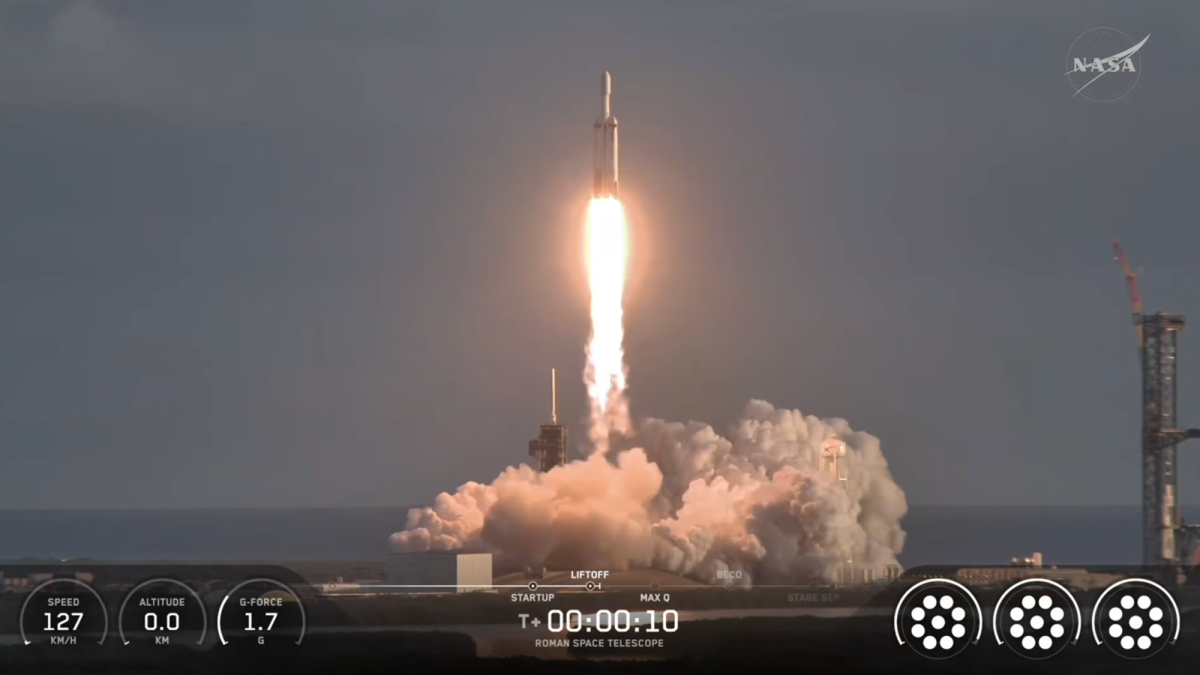
Get the Popular Science daily newsletter💡 Breakthroughs, discoveries, and DIY tips sent six days a week. By signing up, you confirm you are 16+, will receive newsletters and promotional content and agree to our Terms of Use and acknowledge the data practices in our Privacy Policy. You may unsubscribe at any time. Today at 7:26 a.m. EDT, the Nancy Grace Roman Space Telescope officially launched aboard a SpaceX Falcon Heavy from NASA’s Kennedy Space Center near Cape Canaveral, Florida. The Falcon Heavy’s 27 Merlin engines generated over 5 million pounds of thrust, and pushed the rocket through the atmosphere. It got it’s “first taste of space” about four minutes after liftoff. The Nancy Grace Roman Space Telescope shortly after launch. Image: NASA Roman is now en route to the second Lagrange point (L2), roughly 932,000 miles “behind” Earth as viewed from the sun. Once it reaches L2, the new space telescope will be about four times farther from Earth than the moon. Ahead of the launch, NASA also announced the Adopt a Pixel campaign, where users can claim a pixel on one of Roman’s first images. Users will be assigned a pixel number that they can look up and receive a printable digital certificate. Teams inside the Payload Hazardous Servicing Facility at NASA’s Kennedy Space Center in Florida encapsulate the agency’s Nancy Grace Roman Space Telescope within the payload fairing on Friday, August 21, 2026, ahead of mating to a SpaceX Falcon Heavy rocket. Encapsulation shields the spacecraft during rollout, ascent, and the early phases of flight. Image: Kennedy Space Center / NASA What is Roman’s mission? First announced in 2020, the Roman Space Telescope arrives after years of development—as well as a close brush with cancellation in 2025. Astronomers estimate the Roman Space Telescope will measure light from as many as one billion galaxies while also conducting the first complete statistical census of planetary systems in the Milky Way. The discoveries made over the course of its five-year mission are expected to help answer some of the most persistent questions about infrared astrophysics, exoplanets, and dark matter. If all goes well, NASA may even extend the mission for an additional five years. NASA’s Nancy Grace Roman Space Telescope will survey vast swaths of sky during its five-year primary mission. During that time, scientists expect it to see an incredible number of new objects, including stars, galaxies, black holes and planets outside our solar system, known as exoplanets. This infographic previews some of the discoveries scientists anticipate from Roman’s data deluge. Image: NASA’s Goddard Space Flight Center/ Scott Wiessinger (eMITS)/Ashley Balzer (eMITS)/Julia Shepherd (Intern)/ Scientists will also pair Roman’s infrared data with visible-light observations taken from the ground-based Vera C. Rubin Observatory, a National Science Foundation–Department of Energy collaboration. What’s onboard? Roman’s equipment includes a massive, 300.8 megapixel camera known as the Wide Field Instrument (WFI), as well as a system of prisms, self-flexing mirrors, masks, and detectors collectively known as a Coronagraph. This addition will help block the glare of distant stars in order to better focus on their orbiting plants. The telescope’s nearly eight-foot-wide mirror and accompanying instruments will provide it with a field of view about 100 times wider than Hubble. While the primary mirror is about the same size as Hubble’s, design advancements have lightened the overall weight by about 80 percent. NASA’s Nancy Grace Roman Space Telescope pictured on Friday, August 7, 2026, after engineers and technicians working inside the Payload Hazardous Servicing Facility at NASA’s Kennedy Space Center in Florida had carefully mated the observatory to its payload adapter and a strut payload attach fitting, a specialized piece of hardware designed for large, heavy loads. This allows the team to secure the payload to the second stage on SpaceX’s Falcon Heavy rocket. Image: Kennedy Space Center / NASA. It also carries 1.35 million names aboard on a commemorative memory card. These names were submitted by people all around the world, including astronauts from Artemis II and Artemis III. April’s Artemis II also has a special memory card with names aboard. Who was Nancy Grace Roman? The space telescope is named in honor of Nancy Grace Roman (1925-2018), NASA’s first chief astronomer and a pioneering advocate for the development of orbital observatories. Widely known as the Mother of Hubble, Roman was instrumental in securing funding support for the once-controversial project. Nancy Grace Roman, shown here at NASA’s Goddard Space Flight Center in approximately 1972, was the first female executive and the first Chief of Astronomy at NASA. Image: NASA “Hubble has brought astronomy into everyday life in a much more general way than it was before. The fact that it exists is something I’m proud of,” she said. Roman’s love of astronomy began when she was a child. She had already formed an astronomy club for her classmates by the age of 11 in Reno, Nevada, and later graduated high school a year early while through an accelerated program in Baltimore, Maryland. She faced numerous obstacles as one of the first women in the field of astronomy, at one point even leaving her position at the University of Chicago after it became clear she wouldn’t receive tenure due to her gender. Her dedication to making the Hubble Space Telescope a reality ultimately led to the identification of dark matter, which she famously considered the program’s most interesting discovery. Nancy Grace Roman stands next to a scale model of the Hubble Space Telescope outside the Hubble control center at NASA’s Goddard Space Flight Center in Greenbelt, Maryland. Roman is known as the “Mother of Hubble.” Image: NASA When should we see Roman’s first images? We should receive the first images in early 2027. Over the next three months, the NASA team will perform an orchestrated series of deployments, calibrations, and tests before Roman reaches its final orbit. Roman has a primary mission lifetime of five years and is designed to support an additional five years. 2026 Popular Science Home of the Future Awards 39 products that will improve your everyday life.
NASA’s Nancy Grace Roman space telescope launches
Full Article
Original Source
Read the full article at Popsci →KhanList aggregates and links to publicly available news content. We do not host full articles from third-party sources. Always verify important information with original sources.