
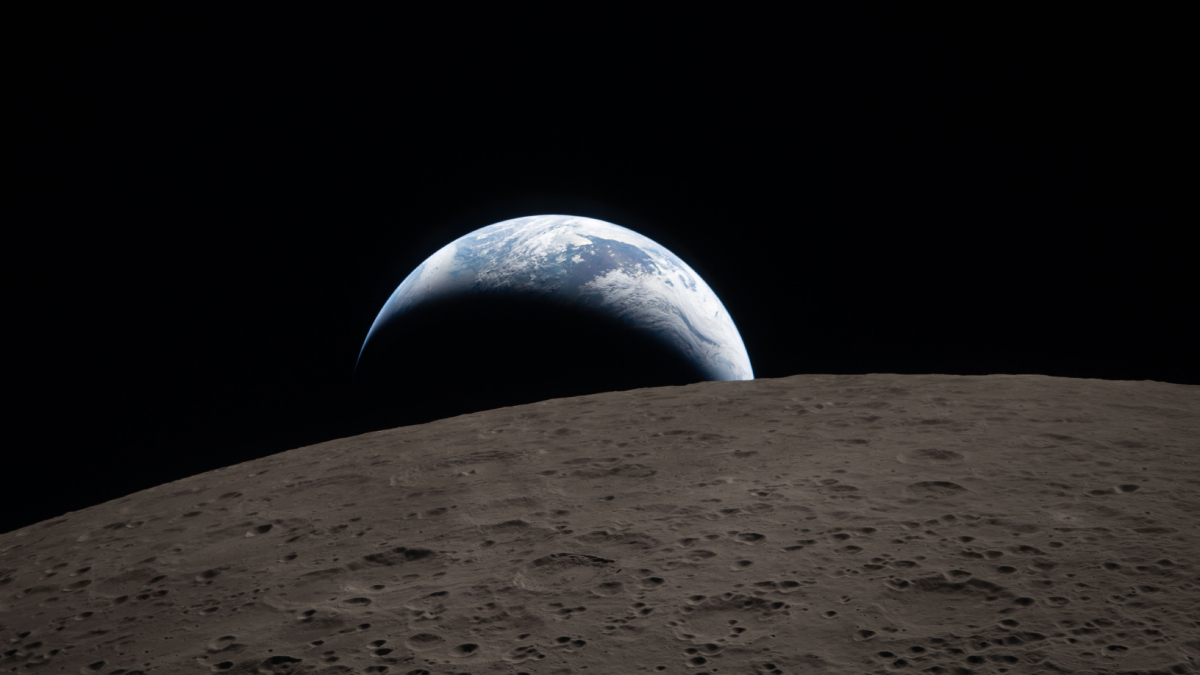
Research & Developments is a blog for brief updates that provide context for the flurry of news regarding law and policy changes that impact science and scientists today. In March, NASA Administrator Jared Isaacman announced a series of new agency initiatives designed to achieve President Trump’s National Space Policy. The initiatives, collectively called “Ignition,” aim to accelerate the pace of space missions and move the agency toward a focus on human exploration of the Moon and Mars. “If we concentrate NASA’s extraordinary resources on the objectives of the National Space Policy, clear away needless obstacles that impede progress, and unleash the workforce and industrial might of our nation and partners, then returning to the Moon and building a base will seem pale in comparison to what we will be capable of accomplishing in the years ahead,” Isaacman said in a statement at the time. Some of the changes in NASA’s direction were announced immediately, like pivoting from a cislunar gateway to a permanent base on the Moon’s surface and pushing an attempted Moon landing back until the Artemis IV mission. The agency promised that efforts to align other NASA divisions with Ignition would be forthcoming throughout the year. Those changes are now starting to manifest. NASA recently announced some changes that appear aligned with Ignition initiatives. Here are few of them. To the Moon, To Stay In April, NASA’s Artemis II mission successfully flew around the Moon, bringing humanity the closest we’ve been to our nearest celestial neighbor in 50 years. Just prior to that milestone, NASA announced a shift in its plans for future Artemis missions: a landing on the lunar surface would now be attempted during Artemis IV rather than Artemis III, and Artemis III would now be a technological test of the landing equipment. The latest architecture for the Artemis missions has Artemis III demonstrating its crewed landing technology in summer 2027 and Artemis IV landing on the Moon in 2028. Credit: NASA, Public Domain In a 23 October press conference, Isaacman confirmed this new direction for Artemis, that Artemis III is on schedule for launch in summer 2027, and that Artemis IV would launch in 2028. To achieve a 2028 landing, Isaacman said the Artemis technology teams had updated the architecture of the missions and were undergoing a competitive process to select the commercial space company that would enable a crewed landing. In his March Ignition announcement, Isaacman said that NASA planned “to return to the Moon before the end of President Trump’s term,” and the updated timeline would accomplish that. “NASA has no intention of sitting idly by as all the pieces come together,” Isaacman said at the October press event. “NASA is energized, our core capabilities are being rebuilt, our machine shops are running 24/7, and our experts are in the field attacking the critical path.” “Faster to Science” NASA’s Science Mission Directorate (SMD) announced on 21 October that it will be streamlining the process by which it solicits and selects new science missions. The existing 2-step process requires prospective mission teams to submit detailed designs in the first phase, in addition to making the scientific case for the mission. The need for detailed designs in Step 1 has been seen by some as a burdensome requirement, as teams whose proposals are not selected will have wasted a lot of time and money developing technical designs that will never be used. At a 26 October community town hall, SMD associate administrator Nicola Fox outlined the new selection process, called “Competition Model 2.0” or CM2.0. CM2.0 will no longer require detailed mission designs in the initial phase, Fox said. Instead, proposed missions would “compete on the science first” and worry about detailed implementation work in the second step. The process would also be open to principal investigators (PIs) “without a major university or commercial backing.” “Everybody wants change until you change something, and then nobody likes change.” NASA estimates that CM2.0 will shorten the time from when proposals are solicited to when missions are selected by 45%. “This is such a great approach!” Kathleen Mandt, a planetary scientist at NASA’s Goddard Space Flight Center (GSFC) in Greenbelt, Md., commented on social media. “More scientists will be able to put forward their ideas while funds for mission design are used more effectively. This approach also does more to protect the technical workforce at our centers.” Ahead of the October event, members of NASA, the science community, and the media were invited to submit questions about CM2.0. Many expressed concern that simplifying mission design from the first step would advance proposals that are technologically infeasible. Fox assured participants that Step 1 would still require some mission design, which would be evaluated along with the science. How much design? Fox did not specify, and seemed frustrated at questions asking for more information, noted Alejandro Soto, planetary scientist and engineer at the Southwest Research Institute in Boulder, Colo., on social media. NASA's Nicky Fox keeps talking about not needing a "point design" in future mission proposals, but she never defines what this means. She seems frustrated by all of the questions on this topic, but doesn't see that as a sign that a more detailed explanation is needed.— Alejandro Soto (@soto.space) 2026-10-26T18:44:46.908Z “Traditionally, NASA wanted mass, volume, and cost estimates that only required 30% margin (an indirect way of measuring design uncertainty),” Soto added. “What is it now? 50%? 80%? Or more? Currently, there’s no detail like that.” “There will be some teething problems, I’m sure,” Fox said. “Everybody wants change until you change something, and then nobody likes change.” Science Centers of Excellence CM2.0 also calls for the detailed mission implementation design in Step 2 to be carried out in partnership with Goddard or the Jet Propulsion Laboratory (JPL) in Pasadena, Calif. Both of NASA’s newly minted “Science Centers of Excellence” have long overseen the technical and engineering aspects of NASA missions. NASA closed its research library at Goddard in 2025. Credit: NASA, CC BY 2.0 Both facilities have experienced significant upsets in the past two years. In 2025, whistleblowers alleged that NASA leadership was prematurely implementing the president’s 2026 budget request and closing down many buildings on Goddard’s campus. Goddard staff reported being barred from laboratories and specialized equipment being moved or dismantled. Goddard also closed its longstanding library, and there are conflicting reports about why NASA’s spaceflight records archive was taken offline for six months: NASA says it was routine maintenance, while internal communications obtained through Freedom of Information Act requests suggest there was an unreported security issue. Staffing-wise, Goddard is estimated to have lost nearly a third of its workforce (roughly 6,600 people) since January 2025. JPL laid off 11% of its workforce in 2025. The trend at the Centers of Excellence echoes that of NASA as a whole. Since January 2025, thousands of workers, including more than 2,000 senior-level staff, have left the agency voluntarily or through reductions in force. Some estimates suggest that NASA has actually lost more than 12% of its workforce since 2023. “How do you expect JPL and GSFC to manage this new process when they have lost so many people and facilities?” One town hall question addressed the problem succinctly: “How do you expect JPL and GSFC to manage this new process when they have lost so many people and facilities?” Both Fox and Curt Niebur, the lead scientist for flight programs at NASA, brushed off this concern. “It’s easy to underestimate how good and how creative our engineers at Goddard and JPL are,” Niebur said. “Yes, our implementations are challenging, but yet they have consistently found solutions to those challenges, and we’re placing a lot of faith that they’ll continue to do so.” A ROSES In Any Other Year… NASA’s annual Research Opportunities in Space and Earth Sciences (ROSES) solicits basic and applied science research proposals across SMD every year. The community was concerned when the ROSES-25 solicitation was delayed last year—NASA announced it in July rather than February as expected, and it remains open as of October 2026. ROSES-26 was never announced. Although the 26 October town hall was not meant to be about ROSES, the top voted question from the community asked, “Why was there no ROSES-26? Where did all the congressionally appropriated money for [fiscal year] FY 26 go?” Fox said that because ROSES-25 was still open, NASA never announced ROSES-26. The agency is planning to open ROSES-27 no later than January 2027 and will solicit proposals with the CM2.0 process. It appears that NASA plans to skip ROSES-26 entirely, and Fox said that FY26 funds for ROSES went toward the ongoing ROSES-25 process. The Buck Stops Where? Lastly, Fox was asked if the recent slow cadence of planetary science missions was because of the old, slow selection process. She said, no, and implied that teams whose missions are over budget or behind schedule carry the blame. “The community needs to realize that when your mission goes over budget, you kill the next mission.” “Cost and schedule discipline is non-negotiable, and that is across all mission types,” Fox said. “I think the community needs to realize that when your mission goes over budget, you kill the next mission…. If your mission goes over by about $150–$200 million, you just killed the next SMEX,” she said, referring to the Small Explorers mission class. Paul Byrne, a planetary scientist at Washington University in St. Louis, Missouri, had another opinion. “The biggest issue with NASA’s missions isn’t a lack of industry involvement or length of review. It’s that NASA lacks the money to fly missions regularly,” he commented on social media. “It’s great to shorten competition timelines, bring more industry in, open the field to more entrants/PIs/science teams,” Byrne added, referring to Ignition objectives. “But if there isn’t money to run competitions more frequently…what’s the point?” —Kimberly M. S. Cartier (@astrokimcartier.bsky.social), Staff Writer These updates are made possible through information from the scientific community. Do you have a story about how changes in law or policy are affecting scientists or research? Send us a tip at [email protected]. Text © 2026. AGU. CC BY-NC-ND 3.0Except where otherwise noted, images are subject to copyright. Any reuse without express permission from the copyright owner is prohibited.
NASA’s Ignition Sequence Has Begun
Full Article
Original Source
Read the full article at Eos →KhanList aggregates and links to publicly available news content. We do not host full articles from third-party sources. Always verify important information with original sources.