
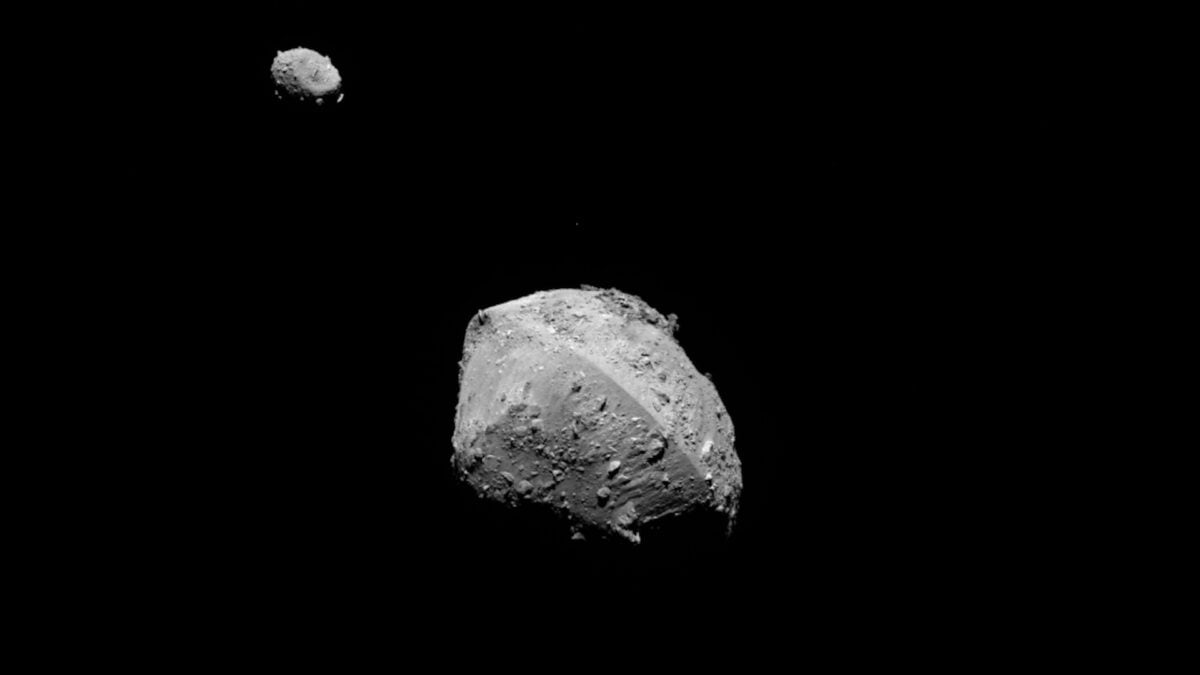
In 2022, NASA crashed a spacecraft into an asteroid at nearly 15,000 miles per hour (24,000 kilometers per hour) as a first-of-its-kind test of a planetary defense system designed to alter the trajectory of an incoming object. Four years later, it looks like asteroid is still dealing with the aftermath. New observations reveal that the impact left one side of the rock visibly flattened and scattered hundreds of boulders across the surrounding area. The European Space Agency (ESA) revealed the first images from its Hera mission, which was sent to observe the site of the crash. Hera is a follow-up expedition to NASA’s DART (Double Asteroid Redirection Test) operation. The new close-up views of the asteroid show that DART left behind a stadium-sized crater and sent the space rock into a chaotic tumble. The impact also appears to have blasted loose previously unknown boulders, which are now encircling the targeted asteroid and its companion. A closer look Hera, which launched on October 7, 2024, arrived at the asteroid three weeks ago and is currently about 19 miles (30 kilometers) away from the space rock. The car-sized spacecraft is designed to perform a detailed, post-impact survey with the aim of turning a one-time space experiment into a well-understood planetary defense mechanism. The mission could also help scientists learn more about how asteroids form. Its target is Dimorphos, a 558-foot-wide (170-meter) space rock that orbits its larger 2,625-foot-wide (800-meter) companion, Didymos. Together, the pair form a binary asteroid system. On September 26, 2022, NASA’s DART slammed into the asteroid, altering the rock’s orbit around its larger companion by shortening its orbital period by 33 minutes. Scientists were able to measure the orbital change using ground-based observations, but they needed a closer look to investigate what exactly happened to the tiny space rock. “Scientists debated whether Dimorphos had sustained an impact crater, changed its shape or stayed the same,” Patrick Michel, Hera principal investigator, said in a statement. “Much to our surprise the answer turns out to be all three at once!” The side of Dimorphos that was struck by DART has been flattened into an impact crater the size of a sports stadium, which is almost as wide as the asteroid itself. Images of the Didymos system before and after the 2022 impact. Credit: ESA Aside from its deformed surface, the impact also appears to have left Dimorphos tumbling wildly in its orbit. Its larger companion Didymos, on the other hand, shows no apparent signs of change from the impact. The images also showed that the asteroid system is surrounded by hundreds of orbiting boulders. “The team will have to take account of these objects in the coming weeks as the mission moves in closer to acquire higher-resolution images of the asteroids,” Michael Kueppers, ESA’s Hera mission scientist, said in a statement. A composite image showing the hundreds of boulders in motion around the Didymos-Dimorphos system. Credit: ESA The new images are just the beginning of Hera’s investigation. The spacecraft is set to examine both asteroids in detail over the next six months. Hera will continue to move in closer to the asteroid system before it deploys a pair of shoebox-sized miniature satellites, named Milani and Juventas, in early 2027. Milani is tasked with identifying the composition of materials on and around Dimorphos while Juventas will use a radar to peer inside the asteroid. “NASA’s DART mission demonstrated that we can change an asteroid’s orbit. Hera is now revealing what happened to the asteroid itself,” Ian Carnelli, Hera mission manager, said in a statement. “By combining these two missions, humanity is taking a decisive step towards making asteroid deflection a reliable tool for protecting our planet.”
NASA’s DART Mission Left a Stadium-Sized Crater on an Asteroid. And We Just Got the Pictures to Prove It
Full Article
Original Source
Read the full article at Gizmodo →KhanList aggregates and links to publicly available news content. We do not host full articles from third-party sources. Always verify important information with original sources.