
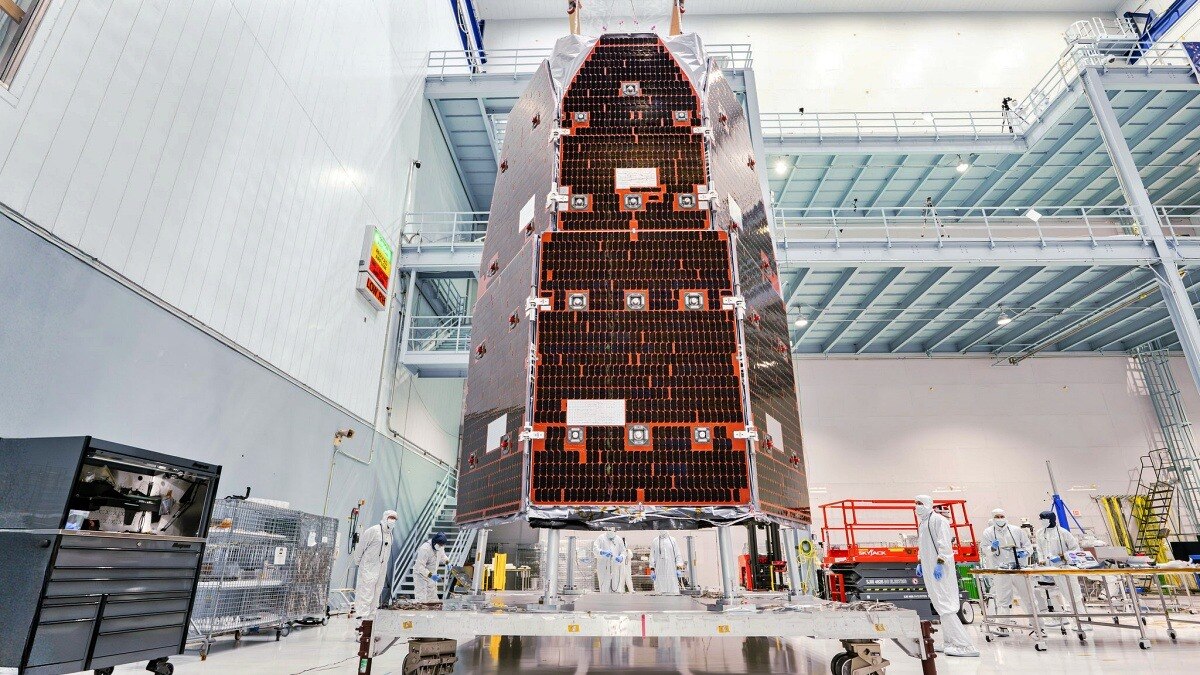
Nasa and SpaceX are set to launch the Nancy Grace Roman Space Telescope on Sunday from Florida. The mission will send the observatory to L2 to probe dark energy, dark matter and distant worlds.Technicians are seen working on the Nancy Grace Space Telescope. (Photo: Nasa)Nasa is in the final stages of preparation to launch its next major space observatory, the Nancy Grace Roman Space Telescope, on Sunday, August 30, in a mission that will send the powerful infrared telescope around 1.5 million kilometres away from Earth.Nasa and SpaceX are targeting liftoff at 7:26 a.m. EDT aboard a SpaceX Falcon Heavy rocket from Launch Complex 39A at Nasa's Kennedy Space Center in Florida. Live launch coverage is scheduled to begin at 6:20 a.m. EDT.The telescope is named after Nancy Grace Roman, Nasa's first chief astronomer and a pioneering scientist often remembered as the “Mother of Hubble.” Roman is expected to dramatically expand scientists' ability to study the universe by combining sharp infrared vision with an extraordinarily wide field of view. The telescope will be able to observe an area of the sky at least 100 times larger than Nasa's Hubble Space Telescope in a single view. This combination of wide-angle observations and high-resolution imaging will allow Roman to conduct sweeping surveys of the cosmos at an unprecedented scale.One of its biggest scientific goals will be to investigate two of the universe's greatest mysteries: dark energy and dark matter. Dark energy is believed to be driving the accelerating expansion of the universe, while dark matter is an invisible form of matter whose presence is inferred through its gravitational effects. Roman will also search for and study exoplanets orbiting distant stars, map billions of galaxies and investigate black holes. Its observations will stretch from objects within our own solar system to some of the most distant regions of the observable universe.After separating from the Falcon Heavy rocket, Roman will begin its journey towards the second Sun-Earth Lagrange point, known as L2. The region lies about one million miles, or roughly 1.5 million kilometres, from Earth.L2 is a gravitationally stable location that allows spacecraft to maintain a relatively constant position with respect to Earth and the Sun. It is also home to several major space observatories, making it an important location for astronomy missions.Roman has a five-year primary mission, although Nasa hopes the telescope will remain operational for up to 10 years.Its scientific data will be made publicly available after processing, potentially allowing researchers around the world to explore one of the largest and most detailed views of the universe ever created.- EndsPublished By: Sibu Kumar TripathiPublished On: Aug 29, 2026 11:43 IST
Nasa to launch Roman telescope 1.5 million km from Earth on Sunday
Full Article
Original Source
Read the full article at Indiatoday →KhanList aggregates and links to publicly available news content. We do not host full articles from third-party sources. Always verify important information with original sources.