
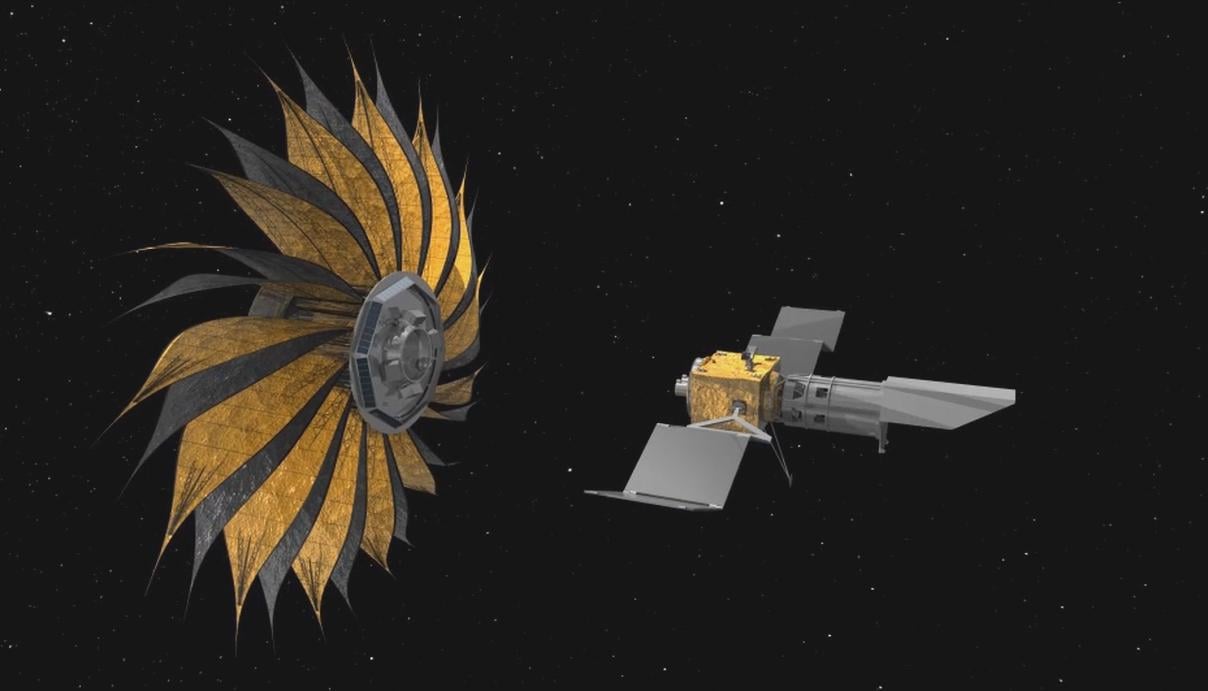
A NASA-led team is hoping to take a short cut in directly imaging extrasolar earthlike planets. The idea is to use what they term a hybrid telescope composed of an orbital starshade coupled with the next generation of extremely large ground-based optical telescopes. Positioned some 175,000km away in an elliptical Earth orbit, the starshade would likely first be used in conjunction with the European Southern Observatory's Extremely Large Telescope, now scheduled to see scientific first light in northern Chile by late 2030. The starshade would block out the parent star's light to enable directly imaged optical observations of nearby solar systems and rocky earth-sized worlds. That is, planetary systems all located within some twenty light years of Earth. Dubbed the Hybrid Observatory for Earth-like Exoplanets (HOEE), the team has already applied for Phase B NIAC (NASA Innovative Advanced Concepts) funding that they hope to see granted by 2027. Current direct imaging space instruments, such as NASA’s James Webb Space Telescope’s Near Infrared Camera and NASA’s planned Roman Space Telescope’s Coronagraph Instrument, are unable to directly observe earth-like exoplanets, write the authors of a 2026 paper appearing in the journal Nature Astronomy. We need to go for something that is more efficient and available now; a hybrid observatory that can observe the exoplanetary system in optical light, Vladimir Airapetian, a senior astrophysicist at NASA Goddard Space Flight Center and a HOEE project team member, told me in Paris. The challenge is to block light from the star in order to reveal a planet that in optical light would be a billion times fainter than the star itself. To do that, the starshade would create an artificial eclipse to occult the parent star’s light to allow ground-based observers to receive reflected light directly from the extrasolar planet. Dubbed an occulter, the starshade would likely feature 48 petals, each 24.5-m long, and a 50-m-diameter central disk, note the Nature Astronomy paper’s authors. The starshade would also be capable of being repositioned within six meters of accuracy, using some sort of microthrusters, most likely powered by hot hydrogen gas. Our team proves that by deploying a starshade to cast a "perfect shadow" over Earth's largest telescopes, HOEE can suppress stellar glare before it ever enters the atmosphere, says Airapetian. The starshade would hover directly on the line of sight between the ground telescope and the target star, offering continuous fine alignment on the celestial target, Mather has written in a previous presentation. The concept relies on a long elliptical astro-stationary orbit to match Earth’s rotation, using chemical propulsion for station-keeping and solar electric propulsion for retargeting, Mather has noted. HOEE’s much sharper images would also allow astronomers to see entire exoplanetary systems and to clearly separate planet images from other earth-sized planets and the host star itself. This hybrid telescope’s extreme sensitivity would in principle enable the detection of an exoearth within the first minute of observation. HOEE would also enable a definitive path to identifying the chemical signatures of life. Airapetian wants to find active stars that are flaring frequently enough to create extrasolar auroras on rocky planets orbiting solar-type F, G, and K stars. These would ideally be stars in their first billion years on the hydrogen-burning main sequence. The idea is to look for potential exoearths circling other sun-like stars that might have either precursors of life or primitive life. An illustration of LHS 1815b, an ancient rocky exoplanet orbiting a star in the galactic thick disk. Image Credit: NASA We're going for the spectral lines from red and green auroras that would signal that the atmospheres of these planets can support nitrogen and oxygen, says Airapetian. As for projected costs and the final design? Airapetian says it would clock in around the billion-dollar range. And the final occulter design would likely involve an inflatable structure to keep the total launch mass under 1,500 kg. The idea is that the starshade would efficiently collapse into a standard launch vehicle’s payload, Mather has written. The Bottom Line? For decades, the starshade was a beautiful but "impossible" dream, says Airapetian. Today, through NASA funding, that dream is becoming a buildable reality, he says. Sources: Vladimir Airapetian John Mather Nature Astronomy
NASA Starshade Would Enable Astronomers To Directly Image Rocky Exoworlds
Full Article
Original Source
Read the full article at Universetoday →KhanList aggregates and links to publicly available news content. We do not host full articles from third-party sources. Always verify important information with original sources.