
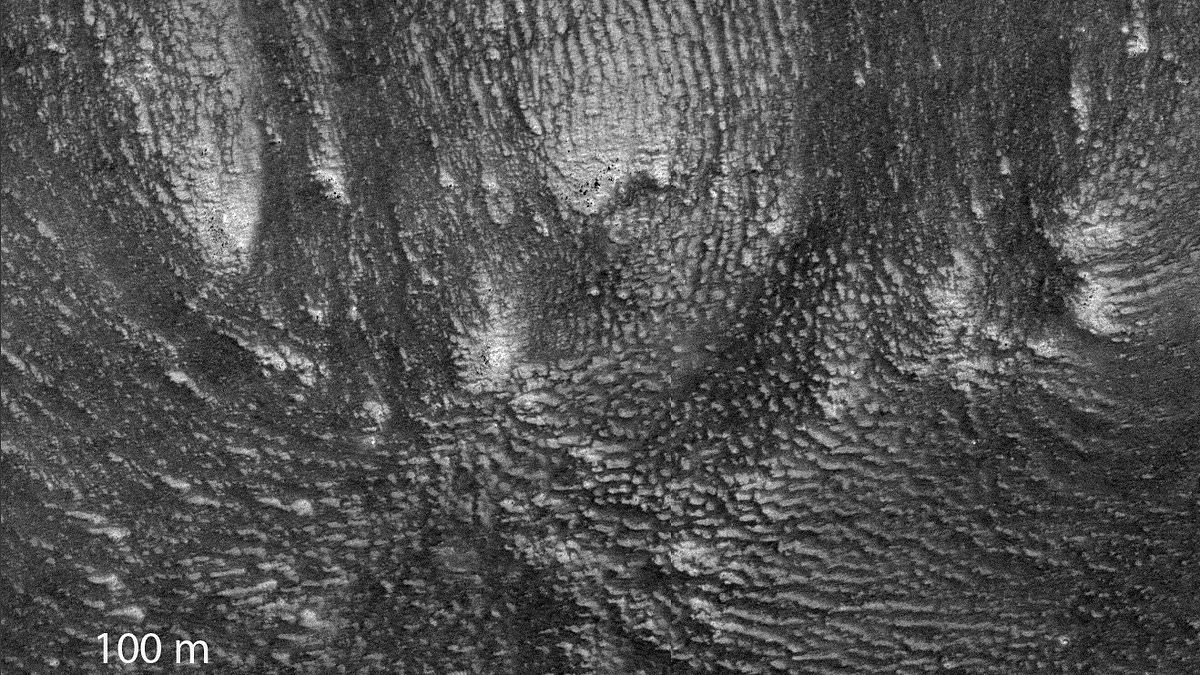
Nasa has spotted a baffling formation of boulders on Mars that even its top scientists can't explain.Images taken from orbit reveal bright rocks arranged into rows separated by gaps of 16 to 33ft (five to 10m), like the whorls in a fingerprint.These Martian 'Zen gardens' are located on the Daedalia Planum, a vast lava field on the slopes of the great Tharsis volcanoes, at an altitude of 17,900ft (5,455m). Scientists describe this strange terrain as looking like it has been 'raked into furrows like a Japanese dry garden'.However, they have no idea how it got there.'Some process has evidently sorted and segregated the larger boulders from the finer soil,' Nasa scientists explained in a blog post.'Exactly what that process is presents a perplexing puzzle.' Nasa has spotted a baffling formation of boulders on Mars that even its top scientists can't explain Daedalia Planum was formed tens of millions of years ago out of the cooling lava flows from Arsia Mons, one of the three Tharsis Montes volcanoes near the planet's equator.Scientists got their first glimpse of this vast volcanic wasteland in 2002 when the Mars Odyssey orbiter passed overhead.In those rather low-resolution images, the landscape appeared to be topographically featureless.However, when the Mars Reconnaissance Orbiter reached Mars in 2006, it carried a new tool known as the High Resolution Imaging Science Experiment (HiRISE).Dr Zach Dickeson, a postdoctoral research associate at Imperial College London who works with HiRISE data, told the Daily Mail: 'HiRISE is incredibly valuable as the only camera in orbit of Mars capable of taking pictures with this level of detail.'Each pixel covers an area of 25 cm, making a resolution similar to using Google Maps on Earth. This means that HiRISE can also clearly see the rovers on the surface of Mars.'Since then, HiRISE has captured over 100,000 photos of the Martian surface, producing incredibly detailed maps.In 2024, one of those images revealed that the Daedalia Planum was far from featureless. Researchers compare the strangely arranged boulders to a Japanese Zen garden or the whorls in a fingerprint These Martian 'Zen gardens' are located on the Daedalia Planum, a vast lava field on the slopes of the great Arsia Mons volcano Scientists aren't entirely sure what has caused these rocks to sort themselves into such strangely regular patterns.However, Nasa suggests that it could be related to the repeated freezing and thawing of ice near the surface.Dr Joel Davis, Associate Professor of Planetary Science at Imperial College London, told the Daily Mail: 'These curious structures are found high up on the slopes of Tharsis Rise, the largest volcanic province on Mars. 'These beautiful patterns in the landscape may reflect layering within the rock or perhaps the repeated action of ice melting and refreezing. I have not seen landscapes like this on Mars before.'As the surface cycles between temperatures, mixtures of small and large grains can become separated through a process called 'grain size convection'.Nasa says: 'This action produces pingos and frost heaves on Earth, features that are thought to require liquid groundwater buried beneath a frozen surface.'Scientists now believe that there may be a layer of permafrost, perpetually frozen water ice, beneath almost the entire surface of Mars.Although there is still no direct evidence for water beneath the volcanic plains of the Daedalia Planum, its high location could expose the area to 'unique periglacial processes'.An alternative theory is that the strange rows of rocks could have been formed by geological shaking. Scientists think these structures may have been formed by alternating freeze-thaw processes or by violent shaking that caused the grains to be arranged by size. The copper-colored band shows enhanced-color HiRISE imageryNasa says this takes place through something called the 'Brazil nut effect' that causes grains of different sizes to naturally arrange themselves.Imagine shaking a bag of mixed nuts of all different sizes; if you shake it vigorously enough, you should see the largest nuts, the Brazil nuts, rising to the surface.Scientists believe that something similar might have happened in the Daedalia Planum, with natural vibration driving the biggest rocks into structured rows at the surface.However, the question remains where this violent shaking might have come from.Nasa says: 'Seismic shaking of Daedalia Planum could take place if the interior of Tharsis is still active and rumbling.'We know that Mars was volcanically active in its recent geological history and, although we are yet to witness an eruption, scientists have only been watching the Martian surface for about 60 years.That means there could well be periods of violent volcanic activity on the Red Planet that we are simply yet to witness.However, for now at least, how these Martian 'Zen gardens' truly formed will remain a stubborn mystery.MARS: THE BASICSMars is the fourth planet from the sun, with a 'near-dead' dusty, cold, desert world with a very thin atmosphere. Mars is also a dynamic planet with seasons, polar ice caps, canyons, extinct volcanoes, and evidence that it was even more active in the past. It is one of the most explored planets in the solar system and the only planet humans have sent rovers to explore.One day on Mars takes a little over 24 hours and a year is 687 Earth days.Facts and Figures Orbital period: 687 daysSurface area: 55.91 million mi²Distance from Sun: 145 million milesGravity: 3.721 m/s²Radius: 2,106 milesMoons: Phobos, Deimos
Nasa spots a strangely neat rows of boulders on Mars - and scientists can't explain the perfect formation
Full Article
Original Source
Read the full article at Dailymail →KhanList aggregates and links to publicly available news content. We do not host full articles from third-party sources. Always verify important information with original sources.