
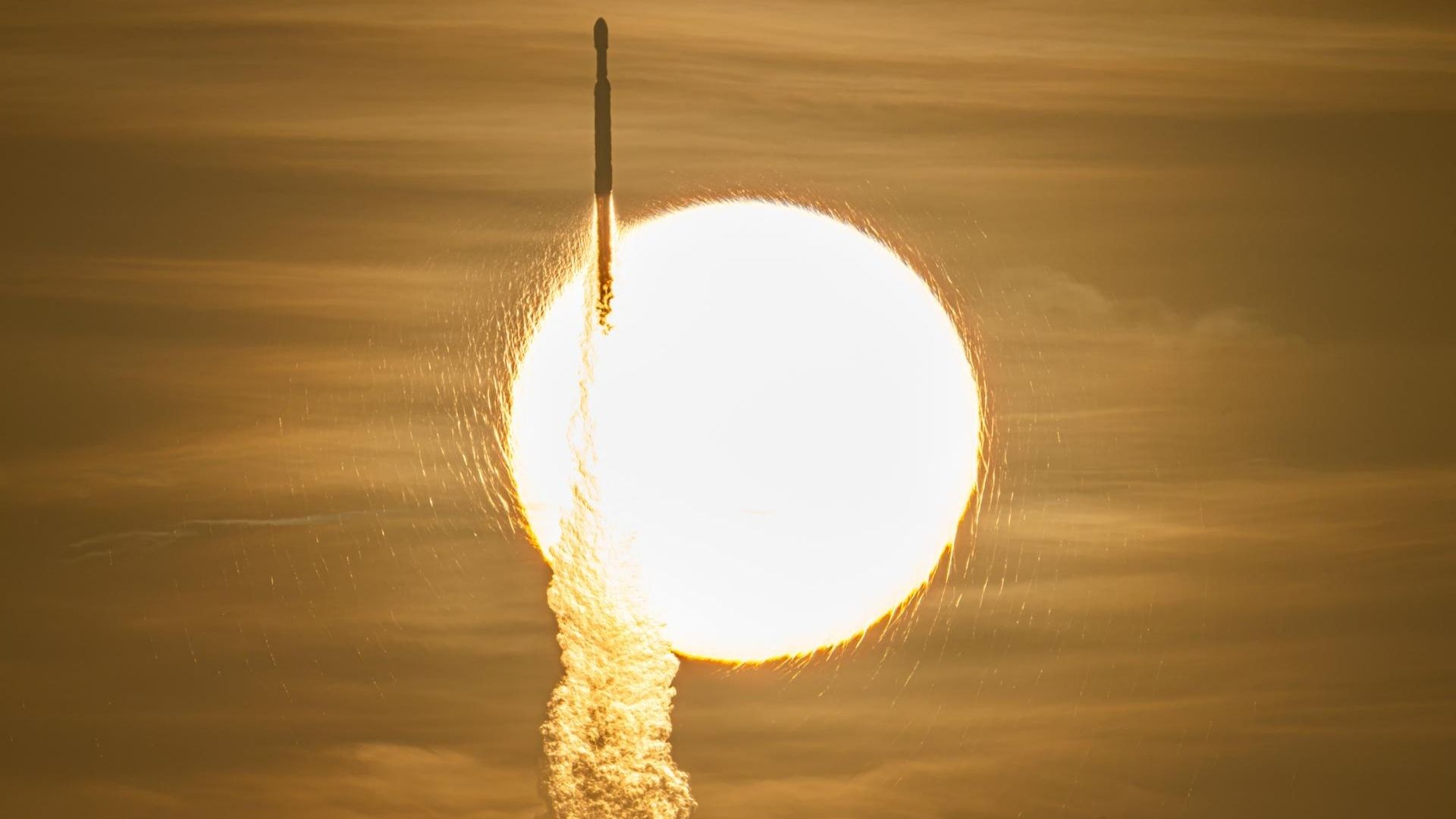
NASA has launched the Nancy Grace Roman Space Telescope on a SpaceX Falcon Heavy rocket, beginning a mission to study some of the universe’s biggest mysteries. The telescope lifted off on August 30 from NASA’s Kennedy Space Center in Florida and is now heading toward its final orbit about one million miles from Earth. Roman is designed to survey large areas of the sky and give astronomers new ways to investigate dark matter, dark energy and planets beyond our solar system. According to NASA, the mission is expected to expand scientists’ view of cosmic history and support a wide range of research as it begins its observations. Telescope hunts mysteries The new telescope is now beginning a roughly three-month journey to its destination, the second Sun-Earth Lagrange point, or L2, about one million miles from Earth. Once operational, Roman is expected to transform how astronomers survey the cosmos. Its defining feature is the combination of a wide field of view with high-resolution infrared imaging, allowing it to observe enormous areas of the sky while capturing distant and faint objects in detail. The telescope is designed to investigate how the universe has evolved over cosmic history and help scientists understand two of its most poorly understood components: dark matter and dark energy. Dark matter cannot be seen directly but influences the motion and distribution of galaxies, while dark energy is associated with the accelerating expansion of the universe. By mapping galaxies across vast regions of space and measuring their properties, Roman will provide new data for studying both phenomena. “With its large field of view and fast survey speeds, Roman will usher us into a new era of discovery and make the invisible visible, setting the foundation for humanity’s search for life beyond our solar system,” said Nicky Fox, associate administrator for the Science Mission Directorate at NASA, in a statement. Roman maps cosmos At the heart of the observatory is the Wide Field Instrument, its primary science instrument. The infrared camera contains 18 detectors, each with a resolution of 4K, together providing a 300-megapixel imaging system. The detectors are designed to capture photons from infrared light and turn them into detailed images of distant cosmic objects. Roman’s optical system is built for rapid, stable observations. Unlike telescopes that spend significant amounts of time moving between individual targets, Roman can scan large portions of the sky. NASA estimates that it will be capable of surveying the universe about 1,000 times faster than the Hubble Space Telescope. The observatory also carries a Coronagraph Instrument designed to demonstrate technology for directly imaging planets around other stars. By blocking or suppressing the overwhelming light from a host star, the instrument will attempt to capture images of much fainter planets nearby. Its initial demonstrations will focus on Jupiter-like worlds and could help advance technologies needed for future missions such as NASA’s proposed Habitable Worlds Observatory, which aims to study potentially Earth-like planets. Roman is also designed to generate an unprecedented volume of scientific data. NASA expects the telescope to transmit about 1.4 terabytes of data to Earth every day, making it the highest data rate yet for a NASA astrophysics mission. Artificial intelligence, machine learning, and citizen scientists will help researchers process the enormous datasets and identify objects and events that warrant closer investigation. Following launch, Roman successfully deployed its solar panels and lower instrument sun shade. Over the coming days, ground controllers will deploy additional components, conduct trajectory corrections, and activate the coronagraph. The Wide Field Instrument is expected to begin operating several weeks into the journey. After reaching L2, NASA will spend about three months commissioning and calibrating the observatory. The agency expects to release Roman’s first images by early 2027. According to NASA, rather than focusing on a single type of celestial object, Roman is designed as a wide-ranging survey observatory. By combining speed, infrared vision and a huge field of view, the telescope could produce a new map of the universe and reveal phenomena that previous space telescopes were unable to see. Get the latest in engineering, tech, space & science - delivered daily to your inbox.Jijo is an automotive and business journalist based in India. Armed with a BA in History (Honors) from St. Stephen's College, Delhi University, and a PG diploma in Journalism from the Indian Institute of Mass Communication, Delhi, he has worked for news agencies, national newspapers, and automotive magazines. In his spare time, he likes to go off-roading, engage in political discourse, travel, and teach languages.
NASA launches new telescope that can scan the universe 1,000 times faster than Hubble
Full Article
Original Source
Read the full article at Interestingengineering →KhanList aggregates and links to publicly available news content. We do not host full articles from third-party sources. Always verify important information with original sources.