
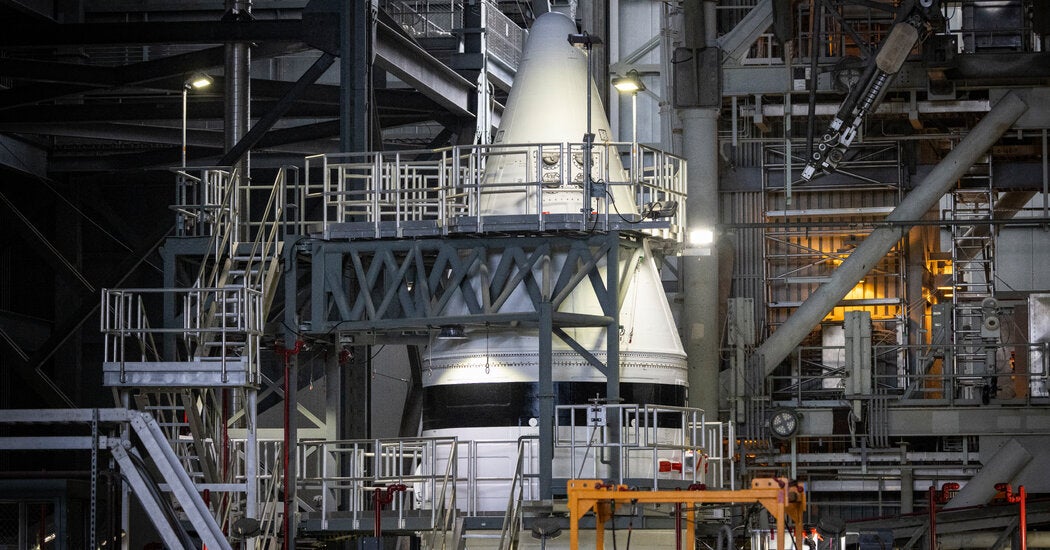
AdvertisementSKIP ADVERTISEMENTAdministrator Jared Isaacman said that the space agency was exploring ways to keep Artemis III on target without compromising safety.The nose cone of a solid rocket booster last month at Kennedy Space Center, in Cape Canaveral, Fla. It will be used on the Space Launch System for the Artemis III mission.Credit...Marco Bello/Agence France-Presse — Getty ImagesOct. 23, 2026, 7:20 p.m. ETCan NASA land astronauts on the moon in 2028?On Friday, NASA’s administrator, Jared Isaacman, did not promise yes, but he said the space agency was working as hard as possible to meet that target.“We have the mandate, we have the resources, the support from our stakeholders to be able to execute, and that’s what we intend to do,” Mr. Isaacman said during a news conference that provided updates on NASA’s Artemis program, which aims to put Americans back on the lunar surface for the first time since 1972.In April, NASA sent four astronauts on a loop around the moon, without landing, during the Artemis II mission. In summer 2027, Artemis III is scheduled to orbit Earth for 14 to 17 days so that astronauts can practice docking procedures with prototypes of lunar landers, which are being developed by two commercial companies: SpaceX, which is owned by Elon Musk, and Blue Origin, Jeff Bezos’ company.NASA has not yet decided which lander it will use for Artemis IV, the mission scheduled for late 2028 that will put two astronauts on the lunar surface near the moon’s south pole. Both lander designs will have to conduct an uncrewed demonstration flight to the moon before astronauts climb aboard.Many outside experts doubt that a 2028 moon landing is possible and expect that China will get its astronauts to the surface before Artemis does. At the news conference, Mr. Isaacman and other top NASA officials talked about how they were looking to speed things up without compromising safety. For example, the agency is exploring the idea of a simpler spacesuit design for the early Artemis moon landings. This suit would not have all of the capabilities that NASA will eventually need when astronauts spend weeks or months on the moon. But it would cut the mass in half, to 250 pounds per suit, saving precious weight that would need to go to the moon and back.“When you think about what has to be delivered to the lunar surface, that is a really big deal,” said Jeremy Parsons, the Artemis program manager at NASA.ImageJared Isaacman, the NASA administrator.Credit...Gregg Newton/Agence France-Presse — Getty ImagesIn his introductory remarks, Mr. Isaacman harked back to the space race of the 1960s between the United States and the Soviet Union and the quick progress made during the Apollo program. Only nine months passed between Apollo 7, the first mission with astronauts aboard, and Apollo 11, when Neil Armstrong became the first human to step on the moon.Today, the superpower competitor is China, which has made strides with its focused and steady space program over the last couple of decades. China aims to send its astronauts to the moon by 2030.Since becoming NASA administrator last December, Mr. Isaacman has sought to reshape Artemis to take a more step-by-step approach similar to Apollo’s. “It’s a playbook this agency knows really well,” he said.The first Artemis moon landing was initially set to occur during Artemis III, and would have happened in late 2028 at the earliest. But Mr. Isaacman decided that it made more sense to first test out key docking technologies in Earth orbit before relying on them nearly a quarter-million miles away at the moon. That would also allow NASA to launch sooner and build up its rocket-launching experience.“The idea of taking longer, costing more, and flying less somehow, leading to better or safer outcomes, I think is a misunderstanding that’s been left uncorrected for far too long,” Mr. Isaacman said.Kenneth Chang, a science reporter at The Times, covers NASA and the solar system, and research closer to Earth.Related ContentAdvertisementSKIP ADVERTISEMENT
NASA Is Still Aiming for the Next Moon Landing in 2028
Full Article
Original Source
Read the full article at Nytimes →KhanList aggregates and links to publicly available news content. We do not host full articles from third-party sources. Always verify important information with original sources.