
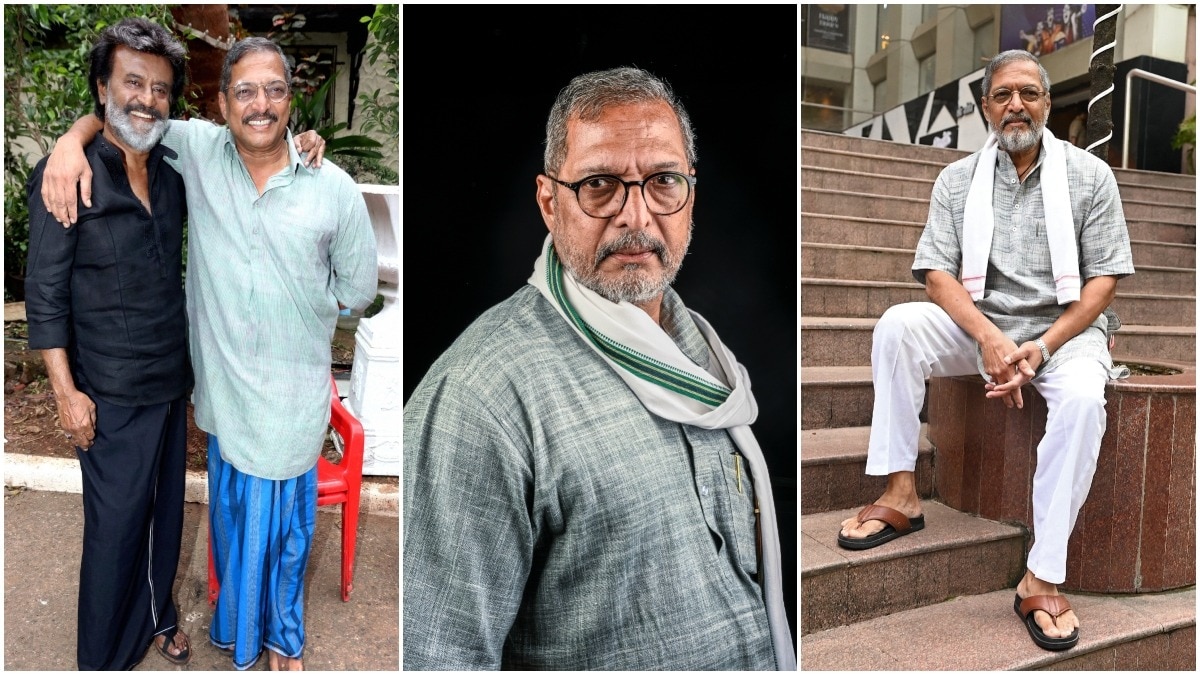
Long before "conscious fashion" became a buzzword, Nana Patekar made hand-spun, hand-woven khadi his constant companion.He was never a high-fashion Bollywood man. New Delhi,Oct 8, 2026 11:25 ISTThere is a saying in Bengali ‘matir manush’ which translates to man of the soil and this phrase stands true for Nana Patekar. The actor commanded the screen with a force few others could match. Off it, however, he rarely looked like someone who had spent decades being a Bollywood star.Patekar died at the age of 75 on Thursday, October 8. He was found unresponsive at his flat in Goa after complaining of severe chest pain and was declared dead at Manipal Hospital at 5:20 am. A post-mortem is expected to establish the exact cause of death.As tributes poured in for the veteran actor, there is another part of Patekar's public persona worth remembering: the way he dressed. Union Minister Nitin Gadkari, right, with actor Nana Patekar during the 'Jalkranti Parishad 2026' event, in Nagpur, Maharashtra. (Photo: PTI) In an industry where celebrity dressing can mean stylists, luxury labels, statement watches and carefully constructed airport looks, Patekar seemed largely uninterested in the performance of being a star. His wardrobe was often made up of the simplest Indian clothes — a white or earthy-toned kurta, pyjama, a gamcha, a Gandhi cap sometimes, and little more than a pair of ordinary sandals. In fact, his last public appearance at a Goa event on September 27, the actor was spotted in a similar avatar: white kurta pyjama and gamcha.VIDEO | Goa: Actor Nana Patekar attended and addressed the Samraat Club International installation ceremony in Dona Paula. (Full video available on PTI Videos - https://t.co/d8jp61yd2p) https://t.co/jl8xn9vXOk— Press Trust of India (@PTI_News) October 4, 2026For Nana, khadi was never just a sartorial choice; it was a statement of identity. Long before "conscious fashion" became a buzzword, Nana made hand-spun, hand-woven khadi his constant companion. Whether walking through airport terminals or gracing a film premiere, he was almost always seen in his trademark, crisp, minimalist kurta-pyjama, often accompanied by a simple gamcha. Mohammed Zeeshan Ayyub, Kubbra Sait, producer Prakash Jha, actors Kranti Prakash Jha and Nana Patekar during the trailer launch of the web series 'Sankalp'. (Photo: PTI) This choice mirrored his personality: unpretentious, durable, and deeply traditional. By choosing khadi, he did not just embrace a fabric; he embraced the slow, painstaking labour of the artisans who crafted it, rejecting the ephemeral nature of high-fashion trends in favor of something with history, texture, and substance. Akshay Kumar and Nana Patekar during the trailer launch of film 'Housefull 5', in Mumbai. (Photo: PTI) He was never a high-fashion Bollywood man. Earlier, that meant cotton shirts, trousers/denims and simple T-shirts; later, as his life became increasingly rooted in rural Maharashtra and farming, the sadra, dhoti, khadi and gamchha became more recognisable. Cotton shirts, trousers/denims and simple T-shirts, these have also been a part of Nana Patekar's wardrobe. A wardrobe far removed from Bollywood glamourPatekar had a long career in an industry where fashion increasingly became another marker of celebrity. Yet he never appeared particularly interested in turning clothes into a status symbol.In a 2023 Filmfare interview, Patekar spoke about spending the Covid-19 period at his farmhouse, which he described as being spread over 12–14 acres, with dogs, cows and bullocks. He said he had helped farmers living nearby and found the rural surroundings a welcome escape from city life.His connection with farming was not simply an image he adopted for photographs.Patekar was closely involved with Naam Foundation, which he co-founded with Makarand Anaspure and which worked on issues affecting farmers, including employment, education and water scarcity. He had spoken repeatedly about how his encounters with families affected by farmer suicides changed his outlook on life.In 2026, while speaking at the Jal Kranti Parishad in Nagpur, Patekar again spoke about his attachment to rural life. He said he felt increasingly disconnected from cities and wanted to spend more time working with rural communities, particularly on water conservation and sustainable development.For an actor who spent much of his career playing men who felt recognisable — policemen, farmers, working-class characters, flawed fathers and men pushed to their limits — there was something fitting about an off-screen wardrobe that rarely tried to separate him from ordinary life.Nana Patekar may have been one of Indian cinema's most formidable actors. But he never seemed particularly interested in dressing like one.- Ends
Nana Patekar never dressed like a Bollywood star. Kurtas, gamcha and a farmer's simplicity
Full Article
Original Source
Read the full article at Indiatoday →KhanList aggregates and links to publicly available news content. We do not host full articles from third-party sources. Always verify important information with original sources.