
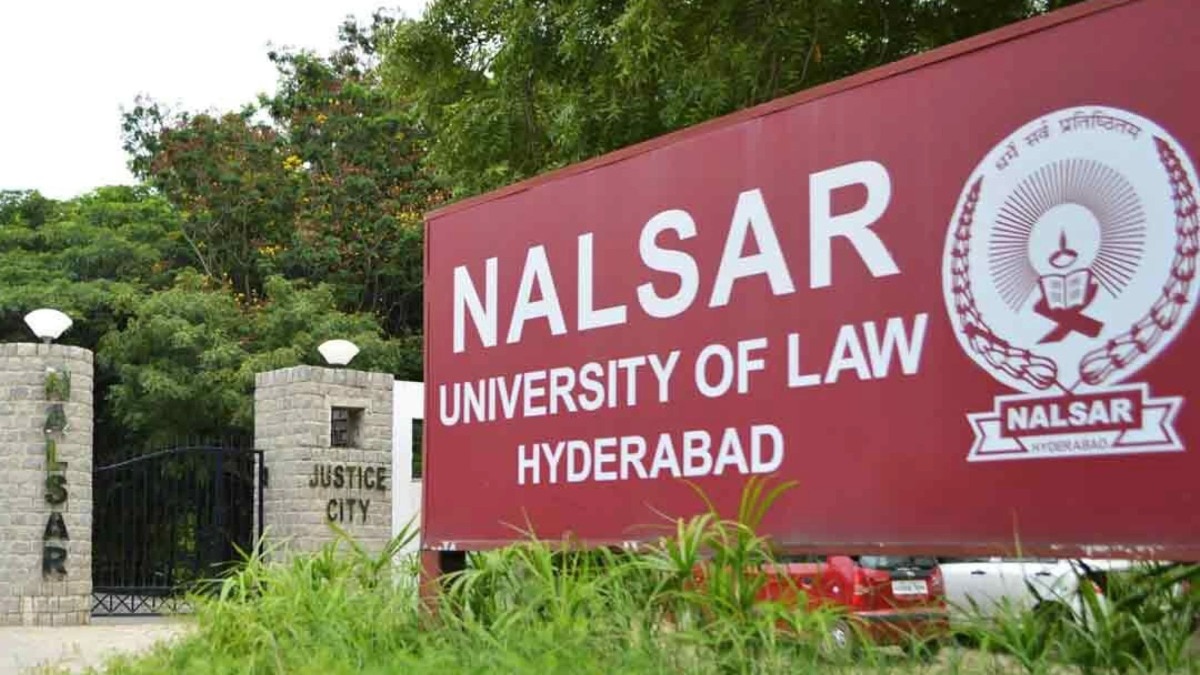
The row over the Chief Justice of India's proposed visit to NALSAR and the court's warning to protesting students has widened. The university, which was set up almost three decades ago, has evolved significantly over the years and is currently ranked third in the latest NIRF law rankings. The university, located in Hyderabad, was founded in 1998 through the National Academy of Legal Studies and Research University Act, 1998, enacted by the then Andhra Pradesh Legislative Assembly. (Image: NALSAR)NALSAR University recently came into the spotlight after more than 450 of its students opposed Chief Justice of India Surya Kant’s participation as a chief guest in the university’s convocation ceremony. Following the protest, the Bar Council of India initially observed that students involved in the protest should not be allowed to practise law.The remarks triggered reactions from sections of the legal community and academic circles.Subsequently, the bench clarified that no student would be prevented from receiving a graduation degree or from practising law, effectively softening the earlier position.Amid the debate that followed, attention turned not only to the protest but also to the institution itself. In India’s legal and judicial landscape, direct student opposition to a sitting Chief Justice of India is uncommon, particularly within a National Law University. The episode prompted renewed discussion on how a university established to train future lawyers came to witness such an assertion of student dissent.NALSAR, ranked third among India’s law universities in the latest NIRF rankings, had institutional associations with former Chief Justices of India, including Justice NV Ramana. The university is additionally linked with Justice BR Gavai, who was appointed as the inaugural Dr BR Ambedkar Chair Professor on Constitutional Law and Social Inclusion, a position created to promote research and engagement in constitutional studies and social inclusion. Hon'ble Mr. Justice UC Banerjee, the Founder-President of the University inaugurating the University on 5th July 1998 A NATIONAL NAME, A STATE STATUTEThe university, located in Hyderabad, was founded in 1998 through the National Academy of Legal Studies and Research University Act, 1998, enacted by the then Andhra Pradesh Legislative Assembly.The story, however, began earlier. The initial efforts to establish NALSAR took shape in the mid-1990s under the leadership of Justice Prabha Shankar Mishra, who served as Chief Justice of the Andhra Pradesh High Court between 1995 and 1997.To advance the proposal for a premier law university in Hyderabad, the National Society for Promotion and Advancement of Legal Studies and Research was formed by a group of senior jurists that included Justice Prabha Shankar Mishra, Justice MN Rao, Justice Syed Shah Mohamed Quadri, Justice Y Bhasker Rao, Justice S Parvatha Rao, Justice Venkatarama Reddi, and Dr MS Rajajee.The decisive phase came after Justice Umesh Chandra Banerjee assumed office as Chief Justice of the Andhra Pradesh High Court on 1 February 1998.According to university records, they concluded that pursuing a parliamentary enactment would be more complex and time-consuming.The Act came into force on June 15, 1998. Professor Ranbir Singh took charge as the founding Director and moved quickly to organise the university’s first entrance examination in November 1998. Hon'ble Mr. Justice U.C. Banerjee, the Founder-President of the University releasing the Course Material on the day of Inauguration of First Academic Session of the University (1998-99) on 1-12-1998. Others are Prof. (Dr.) Ranbir Singh, Director and Mr YV Rama Krishna, Registrar. (Image: NALSAR) The inaugural batch of the BA, LL.B. (Hons.) programme began classes in December 1998 from temporary premises in Barkatpura, Hyderabad.FROM BARKATPURA TO SHAMIRPETNALSAR’s first campus was located in Barkatpura, where the university operated from a dedicated building with hostel facilities for women students, a library, reading rooms, dining facilities, and an on-site kitchen. The arrangement was modest, but it provided the infrastructure necessary for the university’s initial academic operations.In 1999, the Andhra Pradesh government allotted 50 acres of land at Shamirpet for the university’s permanent campus.By mid-July 2000, just over a year after the groundbreaking ceremony, NALSAR shifted to Shamirpet along with its faculty, staff, and the first three batches of students.FROM A NEW LAW SCHOOL TO A NATIONAL INSTITUTIONFrom its inception, NALSAR described its mission in terms of constitutionalism, the rule of law, justice, and social inclusion, with particular attention to the needs of marginalised communities.The university’s early records indicate that these principles influenced decisions relating to admissions, curriculum design, and campus development.The university’s subsequent development was carried forward under Professor Veer Singh, while Professor Faizan Mustafa, who took over in 2012, introduced a credit-based elective system that significantly expanded curricular flexibility while retaining academic requirements.In November 2022, Professor Srikrishna Deva Rao, a member of NALSAR’s founding faculty, returned to lead the university as Vice-Chancellor after heading several other law schools in the country.Over the years, NALSAR expanded beyond undergraduate legal education. It introduced postgraduate and doctoral programmes and established research centres in constitutional law, intellectual property, air and space law, alternative dispute resolution, public policy, criminal justice, and human rights.Today, NALSAR is positioned among India’s leading law schools and was ranked third in the National Institutional Ranking Framework (NIRF) 2025 law rankings.In 2022, NALSAR announced steps towards more gender-neutral institutional practices, including changes relating to hostel facilities and official documentation.NALSAR’s library now houses more than 27,000 volumes, including law reports, journals, periodicals, manuals, textbooks, and other legal reference materials. Admission to its undergraduate programme is conducted through the Common Law Admission Test (CLAT), and with only around 160 seats offered annually, competition for admission remains highly selective.National Law Universities were designed with substantial judicial participation in their governance, yet they are also expected to encourage independent legal reasoning and constitutional scrutiny of public institutions, including the judiciary itself.NALSAR’s history therefore provides an important lens through which to view the present moment. Established through an Andhra Pradesh legislative enactment, often mistaken for a parliamentary institution, shaped by judicial involvement from its inception.The current episode has brought that history back into public focus, highlighting the continuing tension between institutional authority and the independence expected of future members of the legal profession.- EndsPublished By: Rishab ChauhanPublished On: Aug 13, 2026 22:41 IST
NALSAR's birth: How judges and a future CJI shaped India's law school powerhouse
Full Article
Original Source
Read the full article at Indiatoday →KhanList aggregates and links to publicly available news content. We do not host full articles from third-party sources. Always verify important information with original sources.