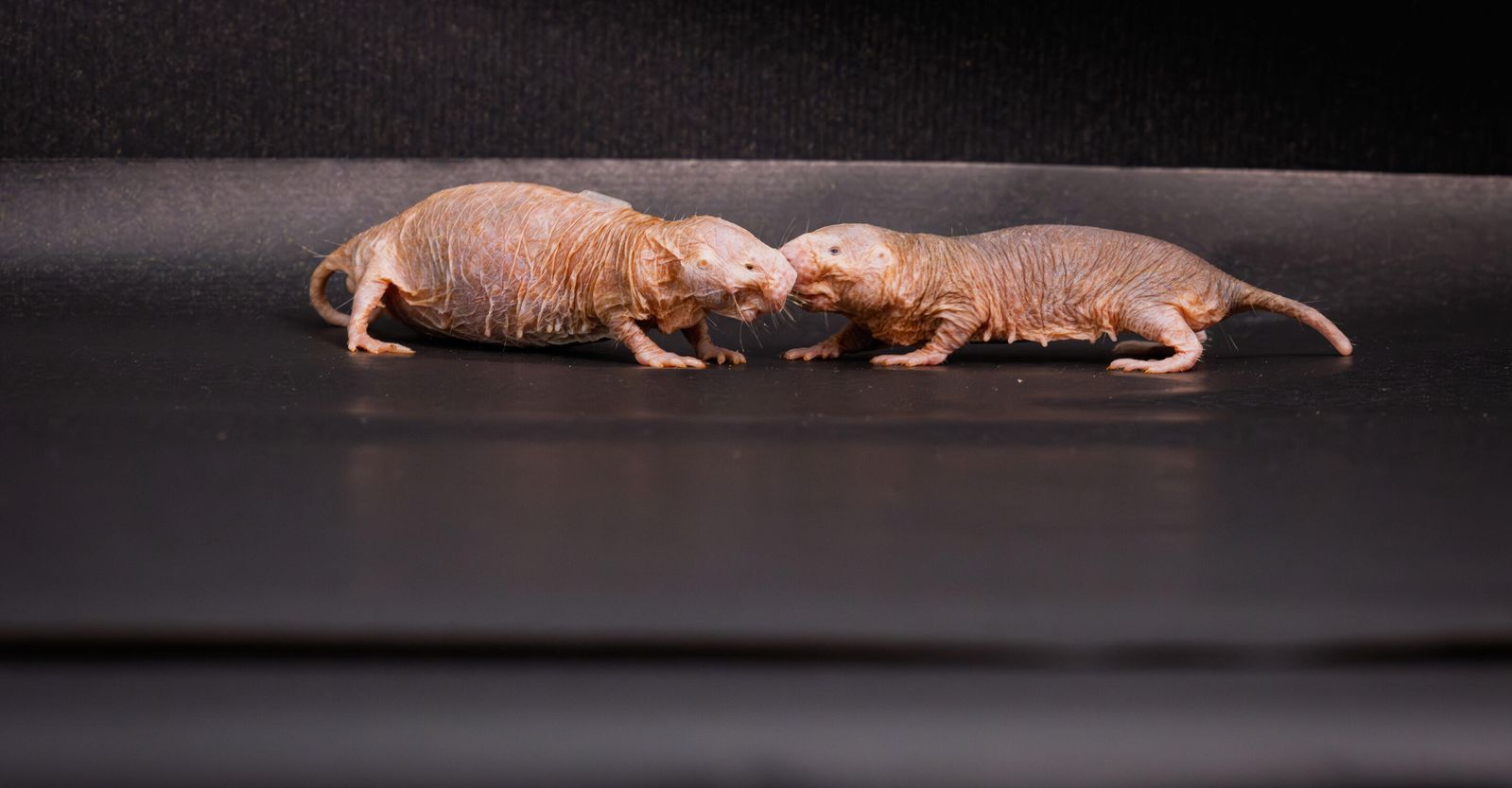
The strange-looking creatures are one of two known mammals that use a social structure like that of bees and ants. A ruling rodent maintains power over her colony via one key chemical compound, according to new research A pregnant naked mole-rat queen, on the left, and a worker, on the right, sniff each other. Felix Petermann / Max Delbrück Center As if naked mole-rats aren’t weird enough, new research suggests that a chemical released by their queens prevents all other females in their respective colonies from reproducing. The alien-looking creatures are one of only two known mammals that strictly divide labor roles within a group, or have a eusocial organizational structure, which is typically seen in ants and bees. Within a naked mole-rat colony, a single queen rules over infertile workers and soldiers that gather food, care for the young and defend against predators. The monarch is responsible for all breeding, but how she maintains her dominant status has been unclear to scientists. Now, a study published in the journal Nature on July 15 has found that the chemical compound isopropyl myristate temporarily induces infertility in female naked mole-rats. The findings reveal a mammalian equivalent of queen pheromones used by eusocial insects and suggest that chemical communication may play a larger role in regulating mammalian social behavior than previously thought. For a long time, “the theory was that the queen is larger and more aggressive than the other animals, exerting her dominance through pushing and shoving,” says study co-author Gary Lewin, a molecular physiologist at the Max Delbrück Center for Molecular Medicine in Germany, to Michael Le Page at New Scientist. “But we never found that very satisfying as an explanation.” Lewin and his colleagues suspected that scent might be important, especially because they had previously found that naked mole-rats use smell to recognize members of their own colony and sniff out outsiders, per a statement. So, they set out to identify the odors produced by 351 naked mole-rats across ranks, ages and reproductive states. Chemical analysis revealed that isopropyl myristate was always lingering around queens but was practically undetectable in other colony members. “We were really aiming to just identify the chemical profile of the naked mole-rats,” says study co-author Mohammed Khallaf, a neuroscientist at the Max Delbrück Center, to Jacob Smith at Nature. “I got very excited when we found this compound that’s only produced by the queen.” Fun fact: You might be using isopropyl myristate The chemical compound, which is considered odorless to humans, is commonly used in cosmetics as a solvent, a substance that dissolves another material, and a moisturizer. Lewin says some of his lab mates thought they could smell isopropyl myristate when it was around, per New Scientist. Swabs of various body parts of queens revealed that isopropyl myristate was most abundant in vaginal, anal and mouth secretions. Levels of the compound, particularly in vaginal secretions, also peaked during ovulation and declined during pregnancy and lactation, the team found, tying it to reproduction. Next, the researchers conducted experiments to see whether other naked mole-rats could detect the queen’s chemical signature. They exposed tissue from non-breeding animals’ noses to isopropyl myristate and found that the compound activated cells that respond to smell. The scent also stimulated the brain region responsible for processing odors, called the olfactory bulb. Creatures exposed only to air, meanwhile, had less of a cellular response in this brain area, suggesting that the animals can smell isopropyl myristate. To test whether the compound suppresses reproduction, isopropyl myristate was sprayed each day in cages housing non-breeding female-male pairs, and no pregnancies ensued. However, in pairs that didn’t get doused, nearly all females became pregnant. The compound boosts levels of prolactin, a hormone that reduces fertility, and lowers levels of progesterone, a hormone that promotes fertility, the team found. Naked mole-rat queens' secret sauce What’s more, removing a queen from a colony and adding daily isopropyl myristate prevented the usual chaotic battle among high-ranking females that would have otherwise vied for her spot. “We produced peacefulness,” Lewin tells New Scientist. “That’s probably the most dramatic experiment.” When they stopped spraying the substance, fighting ensued and eventually a new queen rose to power. The study is convincing, says Chris Faulkes, an ecologist at Queen Mary University of London who wasn’t involved in the work, to New Scientist, but it also raises many questions. For instance, it’s unclear how the queens synthesize isopropyl myristate and which proteins are used to detect it, Lisa Stowers, a neuroscientist at Scripps Research who also didn’t participate in the study, tells Nature. Nevertheless, the discovery is helping researchers resolve a longstanding mystery. “The idea that a single scent can maintain peace and prevent violence may sound like science fiction,” Khallaf says in the statement. “In the world of naked mole-rats, it is reality.” You Might Also Like Get the latest stories in your inbox every weekday. More about: Animals Brain Chemistry Ecology Neuroscience Rodents and Shrews
Naked Mole-Rat Queens Emit a Special Scent to Stop Their Rivals From Reproducing, a New Study Suggests
Full Article
Original Source
Read the full article at Smithsonianmag →KhanList aggregates and links to publicly available news content. We do not host full articles from third-party sources. Always verify important information with original sources.