
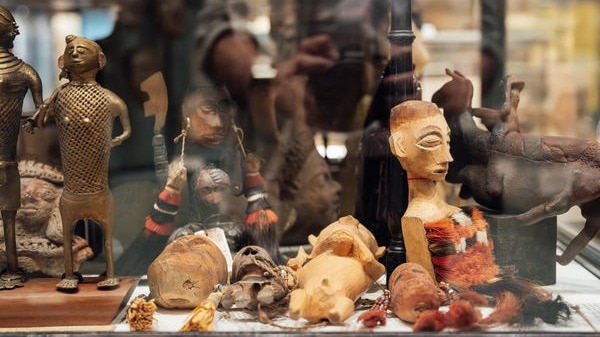
The return of 39 Naga ancestral remains from the Pitt Rivers Museum of Oxford University in the UK is more than a homecoming. After nearly a century away, the remains, many of them skulls, are returning to Nagaland, bringing attention to colonial-era collecting, and the Naga community's efforts to reclaim its past.The Pitt Rivers Museum transferred 39 Naga ancestral remains to a community delegation. Their return restores ancestral connections and advances reconciliation over colonial-era collections. (Image: Pitt Rivers Museum)New Delhi,Nov 27, 2026 14:09 IST"Ancestors are like stars in the night sky. We can't always see them, but we know they're always there."It is an anonymous quote used in remembrance of those who have passed away. Today, it resonates with the Naga people as they prepare to welcome their ancestors back to their homeland.The 39 ancestral remains, held at Britain's Pitt Rivers Museum for nearly a century, which include those of two children, a woman and a village chief, were handed over to a Naga delegation earlier this month following years of discussions, and will reach Nagaland on Friday, according to Nagaland Today. Their arrival marks a significant moment for communities seeking to reclaim a part of their history taken away during British colonial rule.The return is part of a larger effort to restore ancestral connections, recognise historical wrongs, and give communities the opportunity to decide how their forebears should be remembered and honoured. The remains had been housed at the Pitt Rivers Museum, part of the University of Oxford, for decades. Many were collected by British administrators John Henry Hutton and James Philip Mills, who served in the Naga Hills during the colonial period between approximately 1910 and 1940.The repatriation process gathered momentum in 2020, when Naga anthropologist Dolly Kikon approached the museum after learning that it was reviewing the ethics of displaying human remains. What followed was six years of discussions, historical research and consultations involving Naga representatives and the institution. Kikon, a professor at the University of California, Santa Cruz, has described the development as the first repatriation of human remains to India of its kind.HOW REMAINS OF NAGA ANCESTORS ENDED UP IN OXFORDThe Pitt Rivers Museum, established in 1884, grew into one of the world's prominent repositories of archaeological and anthropological material. Its collection, which now exceeds 600,000 objects, includes material gathered from different parts of the world during the colonial era.A considerable portion of its holdings came through British administrators, travellers, missionaries and researchers who collected material during their time in territories under colonial control.Among those who contributed to its Naga collection were Hutton and Mills. Both were members of the Indian Civil Service and served in administrative positions in the Naga Hills.Hutton, who became Deputy Commissioner of the Naga Hills District in 1917, developed an interest in the region's communities and their traditions. His academic work included books on the Angami and Sema Nagas. Mills, who succeeded him as Deputy Commissioner in the 1930s, also undertook extensive ethnographic research and authored studies on the Lhota, Ao and Rengma Naga communities.Their administrative positions gave them considerable access to the region and its people. However, the circumstances in which some of the material entered museum collections raise uncomfortable questions about the relationship between colonial authority and the acquisition of cultural and human remains.One particularly revealing episode concerns Mills's 1936 expedition to Pangsha village. Travelling with an armed escort, he sought the return of human heads reportedly taken from a neighbouring community. His account of the expedition also referred to the museum receiving what he described as valuable specimens.The episode illustrates how colonial officials could combine their administrative and military authority with their interest in ethnographic collections. What might have been presented as academic collecting was not always separate from the unequal power structures of the time.WHY MANY OF THE REMAINS ARE SKULLSAn important aspect of the repatriation is that many of the remains are skulls, reflecting the historical practice of headhunting among several Naga communities.The practice needs to be understood within its historical and cultural setting rather than viewed only through the lens of colonial descriptions. For certain Naga communities, headhunting was historically associated with ideas of warriorhood, courage, social standing and the protection of one's village. It was embedded in a complex system of traditional beliefs and community practices.The taking of an enemy's head was not an isolated act of violence. It carried social and symbolic significance within the societies in which the practice existed. The skulls subsequently became part of the historical record of a period when warfare, inter-village rivalries and ideas of honour shaped aspects of community life.This context, however, does not diminish the importance of how the remains were acquired or the need to return them to their communities of origin.The larger Naga collection at the Pitt Rivers Museum also includes material connected with human remains. According to the museum's records cited in research on the collection, 219 items are classified as human-remains-related material. These comprise 39 ancestral human remains and 178 objects containing, or potentially containing, human hair.The scale of the collection highlights that the return of the 39 individuals is an important beginning, rather than necessarily the end of discussions surrounding Naga ancestral material held abroad.A RETURN FROM UK AFTER YEARS OF NEGOTIATIONSThe decision to reconsider the museum's display of human remains became an important turning point in the process.During the Covid-19 pandemic in 2020, the Pitt Rivers Museum removed human remains, including shrunken heads, from public exhibition as part of a wider reassessment of its colonial collections. This opened up conversations about the future of material that had remained in the institution for generations.The museum subsequently worked with the Forum for Naga Reconciliation and representatives from different Naga communities to determine how the remains should be returned.In early November, the institution formally transferred custodianship of the 39 remains to a Naga delegation comprising community leaders and scholars.The museum's director, Laura Van Broekhoven, acknowledged the lengthy nature of the process and expressed hope that the initiative would contribute towards reconciliation and healing.For Nagaland, the immediate significance is more intimate. After spending close to a century and thousands of miles away, 39 ancestors are finally returning to their land.- Ends
Naga ancestors return home after 100 years in Oxford museum
Full Article
Original Source
Read the full article at Indiatoday →KhanList aggregates and links to publicly available news content. We do not host full articles from third-party sources. Always verify important information with original sources.