
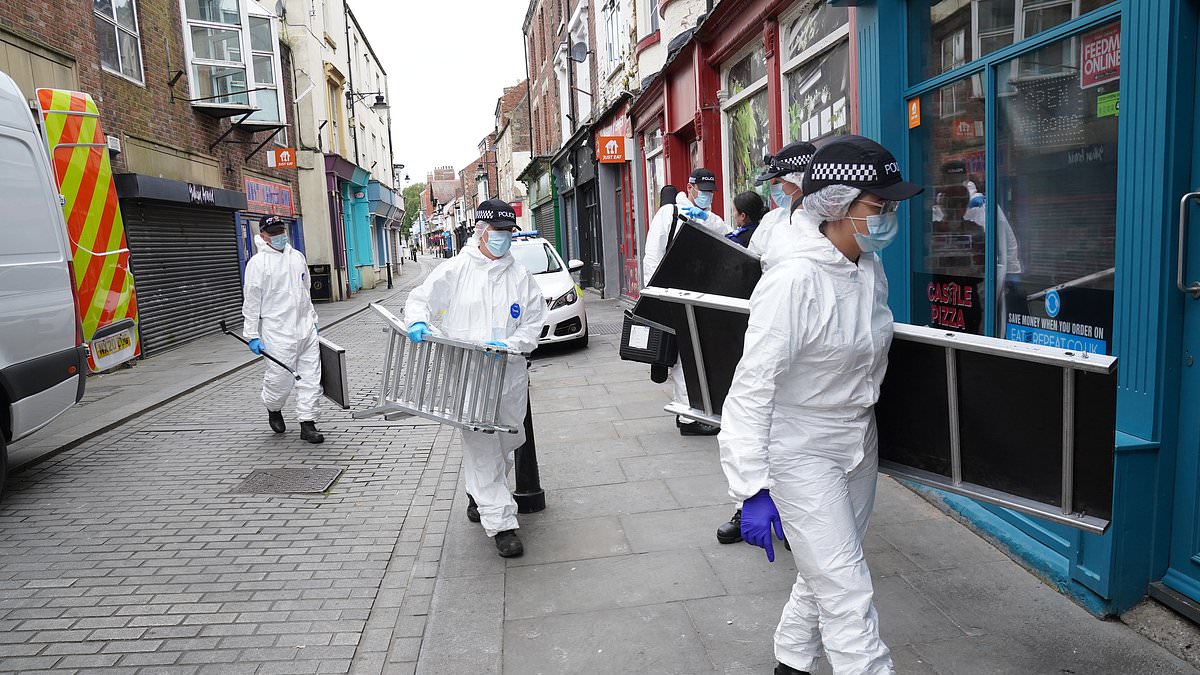
A baby boy whose remains were found wrapped in newspaper from 1910 and hidden under floorboards had twine looped three times around his neck, an inquest heard.Contractors renovating a flat above a pizza shop in Bishop Auckland, County Durham, made the grisly discovery of the baby's remains under floorboards in July 2024.Durham Police was contacted by the building firm about the tiny skeleton – later found to be a full-term baby of around 40 weeks old – but have been unable to say how the baby died. An inquest at Crook Civic Centre was told that the police inquiries involved DNA testing, a radio carbon expert and a forensic anthropologist.The unidentified child was named as 'Baby Auckland' for the proceedings.The court previously heard that carbon dating suggested the baby may have lived at some time between 1726 and 1812 – even though the property he was found in was built in the Victorian era.The skeleton was examined by a forensic anthropologist who determined that the baby was a boy and full-term, although it was not possible to prove whether he was stillborn.He was found with knotted twine around his neck and was partially wrapped in a copy of a Sunday newspaper called The Umpire which was dated June 19, 1910, it was said. Police forensic investigators entering the disused building in Fore Bondgate, Bishop Auckland, County Durham, after the skeleton of the baby was found beneath floorboards in July 2024 The body of the little boy was found in a flat above a pizza shop and had lay undiscovered for more than 100 yearsCoroner Crispin Oliver, who called the case 'tragic', said that all elements of the inquest process were engaged, meaning it was necessary to establish who the deceased was, as well as how, where and when he died.He said: 'This is a sad and unusual case.'He said the inquest intended to establish if the death was unnatural, violent or unknown.Renovations were being carried out in a second floor room at the building at Fore Bondgate by owner Peter Moody, who made the discovery under a floorboard.He told police that the skeletal remains had what looked like about a metre of garden twine around the neck.Records established that the property, used as a cafe at the time, was built in the late 19th century.Detective Chief Inspector Mel Sutherland, who led the police inquiry, said forensic anthropologist Dr Micol Zuppello worked at the scene and established that the remains were human.Dr Zuppello believed the body, since mummified, was placed face-down.She judged the remains were that of a baby of 38-40 weeks development but it was not possible to say if the baby was stillborn.Home Office pathologist Dr Louise Mulcahy told the inquest she could not ascertain the cause of death.There was no sign of trauma on the skeletal remains, but there was no soft tissue left to establish if poisoning was a factor.She confirmed to the coroner that the twine was looped and knotted directly around the baby's neck, then wrapped in newspaper, rather than the cord being used to tie the wrapping, like a parcel.She said: 'I have recorded it was looped around the neck three times, there was a knot, and a further loop.'Mr Sutherland explained how the police inquiry looked at finding a knot expert but the cost of that investigation, given there was no prospect of it leading to a prosecution, was too much.The twine used was generic, so was not an investigative lead, the inquest heard.DNA testing did not reveal any known living relatives, he said.The detective said public appeals in the media led to two sisters to come forward believing they could be related to a servant who worked at the property, but a DNA test did not match.Mr Oliver asked Mr Sutherland if the twine could have been used to hang a religious artefact around the baby's neck, or if string could have been used in midwifery practices at the time, but the detective said neither was likely.Mr Sutherland praised Durham County Council for organising a funeral for the baby, supported by a funeral director who gave their services for free and a memorial firm which provided a headstone.The inquest also heard from Dr Brian Tripney, a radio carbon dating expert from Glasgow University, who used a bone sample to establish that the baby was born in a period between the mid-1600s and 1955.Mr Oliver said he will give his conclusion later on Thursday.After the funeral in April, Cathy Hunt, Durham County Council's cabinet member for children and young people's services, said: 'Sadly, for reasons we will never know, this little boy was never given the dignified and appropriate burial he deserved, so it was important that he was laid to rest in a way that honoured a life that could have been.'
Mystery baby boy had twine tied around his neck when his skeletal remains were found under floorboards in newspaper from 1910, inquest hears
Full Article
Original Source
Read the full article at Dailymail →KhanList aggregates and links to publicly available news content. We do not host full articles from third-party sources. Always verify important information with original sources.