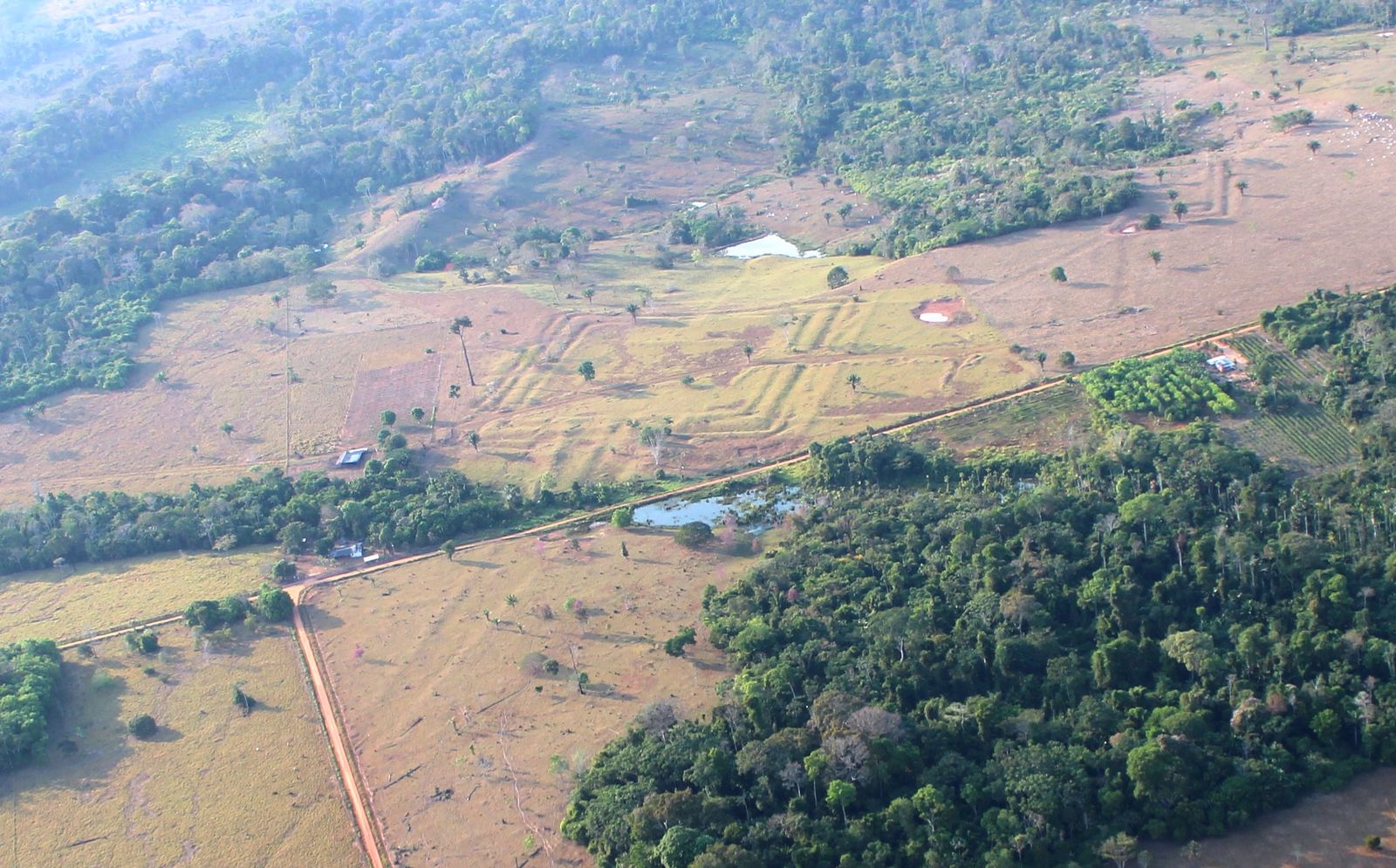
Scientists recently discovered hundreds of monumental, geometric earthworks known as “geoglyphs” in northern Brazil from the Aquiry civilization Archaeologists used lidar to “see” through the Amazon’s dense canopy and discovery nearly 400 previously undocumented geoglyphs. Martti Pärssinen Millions of people may have inhabited the southwestern Amazon rainforest roughly 2,000 years ago, part of an ancient civilization that archaeologists now suspect was much larger than previously thought. The civilization, known as the Aquiry, likely peaked between 100 and 300 C.E. During the time, scientists estimate between 1.25 million to 3 million people inhabited more than 70,600 square miles of what is now northern Brazil, an area about the size of North Dakota. Archaeologists came up with those figures based on the results of a recent aerial survey using lidar, a laser-based, remote sensing technology that produces detailed, three-dimensional maps of the landscape. They found nearly 400 previously undocumented geometric earthworks, known as “geoglyphs,” in a 1,740-square-mile area, which they used to estimate the Aquiry’s population size and geographic sprawl. The findings, detailed in a new paper published July 29 in the journal Nature, add to a growing body of evidence showing that the Amazon is not an untouched wilderness but, rather, a landscape that has been shaped by humans for centuries. “That old idea of a pristine Amazônia falls apart,” study co-author Alceu Ranzi, a geographer at the University of Acre, tells Science’s Julia Vaz. Scientists think the Aquiry civilization first emerged around 600 B.C.E. They estimate people lived in villages of roughly 300 inhabitants on average, residing in multi-family longhouses and cultivating crops like squash, maize and manioc; they also grew Brazil nut trees and peach palms for fruit. The Aquiry also built massive geometric earthworks consisting of deep ditches and high outer embankments, which researchers think served as seldom-used public, ceremonial and political centers. They were “venues for gatherings, political decision-making and displays of chiefly generosity, ritual dancing, music, feasting, athletic competitions and ball games,” lead author Martti Pärssinen, an archaeologist at the University of Helsinki, tells NewScientist’s James Woodford. The earthworks form simple shapes like circles and squares, as well as more sophisticated designs like octagons, petagrams and circles inside squares. Most span an average of seven acres, but some are as large as 123 acres, with ditches that are 40 feet wide and up to 16 feet deep. Even more impressive, scientists think the Aquiry built them without metal tools or animals. “The scale and precision of these constructions is simply astonishing,” Pärssinen tells NewScientist. So far, archaeologists have discovered roughly 1,700 geoglyphs in the area, but they suspect the region contains far more—likely between 23,000 and 30,000. Those figures are much higher than earlier estimates, which suggested the entire Amazon rainforest might contain roughly 10,000 earthworks. Did you know? Amazon rainforest The Amazon covers approximately 2.3 million square miles of northern South America. Most of the rainforest is located within the bounds of Brazil, Peru and Colombia, but small areas are also located in Bolivia, Ecuador, Venezuela, Guyana and Suriname. The Aquiry geoglyphs appear to have been abandoned for good between 850 and 950 C.E. Researchers don’t know why for certain, but the available evidence points to a “relatively rapid collapse” that may be somehow related to the decline of other precolonial civilizations, including the Maya, Tiwanaku and Wari civilizations, Pärssinen tells Live Science’s Kristina Killgrove. The researchers were surprised by the scale of the Aquiry civilization, especially because it developed far from major rivers, which historically supported large ancient settlements. And, they note that their study area amounts to less than 3 percent of Amazonia. They think other regions may have had similar population densities, raising the possibility that the Amazon was once home to tens of millions of people before European colonization. “That’s something amazing and something new,” Pärssinen tells Scientific American’s Jackie Flynn Mogensen. Michael Heckenberger, an anthropologist at the University of Florida who was not involved with the study, says the new Aquiry population estimates are “mind-blowing,” but also “plausible and extremely important.” The findings, he suggests, also highlight the need for more research into a region that may hold important clues about the size and complexity of precolonial societies in the Amazon. “The idea of pre-Columbian urbanism in southern Amazonia has gained momentum over the past two decades,” he tells NewScientist. “What we now need to know is what is going on around the detectable earthworks, such as occupational sites, to support the high estimated population.” You Might Also Like Get the latest stories in your inbox every weekday. More about: Ancient Civilizations Archaeology History Indigenous Peoples New Research Rainforest South America
Mysterious Shapes Hidden Beneath the Amazon Canopy Reveal a Sprawling Ancient Civilization Much Bigger Than Researchers Expected
Full Article
Original Source
Read the full article at Smithsonianmag →KhanList aggregates and links to publicly available news content. We do not host full articles from third-party sources. Always verify important information with original sources.