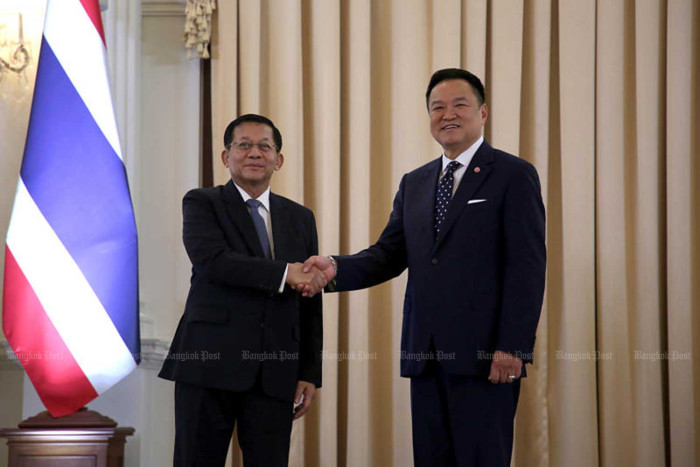
Instability, border closure hurt business Prime Minister Anutin Charnvirakul shakes hands with Myanmar President Min Aung Hlaing at Government House on Aug 6. Chanat Katanyu Thailand and Myanmar are seeking to revive border trade and ease barriers, following years of disruption, the Department of Foreign Trade (DoFT) says.Myanmar leader Min Aung Hlaing's visited to Thailand last week, which showed a positive signal for the recovery of bilateral trade, particularly along the border, it said. DoFT director-general, Arada Fuangtong, said the Aug 6-7 visit marked an important milestone that could become a turning point in reviving economic, trade and investment ties after years of restrictions caused by instability in Myanmar. Talks covered trade, investment, infrastructure connectivity, energy, the environment, labour development and trade facilitation. The Thailand-Myanmar Business Forum 2026, held under the theme "A New Chapter in Thailand-Myanmar Business Partnership", also provided a platform for businesses from both countries to expand commercial networks. Ms Arada said border trade remained a principal economic driver despite security problems and Myanmar's trade restrictions. Trade between Thailand and Myanmar was worth 244.05 billion baht in 2025, with border and transit trade accounting for 199.11 billion baht, or more than 81% of the total. Mae Sot district in Tak, which links Thailand with Myawaddy, remains a major trading gateway. Businesses, however, have faced difficulties including border closures, import licensing, foreign-exchange requirements, transportation problems and security concerns, raising costs and undermining confidence. Thailand has proposed convening the Thailand-Myanmar Joint Trade Commission within this year to address trade barriers, customs procedures, non-tariff measures, logistics and border connectivity. ML Pinitbhand Paribatra, head of the International Relations Department, Thammasat University, said Thailand's engagement with Myanmar's military-backed government was a "test of trust". It is intended to show Myanmar that Thailand was a reliable friend while encouraging it to demonstrate concrete progress in return, he said. He said progress was possible in areas such as combating scam networks and promoting border trade, where existing cooperation and private-sector support could help. But he cautioned that Thailand should not expect quick solutions to armed conflict, cross-border pollution or environmental problems, which are closely linked to Myanmar's unresolved internal conflicts and peace process. ML Pinitbhand said the timing was favourable because Thailand will chair and host Asean in 2028, giving it an opportunity to help facilitate Myanmar's peace process and regional reintegration. Myanmar's close ties with China and India also make engagement strategically important for Thailand, he said. However, he warned that closer relations could expose Thailand to criticism because Min Aung Hlaing -- a former junta leader -- remains subject to international sanctions and faces potential legal action over alleged genocide. If Thailand expands trade and investment with Myanmar and international sanctions later widen, Thai businesses could face repercussions, he said. ML Pinitbhand said Thailand should therefore set clear expectations and red lines, demanding visible progress on Myanmar's domestic politics, cross-border issues and peace process. Engagement, he said, should produce tangible results rather than leave the peace process solely in Myanmar's hands.
Myanmar keen to revive trade links
Full Article
Original Source
Read the full article at Bangkokpost →KhanList aggregates and links to publicly available news content. We do not host full articles from third-party sources. Always verify important information with original sources.