
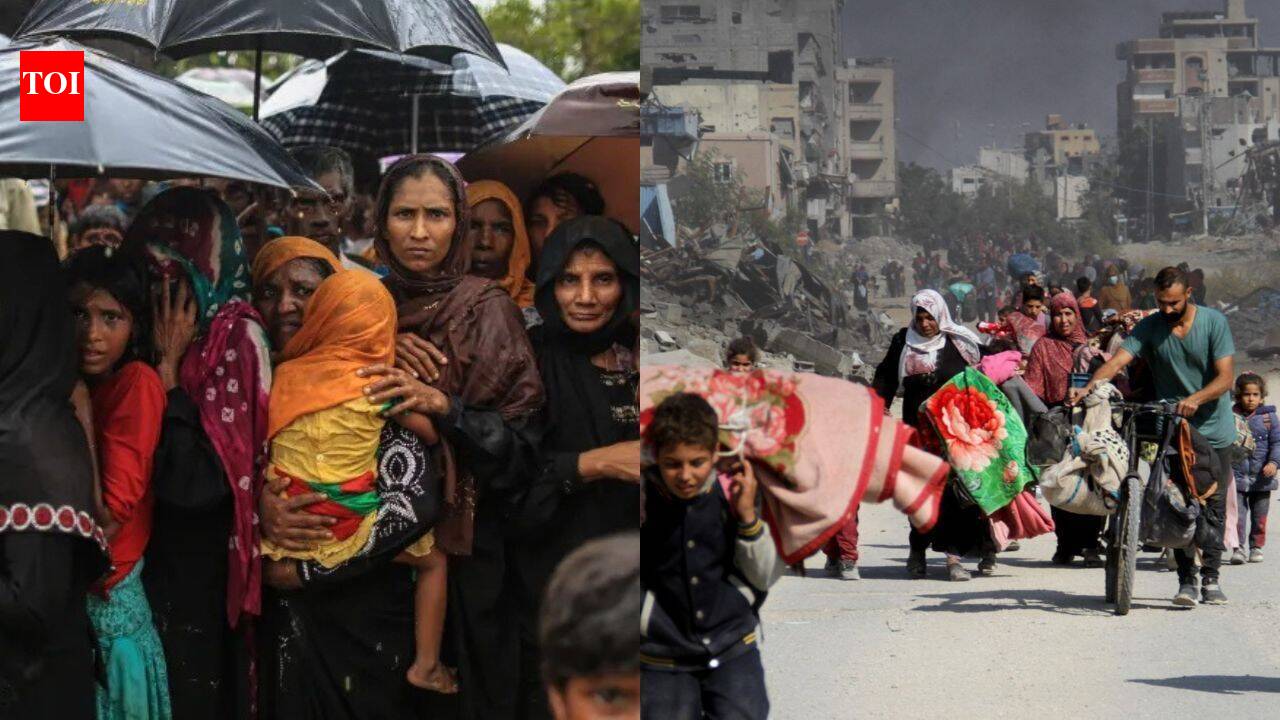
Myanmar genocide ruling raises fresh questions over Israel's case at the ICJA genocide verdict against Myanmar may have delivered a historic moment for the Rohingya, but its biggest shockwaves could be felt far beyond the country's borders.The International Court of Justice's (ICJ) decision holding Myanmar responsible for genocide has opened a legal Pandora's box, putting Israel's ongoing genocide case over Gaza under renewed scrutiny and exposing a growing divide among the world's major powers over the authority of international courts.While Europe has rallied behind the verdict, United States has struck a cautious note, raising questions over the court's interpretation of international law.The ICJ on Thursday found Myanmar responsible for committing genocide against its Rohingya Muslim minority during the military crackdown in Rakhine state in 2017. The verdict, delivered in a case brought by The Gambia in 2019, marks the first time the UN's highest court has held a state responsible for genocide, making it a landmark moment in international law.The ruling has triggered sharply contrasting reactions, with the United States adopting a cautious position while the European Union has thrown its weight behind the court.A US state department spokesperson said Washington was examining the judgment, stressing that the proper interpretation of the Genocide Convention was of paramount importance and that the ICJ should not be politicised.Washington also reiterated its support for Myanmar's people and expressed "grave concerns" over continuing human rights abuses against Rohingya Muslims and other minority groups. The state department highlighted the US role as the largest single humanitarian donor to the Rohingya crisis response.The European Union, in contrast, described the verdict as a landmark judgment and called on Myanmar to implement it without delay. An EU spokesperson said compliance with ICJ decisions was "not optional" but an obligation under international law, reaffirming the bloc's support for the court's role in upholding the international legal order.Myanmar, however, rejected the ruling, with its military-backed government questioning the verdict's legitimacy. Presidential spokesperson Khaing Khaing Soe described the decision as "unfair", pointing to the 9-6 split among the 15 judges."When we look at the result, not all 15 judges agreed with the decision. So this was not a unanimous decision … I would say it is not fair," she told reporters at a press conference in Naypyidaw on Friday.Myanmar's military rulers have consistently denied committing genocide, maintaining that the 2016-17 operations in Rakhine state were counter-terrorism operations targeting the Arakan Rohingya Salvation Army (ARSA), which had carried out insurgent attacks. The ICJ, however, rejected Myanmar's argument that the military campaign was primarily a counter-terrorism operation.Russia's position came into focus after Myanmar invoked a joint declaration issued by US President Donald Trump, Russian President Vladimir Putin and Chinese President Xi Jinping following their November 19 meeting.The declaration stated that the International Criminal Court (ICC) and similar bodies "must not abuse their jurisdiction", emphasising respect for state sovereignty and immunity for state officials.Myanmar's presidential spokesperson Khaing Khaing Soe cited the declaration while questioning the authority of international judicial institutions following the ICJ verdict. However, Moscow has not issued a separate statement on the Myanmar judgment.China, meanwhile, directly raised concerns over the ICJ's approach. Foreign ministry spokesperson Guo Jiakun said Beijing was concerned about "jurisdictional overreach and expanded interpretation", arguing that such practices were not conducive to resolving disputes.He called on the international community to work together to avoid complicating the issue, while reiterating China's support for dialogue and efforts to facilitate the repatriation of displaced Rohingya from Rakhine state.Israel in the crosshairsThe legal Pandora's box opened by the Myanmar verdict could have its biggest implications for Israel. The ICJ is already hearing a genocide case brought by South Africa against Israel over its military offensive in Gaza, and the historic finding against Myanmar could now add another layer to the legal battle.Israel has strongly rejected the allegations, maintaining that its military campaign is aimed at Hamas and not the Palestinian population.The significance lies in how the court examined Myanmar's defence. The military rulers in Naypyidaw had argued that their operations in Rakhine state were aimed at countering insurgents. The ICJ, however, assessed the wider pattern of military conduct and the evidence of killings, sexual violence and destruction of Rohingya villages to determine whether genocidal intent could be established.This reasoning could become relevant when the court examines Israel's arguments that its operations in Gaza are driven by security objectives.The ruling has also put Washington in a politically uncomfortable position. The US has backed Israel throughout the Gaza war and has repeatedly criticised international legal proceedings against its ally.Its cautious response to the Myanmar verdict, particularly its warning against politicisation of the ICJ, raises a larger question about how it would react if the same court eventually reaches an adverse finding against Israel.However, the Myanmar judgment does not automatically decide Israel's case. South Africa's proceedings remain pending, and the court will have to independently assess the evidence against Israel.The bigger question is whether the legal principles applied to Myanmar will carry the same weight when the country facing allegations is a close ally of the world's most powerful nation.
Myanmar genocide verdict divides world, opens Pandora's box for Israel
Full Article
Original Source
Read the full article at Timesofindia →KhanList aggregates and links to publicly available news content. We do not host full articles from third-party sources. Always verify important information with original sources.