
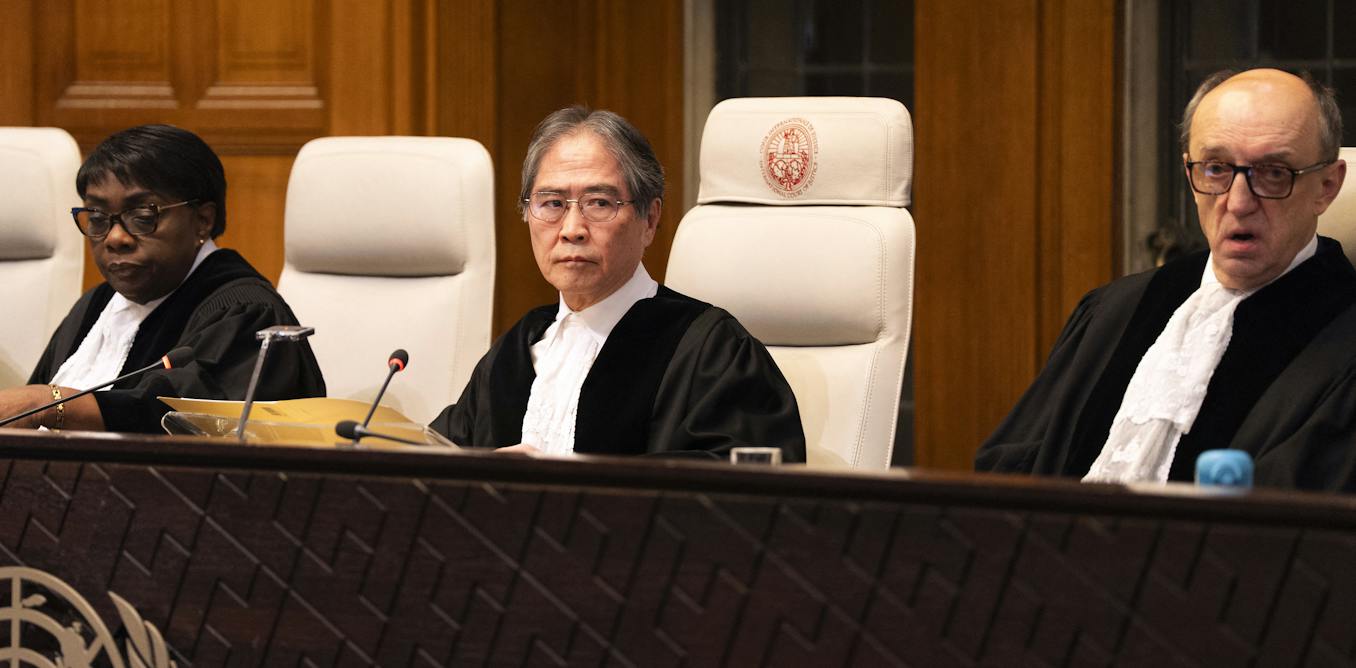
The International Court of Justice’s historic ruling of genocide against Myanmar on Nov. 19, 2026, will have significant consequences for the parties involved in the case – and potentially some who are not. The Hague’s highly anticipated judgment in Gambia v. Myanmar is a major victory for Gambia, the tiny west African nation that filed a complaint with the court against Myanmar in 2019. It is also a major moment of accountability for the military leadership of Myanmar. But as an expert in genocide and mass atrocity prevention, I believe the ruling goes far beyond these nations. Indeed, it is also a watershed moment for international legal justice that is bound to have important effects on the court’s other ongoing genocide cases, particularly the case of South Africa v. Israel. Rohingya refugees watch the International Court of Justice ruling on a screen at a camp in Bangladesh’s Cox’s Bazar on Nov. 19, 2026. Salahuddin Ahmed/AFP via Getty Images What the court ruled Gambia’s case focused on actions that Myanmar’s military government called “clearance operations” in the course of its decades-long violent persecution of the country’s Muslim Rohingya minority. The Tatmadaw, as the Myanmar military is known, justified these actions as a counterinsurgency operation. Yet in the course of those attacks, soldiers were found to have destroyed hundreds of Rohingya villages, and to have committed widespread rapes, torture and summary killings. While the precise death toll of the 2017 attacks may never be known, at least 10,000 Rohingya civilians are thought to have died, and roughly 750,000 Rohingya fled to neighboring Bangladesh. There they joined other Rohingya in what is now the world’s largest refugee camp of over 1.2 million people, comprised of those who had already fled years of the Myanmar government’s persecution and attacks. The court’s ruling that the Tatmadaw’s attacks amounted to genocide rested on its interpretation of the crime of genocide in the 1948 U.N. Genocide Convention, the first major international treaty approved by the United Nations General Assembly. For an attack to be genocidal, it must be directed against an ethnic, religious, racial or national group, and must include at least one of five prohibited acts: killing members of a group; inflicting serious physical or mental harm on members; deliberately inflicting conditions calculated to bring about its destruction; imposing measures intended to prevent births; or forcibly transferring children from the group. Beyond these factual requirements, genocide requires that the perpetrator specifically intended these acts to destroy the group, in whole or in part. In its ruling, the court agreed that the facts of Myanmar’s attacks met the legal definition of genocide. For the notoriously difficult and demanding requirement for proving the “special intent” to destroy a group, the court determined that the pattern, selective targeting and lethality of the attacks on Rohingya villages could not plausibly be explained as a counterinsurgency operation. Instead, the only reasonable inference that could be drawn from the military’s actions, the court determined, was the specific intent to destroy the Rohingya ethnic minority. A series of historic firsts The court’s decision is unprecedented in many important respects. In an influential previous ruling on violations of the Genocide Convention, in Bosnia and Herzegovina v. Serbia and Montenegro in 2007, the court found only that Serbia had not met its legal duty to prevent genocide by failing to use its influence to restrain the Bosnian Serb army in the Srebrenica massacre of 1995. In the Myanmar ruling, by contrast, the court ruled for the first time that a country is legally responsible for committing genocide – not merely failing to prevent it. Further, the court ruled for the first time that a country that has committed genocide also has multiple obligations toward the victim group. Those include designing and implementing a comprehensive program of reparations and compensation for victims; creating conditions where Rohingya can make a safe, voluntary and dignified return to their homes; and restoration of their citizenship status after national legislation from 1982 rendered them stateless. Rohingya Refugees cross a river at Tambru, a no-man’s land on the Bangladesh-Myanmar border. Majority World/Universal Images Group via Getty Images Finally, the court also demanded that Myanmar take steps to investigate all those involved in the genocide to determine individual criminal responsibility. Since the International Court of Justice is not a criminal court and only hears cases between states, this order explicitly connects the ruling to other courts where individual perpetrators can be held accountable. These include the International Criminal Court – which had already requested an arrest warrant for Tatmadaw leader Min Aung Hlaing – as well as national courts that may pursue prosecution according to the doctrine of universal jurisdiction. The ruling’s broader implications The court’s ruling in Gambia vs. Myanmar is also likely to have huge ramifications far beyond the case itself. In filing its complaint, Gambia appealed to an innovative argument to establish that it had legal standing. It argued for what’s known as “erga omnes partes,” roughly translated as “toward all parties to a treaty.” According to this line of reasoning, the Genocide Convention imposes such strong legal duties to prevent and punish the crime of genocide that any state, even one that has not in any way been directly harmed, has the standing – in fact, the obligation – to seek legal remedies. In accepting Gambia’s “erga omnes partes” approach, the court opened a pathway for other cases centering on violations of the Genocide Convention. Of these, the most significant by far is the ongoing case of South Africa v. Israel, which charges the Israeli government and the Israeli military of committing genocide against Palestinian civilians in the Gaza Strip. Going forward, other nations would now also have a legal tool for holding perpetrator states accountable for committing the most serious international crimes. The International Court of Justice has no enforcement arm. As such, the Myanmar government cannot be compelled to abide by its rulings, whether to cease any further attacks or persecution on the Rohingya, make efforts to repatriate them or design a comprehensive reparation and compensation plan. But even if Myanmar chooses to ignore the court’s specific orders, the ruling is a major defeat. The reputational damage of being the first country found guilty of state-sponsored genocide is likely to be considerable. Further, the ruling will support claims that other nations have a duty not to assist Myanmar in any way that might support or enable further attacks on Rohingya. While that doesn’t automatically mean other countries will fulfill their duties under international law, many are nonetheless likely to use the ruling to bolster multilateral efforts to impose political, economic and social costs on the Tatmadaw. That could include targeted economic sanctions, financial restrictions, prohibitions on arms sales and other forms of cooperation with Myanmar’s government. The ruling thus comes with a potentially hefty price tag for the military junta. Given the general weakening of international legal institutions over the past 20 years, a dysfunctional U.N. Security Council and an International Criminal Court under siege by the Trump administration, the court’s ruling is a rare victory for international justice and opens new routes for international genocide prevention and accountability efforts. Rohingya refugees watch the International Court of Justice at a camp in Bangladesh’s Cox’s Bazar on Nov. 19, 2026. Salahuddin Ahmed/AFP via Getty Images Before all else, though, it is also a victory for the Rohingya – a people who have suffered decades of persecution. Thousands gathered in their Bangladeshi refugee camps to watch and cheer as the court’s president, Judge Iwasawa Yuji, read the court’s judgment. Camp inhabitants held aloft signs and chanted a simple message as the verdict came down: “Thank you Gambia.”
Myanmar genocide ruling is a watershed moment in international justice – with huge ramifications for other cases
Full Article
Original Source
Read the full article at Theconversation →KhanList aggregates and links to publicly available news content. We do not host full articles from third-party sources. Always verify important information with original sources.