
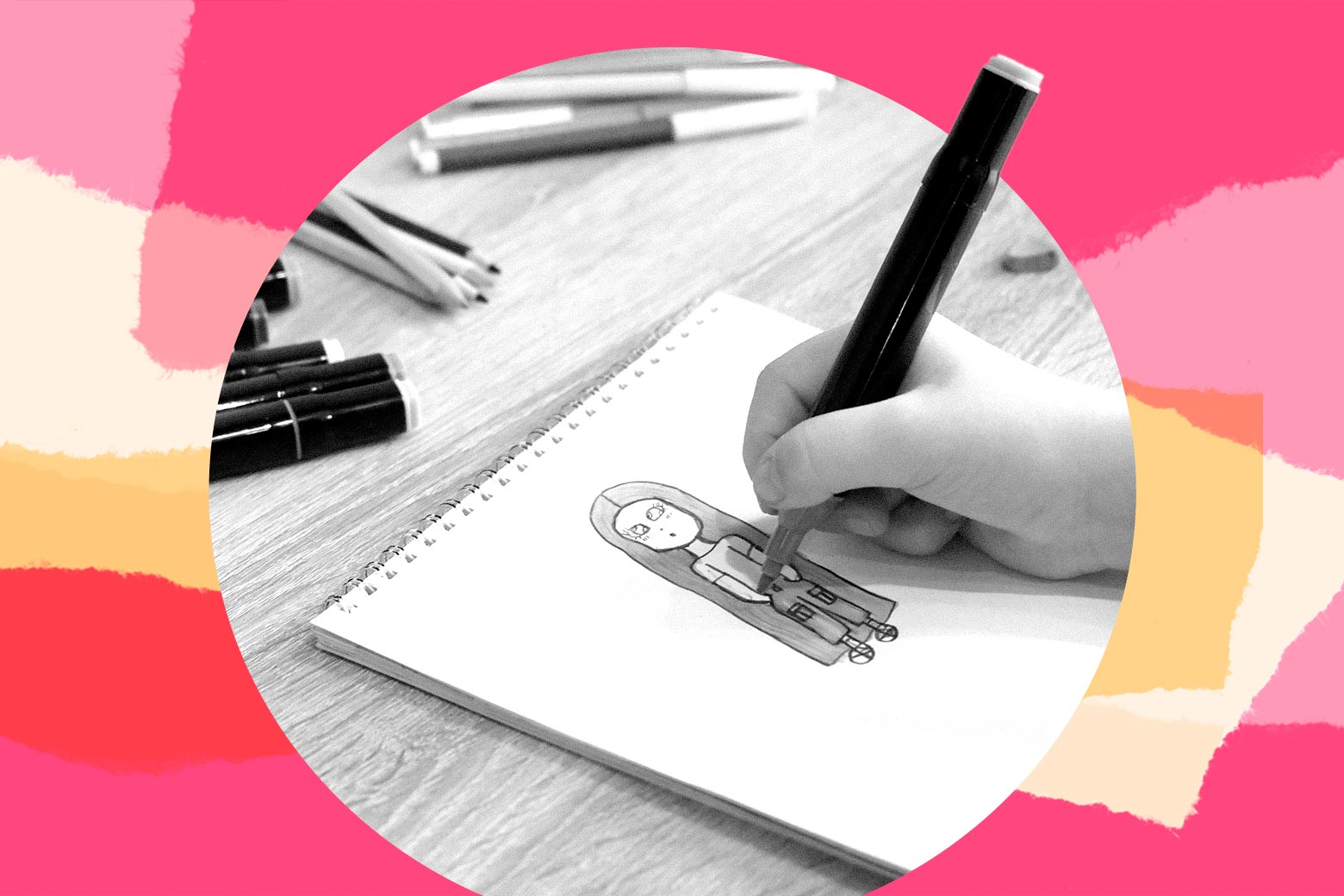
Care and Feeding Photo illustration by Slate. Photo by Elena Kurkutova/Getty Images Plus. Sign up for the Slatest to get the most insightful analysis, criticism, and advice out there, delivered to your inbox daily. Care and Feeding is Slate’s parenting advice column. Have a question for Care and Feeding? Submit it here. Dear Care and Feeding, I am a 68-year-old woman with a close relationship with my granddaughters, “Anisa” and “Karina.” With the start of the school year, I’m now watching them twice a week after school, when my daughter, “Melissa,” has to work late. Anisa (age 8) recently showed me a book she wrote and illustrated herself. It’s written in crayon on standard printer paper (and very cute). I told her how much I liked it. Then she begged me not to tell her mother about it. I asked her why and didn’t get a real answer—but what I’ve gathered, based on some of her vague responses (and I admit this is just my intuition and may not be true), is that it might have something to do with the portrayal of the main character, who is clearly meant to be Anisa herself: She has the same hair color and length that Anisa does, what she’s wearing is an approximation of one of Anisa’s favorite dresses, and the text mentions similar interests. Even the character’s name is similar to Anisa’s. In the story, the girl goes on an adventure to a faraway land and meets a princess. I’m a bit concerned about this. When Karina (who is now 6) was born, Anisa and Karina’s dad abandoned them. This was just before the pandemic, so it was a very stressful time for Melissa. During lockdown in 2020, Melissa confided in me that she was having trouble not taking some of her resentment out on Anisa, who, in appearance, very much takes after her father. But Melissa started seeing a therapist and, within a few months, told me that she no longer felt that way. And she has made a lot of progress where her ex-husband is concerned (it used to be difficult for her to even hear his name, but now she can talk about that era of her life quite easily). She has told me that she no longer thinks about her husband when she looks at Anisa, and from my outside perspective, she seems to love both her kids equally. However, as time passes, Anisa has only gotten to look more and more like her father and has begun to gravitate toward activities and hobbies (soccer, for instance) that her father particularly enjoyed. So I’m still keeping an eye on Anisa and Melissa’s relationship—I can’t help but be wary. I don’t know if that backstory is necessary for you to know. The bottom line is that I’m just not sure where the boundary lies here. Do I tell Melissa about the book Anisa wrote, or honor Anisa’s wishes and not tell her? Should I try to find out more about why Anisa doesn’t want me to tell Melissa about her book? Can I do this without prying too much? —Should I Keep A Secret from My Daughter? Dear Should I, I can understand your unease about Anisa’s insistence that you keep the existence of her book a secret from her mother. You absolutely should not set a precedent for secrets between the two of you that are kept from her mom. That’s a shortcut to a damaged relationship with your daughter (or worse). I do wonder if there was something about the book itself that alarmed you. Are you afraid Anisa is signaling that she means to run away “to a faraway land”? This seems unlikely to me. Children often place themselves at the center of a made-up story (so do adults, by the way). Was there something else in the contents of Anisa’s (seemingly delightful, charming) “book” that concerned you? Are you worried about her fantasy of meeting a princess? Or perhaps you’re not worried about the contents of the book, but only that she wants to keep it hidden from her mother. So I’m going to focus on Anisa’s desire to keep her book a secret. And that’s where the backstory proves helpful. If Anisa still feels on uncertain footing with her mom, despite things between them being so much better now, she may fear her mother’s response to the book she wrote, worried that she’ll be mean, dismissive, or just unenthusiastic. She may be protecting herself in a way that makes complete sense to her. (Children who are mistreated when they are quite young do not just get over it. Many adults suffer decades later from mistreatment that occurred even before they were old enough to consciously remember it!) The route I’d take with your granddaughter would be to ask her, very gently, what she imagines might happen if her mother knew about the story she wrote and illustrated and is so proud of. If she can’t or won’t answer this, I’d take that line of questioning further: “Are you afraid she won’t like it?” or maybe, “Are you worried about what she might say about it?” If Anisa is adamant about not answering—and she very well may be (she might not know the answer. Her fear might be inchoate, based on a feeling that is tied to things she can barely remember, or isn’t consciously aware of), I think it’s OK to say, “I won’t tell Mom about your book if you don’t want me to”—because your relationship with Anisa also needs nurturing and protecting—“and if there are other things you want or need to tell me but don’t want me to tell anyone else, I’ll respect that.” Please add this, though: “But I don’t want to make a habit of you and me having secrets from your mom, sweetheart. Because, you know, your mom isn’t just your and Karina’s mom—she’s also my daughter, and I do my best to always be honest with her. That’s the thing about mothers and daughters: They have to be able to trust each other.” This may have the added benefit of opening up a further conversation with Anisa—if not immediately, then later, after she’s had the chance to turn it over in her mind—in which she expresses more of what she’s feeling and thinking about her mom. Perhaps you’ll learn something that will help you navigate this intergenerational set of relationships going forward. Please keep questions short (<150 words), and don‘t submit the same question to multiple columns. We are unable to edit or remove questions after publication. Use pseudonyms to maintain anonymity. Your submission may be used in other Slate advice columns and may be edited for publication. Dear Care and Feeding, I have a 15-year-old daughter, “Nora.” She has very beautiful and long hair, which during puberty turned from vaguely wavy to very thick and curly. Around four years ago, she wanted to cut her hair in a bob, which I obliged. I took her to a salon that assured me that they specialized in curly cuts. However, the stylist bluntly cut across Nora’s wet hair, then straightened her hair (which was a shock to us; Nora had never used heat tools). When straightened, the bob looked sleek and amazing, but as soon as Nora washed her hair, it looked awful. And we are not a heat-tool family—not to mention that she had liked having curly hair. She lived with the bad haircut; it eventually grew out. While it was short, she frequently complained that it wasn’t long enough for a French braid, and that it didn’t look good curly. Now that it’s long again, I have been purchasing expensive, fragrance-free curl care products, and she has been receiving dry curl-specific trims from her grandmother, who is an amateur but does a good job. I don’t have curly hair, but I love the way Nora looks with her natural curls. The problem is that Nora now wants to cut her hair again! Even though after the horrible salon experience, she begged me never to let her cut her hair again. She insisted she wanted to keep it super long once it grew back. I don’t know what to do. (There is one organic hair salon in our area, but it doesn’t specialize in curls.) Obviously, I want to support my daughter, but her hair has fully recovered from the bad cut, and it looks so nice. What should I do? —Tangled Dear Tangled, It’s her hair, and she’s a teenager, not a child. What she told you when she was a child is not binding. Though feel free, if you haven’t yet, to remind her of the promise she extracted from you, and tell her how uneasy it makes you to break that promise. Let her give you permission to break it and let you off the hook. But as a person with curly hair myself, who has been the recipient of both excellent and terrible haircuts, I sympathize with your plight around salons. (Also with the cost of fragrance-free hair products for curly hair!) It’s worth traveling for it if there’s not a salon in your area that specifically designates itself as trained and expert in cutting curly hair, which is indeed an art. (Both my curly-haired daughter and I have to travel to get our hair cut!) If there’s nothing in reasonable driving distance, tell Nora that her only options are to take a chance at getting another bad haircut (I’m sure you’ve already reminded her how much she hated the last one) or let Grandma the amateur stylist take a whack at it (at least she knows that curls must be dry-cut!). Ever Gotten a Call From Human Resources? Laura Helmuth and Doree Shafrir want to hear about it—and help you navigate your problems at work. Does your colleague constantly bug you after hours? Has an ill-advised work romance gone awry? Ask us your question here! Dear Care and Feeding, My dad’s idea of humor with kids is to physically tease and roughhouse with them. He’ll try to sneak in a poke or a tickle, reach a hand around to tweak their ear, walk his hand across the table to steal fries off their plate—stuff like that. He’ll do the big scary monster face and lumber around trying to catch them. He’ll pick the little ones up suddenly and threaten something silly, like to body-slam them or drop them in the toilet. My 6-year-old daughter, “Jane,” does not find any of this funny AT ALL. She’s never been a kid who likes to wrestle or be chased, and she isn’t ticklish. The result is that she’s started avoiding her grandfather. She won’t sit next to him at the table or on the couch. We’re at the point where she won’t even talk to him. When he approaches, she shouts things like, “Don’t touch me!” or “Leave me alone!” Today she simply left the room when he came in. My mother and I have both told my father to lay off the teasing, telling him that Jane doesn’t think it’s funny and that it’s really bothering her, but he just doubles down (even though I can tell that it bothers him that she’s avoiding him). At most, he’ll say, “I’m just playing, all right?” while trying to poke her or pick her up. We’ve all suggested to Dad that he just talk to her instead of being physical, because Jane likes jokes and funny stories, but he hasn’t listened. It’s like he doesn’t know how else to be around little kids. He was exactly the same when I was Jane’s age. He did stop roughhousing with my older children as they got bigger, but I don’t think it’s fair for Jane to have to put up with this for years to come. I want them to have a good relationship. What can I do? —Adult Daughter of A Tickle Monster Dear Adult, Good for Jane! There aren’t many 6-year-olds (there aren’t nearly as many anything-year-olds as I wish there were) who can so unequivocally stand up for themselves. I completely understand your desire that your dad and your daughter have a good relationship. He is making that impossible. That you might’ve welcomed his “teasing” in your childhood (you don’t say), that your older children endured it too, does not make what he’s doing now—ignoring your daughter’s refusals and crossing her boundaries—OK. Jane needs and deserves you to back her up. Talking to him about his behavior has gotten you (and your mother) nowhere, so stop talking and take action. Stop bringing Jane around. Tell him calmly why you’re doing this. The responsibility for his having a “good relationship” with his youngest granddaughter is his. His behavior has to change. Tell him that. If he won’t or can’t change his behavior, you’re going to have to find a way to live with his not having any relationship at all with your youngest. Your priority needs to be that she feels safe, that she can trust you to protect her (no matter who it is she needs to be protected from), and that she should be proud—not in the least ashamed—of making her feelings known, speaking up, and setting boundaries. Your own relationship with your father may take a hit—and, for all I know, your older children, who may have hated their grandfather’s “teasing” just as much as Jane does, but did not feel empowered to speak up as she has, may be resentful that you didn’t step in for them. You may have to tell them, “I wish I had. I didn’t realize how hard it was on you. It took Jane saying so for me to see it. I’m sorry.” As to your dad: It’s about time someone stood up to him. Maybe this will wake him up. —Michelle More Advice From Slate For the first time in my 10 years of being a parent, I am really struggling—for real. My husband and I have one son, Evan, and we both have excellent relationships with him, but I have reached a roadblock I am not sure how to get around. Without knowing us, you would never put my husband and me together—he is a jock, super social, loves and plays sports, a real “guys’ guy.” I am an introvert and artist and have never played or watched a sport in my life. But he’s my best friend, and we just get each other; I wouldn’t trade my relationship with him for anything. Our son is just like him, and I couldn’t be prouder. But I struggle. Advice Family Kids Parenting
My Young Granddaughter Wrote a Cute, Harmless “Book.” Then She Said Something That Concerned Me.
Full Article
Original Source
Read the full article at Slate →KhanList aggregates and links to publicly available news content. We do not host full articles from third-party sources. Always verify important information with original sources.