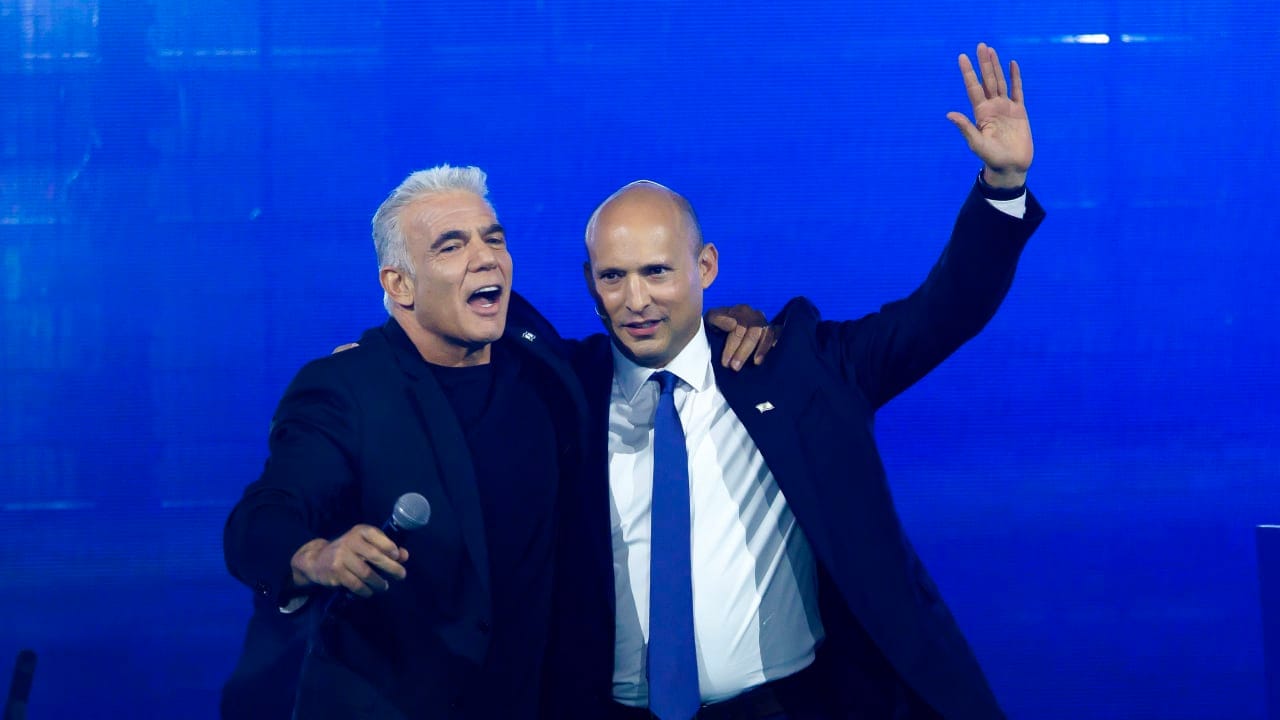
ByLIAT COLLINSJULY 24, 2026 12:43I have a confession to make. I am terrible with names. I might remember that someone has a biblical name, but whether it’s Rachel or Rebecca escapes me, and Shlomo and Shmuel are at similar risk of being switched.Lately a new difficulty has emerged. Party names. Just as I had politicians’ names almost under control, they began switching lists, and the parties themselves changing names with alacrity. When parties have buzzwords rather than platforms, MKs can hop between them, seeking the best opportunities in a place they can temporarily call home.And since many of the party names are generic, one-size-fits-all, it is hard to keep up even for those who don’t suffer from the niche memory lapse.As Israel gears up for the October 27 general election, I can name another challenge to keeping up: mergers.This might explain why Israelis often opt to call a party simply after its leader rather than by its official name. Hence, the focus is on “Bibi,” “Eisenkot,” “Ben-Gvir,” “Smotrich,” “Liberman,” and so on.Israeli opposition leader and former military chief, Gadi Eisenkot, reacts as he launches an election campaign for Yashar, his new political party, at an event near Hod Hasharon, Israel, June 30, 2026. (credit: REUTERS/AMIR COHEN)Take Naftali Bennett as an example. Bennett led a range of parties from Habayit Hayehudi, the New Right, and Yamina. Forgive me if I’ve forgotten any others. Ahead of this election, he registered a party imaginatively called Bennett 2026. It has since formed an alliance with Yair Lapid’s Yesh Atid to collectively become known (even more imaginatively) as Beyachad (“Together”).They make an effort to distinguish their party from Gadi Eisenkot’s “Yashar!” (Straight!), which is currently leading in many polls.What’s in a name? My free advice to Israeli political strategists: take into account how a name like “Yashar” (Straight!) translates into other languages and cultures, and avoid letters that trip off the Hebrew-speaker’s tongue but trip up foreign newscasters, like the guttural “ch” in Beyachad.Yoaz Hendel is another serial party hopper. Note, by the way, that it’s Hendel, not Handel. He entered the Knesset on the Telem list – then part of Benny Gantz’s Blue-and-White party that later morphed into the Israel Resilience Party before becoming the National Unity Party but switched back to Blue-and-White after Eisenkot deserted. (No wonder I get confused.)Hendel then founded Derech Eretz, which was aligned with Gideon Sa’ar’s New Hope (Sa’ar has since realigned with the Likud – for now.) Then Hendel ran with Zionist Spirit (part of Yamina under Ayelet Shaked after Bennett jumped ship). Last year, he formed The Reservists party (Hamiluimnikim), which has since joined with Hilli Tropper in an alliance temporarily known as Yesodot Yisrael (Foundations of Israel). Whether the party and name are solid remains to be seen.This week, Yair Golan’s Democrats party held primaries with an impressive turnout of more than 85% of the party members. It elected a list that reflects its merger of Labor and Meretz, which didn’t pass the electoral threshold four years ago. To its credit, the party has a relatively clear, left-wing agenda. It’s called “Democrats,” after all.The death of old party identitiesPoignantly, nothing remains of the Labor party of old. Mind you, that party was created from different mergers and was always rife with rivalries, including between Yitzhak Rabin and Shimon Peres. Ehud Barak renamed a Labor alliance “One Israel,” and current President Isaac Herzog led Labor/One Israel in an alliance with Tzipi Livni (who’s been through too many parties to name here) as the Zionist Union.Looking at the UK, where Labour is now led by Andy Burnham, and the direction of the US Democratic party, it is clear that many politicians are willing to make a name for themselves by blackening Israel’s name.Even Golan, at the head of the Democrats list, is not immune. (I might black out on names, but I haven’t forgotten Golan blood-libeling Israeli soldiers at the height of the Gaza War, saying: “A sane country does not kill babies as a hobby.” A sane political leader and former deputy chief of staff should know better than to shoot his mouth off, let alone with poisonous lies.)Among the Democrats’s top 10 are Omri Ronen and Moshe Radman, who were prominent in the mass protests over the government’s planned judicial reform (including calling for refusal to serve in the army, or to use the laundered name: refusing to volunteer) and later in the mass demonstrations calling for the immediate release of the hostages held by Hamas, which transitioned into anti-government protests.Radman, by the way, adopted his mother’s maiden name to become Radman Abutbul on social media, apparently in an attempt to show his Moroccan-Sephardi roots and break the Ashkenazi stereotype attached to many of the protest movement leaders.British and American Jews aren’t the only ones wondering where their longstanding political homes have gone. The uncertainty crosses the political spectrum in Israel, too. Like the demise of Labor, there has been an erosion in the political identity of what was once known as the National Religious sector – the old National Religious Party (Mafdal) was taken over and changed by Bennett; today’s Religious Zionists under Bezalel Smotrich are the same in name only.The Likud’s name roughly translates as “United,” the result of several mergers. (Its full name is Likud: A National-Liberal Movement.) Led by Benjamin Netanyahu, it is less united than its name implies (and less liberal, for that matter). Netanyahu is trying to change the way the list is drawn up to give him a greater say in who gets the leading spots, and to reduce the presence of rabble rouser MKs like Tali Gotliv, who have a following within parts of the party but who do not go down well with the general public.It’s not yet clear which (if any) Arab parties will run together on a joint list; their platforms range from Communist to Islamist. The number one issue for the Arab sector is intra-communal violence. The vast majority of homicide victims in Israel are Arab citizens murdered by other Arab citizens, often in self-perpetuating revenge killings.Then, of course, there are the haredi (ultra-Orthodox) parties. The last-minute legislation of the outgoing Knesset contains obvious efforts to keep them as partners in a future Likud-led government. This includes the Basic Law anchoring the importance of Torah studies, and a law temporarily banning the arrest and prosecution of ultra-Orthodox men evading military draft.Shas leader Arye Deri, incidentally, resumed the use of his middle name Makhlouf as a reminder of his Moroccan Jewish heritage. This week, a new party named “Haredi Public,” was announced ahead of the elections.There are so many small parties that it’s impossible to name them all. Some of them are led by very capable people with a strong record, but if they don’t pass the electoral threshold (3.25% of valid votes), their ballots will be wasted.It sometimes seems that politics has become more a ratings war than a campaign over real life-and-death issues. Following the October 7, 2023, Hamas-led invasion and mega-atrocity, and the subsequent war on multiple fronts, security and diplomacy should be high on the list of issues.And whichever party leads the government, it will have to address the need for some measure of judicial reform. If the High Court almost routinely overrules appointments and legislation not to its liking, it is not strengthening democracy but weakening it. Above all, the country needs electoral reform – but it’s almost an impossible mission.Israeli politics is about blocs – loosely named: “Only Bibi” or “Anyone but Bibi.” The prime minister is not automatically the leader of the party that gains the largest number of votes, but rather the person who can present to the president the likelihood of a stable coalition – usually a collection of parties amounting to at least 61 seats out of the 120-member Knesset.This leads to political bartering both before and after an election, and places a disproportionate amount of power in the hands of the smaller parties. And it will be extremely difficult – despite various campaign promises and name-calling – to create a majority bloc without either the Arab parties or the haredi parties.The challenge is not only to create a coalition, but to maintain it. But in Israeli politics, anything goes – you name it.Follow us on Google
My Word: Political name of the game - opinion
Full Article
Original Source
Read the full article at Jpost →KhanList aggregates and links to publicly available news content. We do not host full articles from third-party sources. Always verify important information with original sources.