
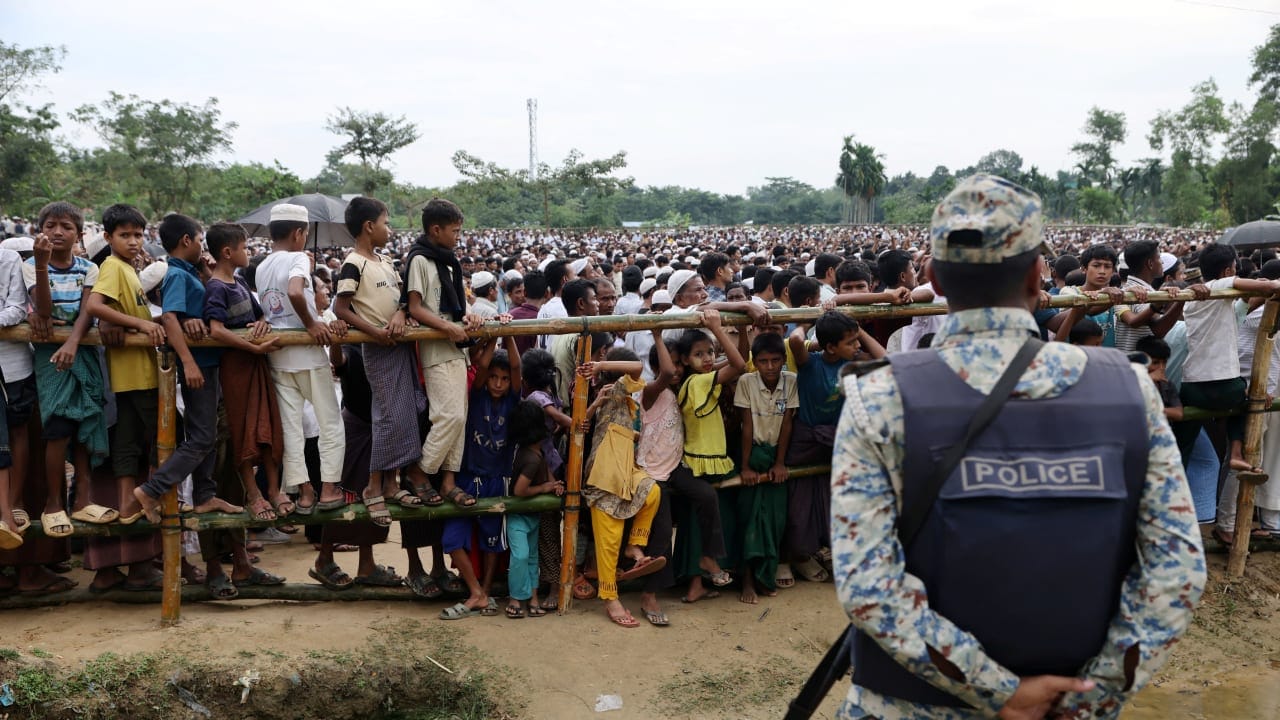
NOVEMBER 27, 2026 12:48Several years ago, I wrote a column under the title “Different peoples, different public relations” in which I took pity on minorities suffering tragedies that were not getting sufficient international attention.Writing in February 2017, I cited the poor people of West Papua, the ethnic Nepalese refugees from Bhutan, and the Rohingya Muslims being massacred in a military crackdown in Myanmar.“To be a Muslim minority persecuted by a Buddhist majority obviously causes such confusion that the average Western liberal prefers to overlook the issue altogether,” I wrote. “Demonization of Israel – the current mutation of antisemitism – and regarding Israel as the source of all evil are far safer. I doubt Myanmar Apartheid Week will be coming to a campus near you any time soon.”Well, finally the Rohingya have had their day in court – but it might not be due only to the recognition of their suffering. Perversely, it might be another way to attack Israel.In a landmark ruling last week, the International Court of Justice found Myanmar guilty of genocide. By a vote of nine to six, the judges determined that Myanmar’s military campaign against the Rohingya amounted to the deliberate destruction of a “protected group.”SCALES OF JUSTICE decorate the International Criminal Court building in The Hague, Netherlands, in 2019. (credit: PIROSCHKA VAN DE WOUW/REUTERS)To reach this verdict, the court creatively reinterpreted the 1948 Convention on the Prevention and Punishment of the Crime of Genocide (Genocide Convention). In previous cases from the early 1990s – Bosnia v. Serbia and Montenegro and Croatia v. Serbia – the classification of genocide required specific intent to “destroy, in whole or in part, a national, ethnical, racial or religious group, as such.”In the Rohingya case, the bar was lowered to skirt around the issue of intent and other factors. The result is another potential “lawfare” weapon against Israel.As The Jerusalem Post’s Yonah Jeremy Bob wrote in his excellent analysis last week, “The ICJ’s ruling on Myanmar goes far beyond the traditional focus of a genocide analysis from Article 2a of the Convention on the Prevention and Punishment of the Crime of Genocide (Genocide Convention) of 1948, which exclusively looks at how many people were intentionally massacred. Instead, the ICJ examined Article 2b, namely, causing bodily and mental harm.“Furthermore, the ICJ found that widespread destruction of housing can become evidence in a genocide case. In addition, the ICJ ruled that Myanmar’s killing of 1.2% of the Rohingya population – 10,000 out of 815,000 – is sufficient grounds for genocide. This significantly downscales the definition of genocide, given its previous applications to the Holocaust, in which six million Jews were killed, or Rwanda, where more than 800,000 people were killed.”In an illuminating article last week, highlighted by the Honest Reporting media watchdog, Andrew Tucker of The Hague Initiative for International Co-operation noted that many of the ICJ findings relied on UN and NGO material. In Israel’s case, these are often based on unsubstantiated figures provided by Hamas itself.Tucker also said the Myanmar ruling should concern NATO among others, as it “risks giving the ICJ an unwarranted power to micromanage armed conflict, including urban warfare against terrorists and other non-State armed groups...“An ICJ judgment is not only a verdict in a particular case but a template. Its propositions will be used in future cases: that genocidal intent may coexist with legitimate military objectives; that an alternative explanation must account for everything; that UN reports compiled without access can carry decisive weight; and that a State can breach the duty to prevent genocide without any finding that genocide occurred...”Incidentally, only the UN Security Council has the authority to enforce the ICJ ruling, but it would need to overcome the veto power of permanent members that include the US, Russia (which is involved in mutual claims of genocide with Ukraine), and China (whose treatment of its Muslim Uighur minority would land the People’s Republic in the ICJ dock if the world were fair).Given a timeline that already stretches to May 2029, it is too early to say how the ICJ case against Israel, initiated by South Africa, will be affected, but it seems the burden of proof has shifted, requiring Israel to prove it had no other course of action in the way it conducted itself in Gaza.I still pity the Rohingya, who suffered gang rape, execution of children, and forced displacement. They would have greater publicity if only they could point a finger at Israel.According to the United Nations High Commissioner for Refugees (UNHCR) site, “More than one million Rohingya refugees live in the largest refugee camp in the world in Cox’s Bazar, Bangladesh. They are an ethnic minority who have been denied citizenship in Myanmar, making them the world’s largest stateless population.”If you were to ask the average person on the street, or any student on any campus – let alone the keffiyeh-clad participants in protests anywhere in the global village: “Who is the world’s largest stateless population?” what are the chances that they would reply “the Rohingya” rather than “the Palestinians”?The Rohingya, like every other refugee population in the world except for the Palestinians, fall under the auspices and budget of the UNHCR. According to its site, “UNHCR protects or assists 129.4 million forcibly displaced and stateless people.” That’s nearly 130 million people, most of whom are not on the global radar.The Palestinians, on the other hand, have their own UN refugee agency, UNRWA, and have the right to pass their refugee status down through the generations. UNRWA cites a figure of some 5.9 million Palestinian refugees, a number that has risen from 700,000 in 1949 when the agency was established.The fact that after nearly eight decades the number of Palestinian refugees has multiplied more than eight-fold, rather than decreased, is particularly remarkable in the face of the ongoing claims of “genocide.”Even more absurdly, the “State of Palestine” has been recognized by some 150 UN member states, making Palestinians the only people who can simultaneously claim to have both a state and to have refugee status in it.The resources that go into perpetuating the Palestinians’ refugee status could be spent on the unfortunate Rohingya or Muslim victims of Islamists in places like Yemen, Afghanistan, Somalia, Sudan, and elsewhere in Africa.Israel went to war in Gaza following October 7, 2023, when Iranian-sponsored terrorists from Hamas, Palestinian Islamic Jihad, and other movements invaded southern Israel, murdering, raping, and mutilating victims.Among the 1,200 murdered that day were entire families shot or burned alive in their homes; 251 people – including a baby, toddlers, and octogenarians – were abducted to Gaza, from where only 168 returned alive.Hamas committed a deliberate act of genocide and won broad support from protesters chanting: “From the river to the sea, Palestine will be free.” This, it should be noted, is a genocidal call to replace Israel, not to live peacefully alongside the Jewish state.Operating from a massive network of terror tunnels built under homes, schools, mosques, and hospitals, Hamas has deliberately used its own population as human shields and then accused Israel of atrocities when, inevitably, there were civilian casualties and physical destruction.The UN has a dedicated Division for Palestinian Rights, incorporating the Committee on the Exercise of the Inalienable Rights of the Palestinian People. It is currently busy with events surrounding the annual International Day of Solidarity with the Palestinian People.This is marked on November 29, commemorating the 1947 UN Partition Resolution, which offered the Arab world Palestinian statehood that they turned down in favor of trying to eliminate the Jewish state. That is the source of the “Nakba,” “The Catastrophe.”Choosing to commemorate one side of the conflict – the side that launched the war – and on that particular date is a manipulative reframing of the narrative. It also deliberately ignores the other half of the story.Hence, on November 30, Israel commemorates the expulsion of more than 800,000 Jews from Arab and Muslim lands. These victims of ethnic cleansing are the world’s most overlooked refugees, with less recognition than even the Rohingya.For the record, Israel didn’t commit genocide in Gaza, but that doesn’t mean it’s willing to commit suicide. The 1,200 slaughtered on October 7 will never have their day in court, but they will always be silent witnesses. There must be a limit to the perversion of justice.Follow us on Google
My Word: International justice and injustice - opinion
Full Article
Original Source
Read the full article at Jpost →KhanList aggregates and links to publicly available news content. We do not host full articles from third-party sources. Always verify important information with original sources.