
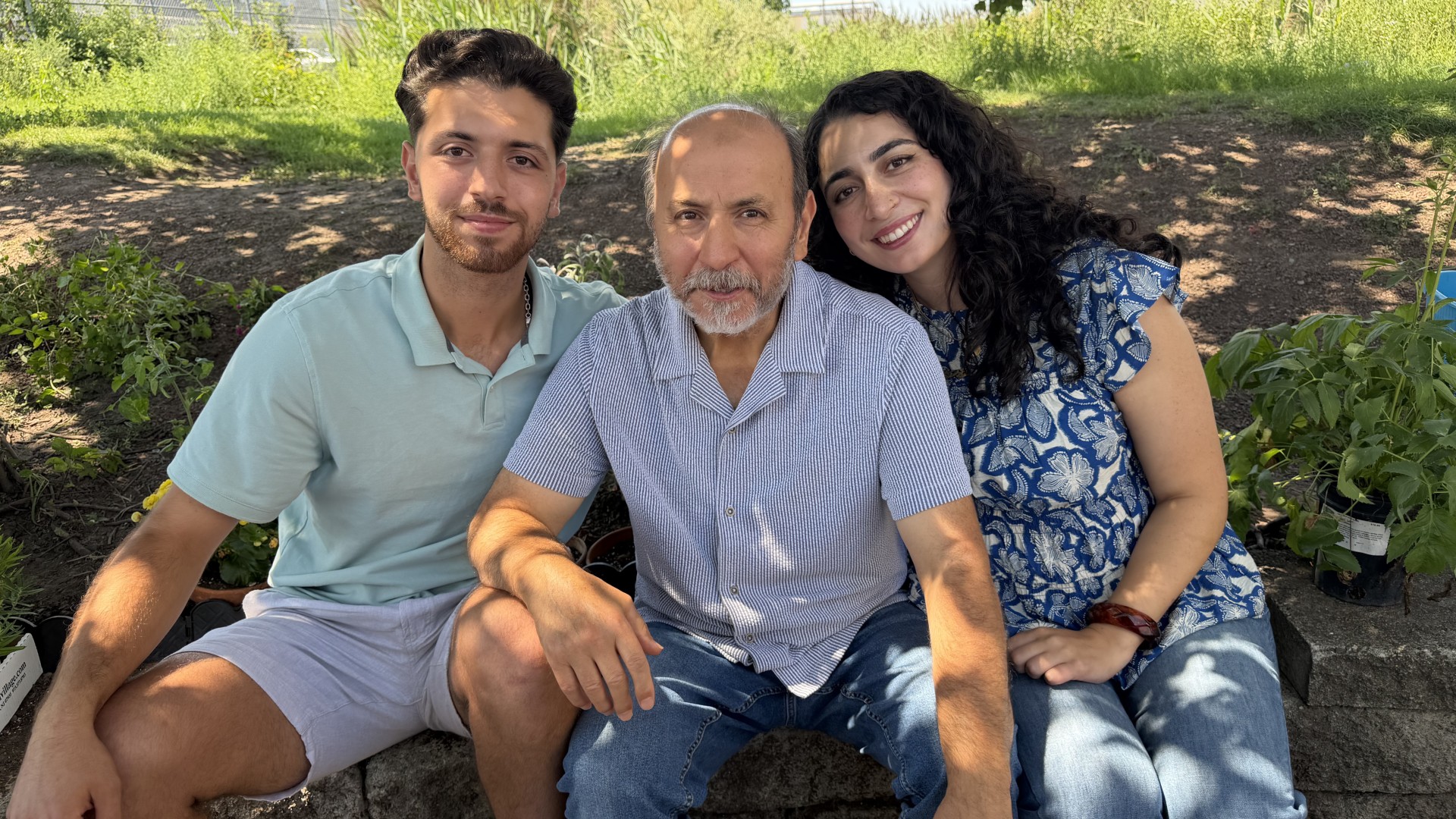
When Zena Saifo arrived at a US Immigration and Customs Enforcement (ICE) office in New Jersey with her father, she expected a routine appointment. Her father, Iemad Saifo, had received a letter telling him to present himself for a "check-in". At the time, he believed he had little reason to worry; he had been working with his lawyers on his immigration case and had been complying with the requirements placed upon him. The family knew immigrants were being detained across the United States, but they didn't expect Iemad to be taken into custody. They arrived at an ICE office in Mount Laurel at 7.30am on 31 July for his 8am appointment. They waited several hours before an officer asked Iemad if he had any medication with him. New MEE newsletter: Jerusalem Dispatch Sign up to get the latest insights and analysis on Israel-Palestine, alongside Turkey Unpacked and other MEE newsletters "That's when I kind of started to question - is he going to be detained?" Zena told Middle East Eye. Soon after, Iemad was called to the back of the office with his lawyer. A few minutes later, the lawyer returned and told the family that ICE was detaining him. Zena asked that she at least be allowed to say goodbye, but her request was denied. "I just felt like my whole world had stopped," the 27-year-old told MEE. "My heart dropped to my stomach." Iemad, a 65-year-old Syrian immigrant and father of four, would spend roughly two weeks in ICE detention before an immigration judge released him on bond on 15 August. For his family, the detention was not only a legal battle. It became a race against time to bring their father home. 'Whole world stopped' Iemad came to the US from Syria in 2002 on a B-1/B-2 joint business/tourism visa and eventually opened Zena's American Mediterranean Cuisine in Collingswood, New Jersey, along with other businesses. His wife and children have US citizenship, and his family have pursued legal avenues to obtain permanent residency for him. His immigration history, however, is complicated. According to the Department of Homeland Security (DHS), Iemad's visa expired in May 2002. An immigration judge ordered him removed in September 2010, but the case was reopened in January 2011. In February 2023, an immigration judge administratively closed his removal case. Iemad also has a criminal conviction. DHS has described him as a "criminal illegal alien" and said he was convicted of witness tampering. 'My whole world had stopped,' Zena Saifo Court records reviewed by WHYY, a public media organisation, show he pleaded guilty to the offence and was sentenced to five years' probation, 100 hours of community service, a fine and restitution. DHS has also referred to previous arrests for theft by deception and identity impersonation. Zena has rejected the characterisation of her father and described him as "a pillar of our family and our community". She said that since he moved to the US, he has sought legal pathways to citizenship. "Our family should not be torn apart because of a nearly decade-old single non-violent offence - my father did what was asked of him and since then has focused on his family, his restaurant and his community." Iemad has also disputed the way the government has described his immigration status. In an interview after his release, he said he had been pursuing permanent residency through his US citizen family and was waiting for an interview. "I am pending, I am compliant, and I'm waiting for my interview," he said. His lawyer, Fiona Powell, said Iemad was eligible to seek bond because of the circumstances of his immigration case and his history in the US. During his detention, more than 150 people, including family members and community supporters, wrote and notarised letters vouching for Iemad's character and urging the judge to release him. His lawyers and family also gathered thousands of petition signatures and letters of support from local elected officials and community organisations. Powell said the community support was significant during the bond hearing, with the judge citing Iemad's strong community ties in deciding to release him. 'There was no humanity' While he was detained, Iemad said he was handcuffed at his wrists and ankles and had his hands chained to his waist. "We [the detainees in transport] waited about 30 hours," he said. "A human line, but a person doesn't feel like a human. There was no humanity in the treatment." He said he went roughly two days without sleep while detainees were packed into rooms where illnesses quickly spread. Homeland Security: Two decades of terrorising people of colour Read More » Iemad also said he had difficulty obtaining some of the medication he takes regularly, after one portion of his medication was not entered into the detention centre's computer system. "I asked to see the doctor," he said. "They told me I would see him soon, but those were empty words." He said that by the time he was released, he was exhausted and felt physically weak. Zena said her father lost roughly 15 pounds (6.8kg) during his detention, and that a pre-existing voice condition worsened after he missed medication and experienced poor living conditions. After he returned home, she said, he spent several days mostly sleeping and recovering. For Zena, some of the most difficult moments came while her father was still detained and she had little idea what was happening to him. Over the phone, she would ask whether he was getting his medication and food. He reassured her that he was doing okay. Zena contacted friends and community members and reached out to people who had previously helped families facing immigration detention. His lawyers told the family that demonstrating community support could help at his bond hearing. Along with Zena, they organised a letter-writing event where people could write and notarise letters supporting Iemad. For Zena, the response showed her that her family was not fighting alone. "I don't think we expected to get over 150 letters of support," she said. "It was really amazing to see." A wider ICE crackdown Iemad's detention came as ICE has expanded its enforcement activity across the US. ICE arrested 49,571 people in July, according to government data provided to the Deportation Data Project at the University of California Berkeley. It was the highest monthly total of the second Trump administration, up 15 percent from June - and 70 percent from February. 'I don't think we expected to get over 150 letters to support. It was really amazing to see' - Zena Saifo The increase has also been accompanied by a growing number of arrests away from highly visible immigration raids, including arrests at workplaces, traffic stops and immigration appointments. The result has been a growing sense of uncertainty among immigrants who might previously have regarded routine interactions with immigration authorities as relatively low-risk. In July, more than half of those arrested had no criminal convictions or charges, according to the data. The Trump administration and DHS have defended the crackdown as necessary to enforce US immigration law and have repeatedly said the agency was prioritising people with criminal records. ICE defended Iemad's detention by pointing to his lack of permanent immigration status and his witness-tampering conviction. "Under President Trump and Secretary Mullin, ICE is targeting the worst of the worst," a DHS spokesperson said in a statement about Iemad. "Nearly 70 percent of ICE arrests are of illegal aliens charged or convicted of a crime in the US." 'The fear doesn't just go away' Iemad's release, however, has not erased the fear that he could be detained again. His immigration case is still pending, and Zena said she remains worried about what could happen to her father and other immigrants facing the same system. "The anxiety, the fear, the immense stress experienced the past two weeks, it's not just something that goes away," she said. Now that Iemad is home, Zena said the family is grateful to the people who helped them through the ordeal. But the experience has also changed how she sees the wider community around her. Her father's detention, she said, showed that the consequences of an immigration crackdown can extend far beyond the person taken into custody, affecting families, friends and communities who are left to navigate the uncertainty with them. "It really just shows we have a responsibility to the communities around us," she said. "We were able to ensure that we're standing up for others and that we don't let any harm go without being addressed."
'My whole world stopped': How a routine ICE check-in upended a Syrian-American family
Full Article
Original Source
Read the full article at Middleeasteye →KhanList aggregates and links to publicly available news content. We do not host full articles from third-party sources. Always verify important information with original sources.