
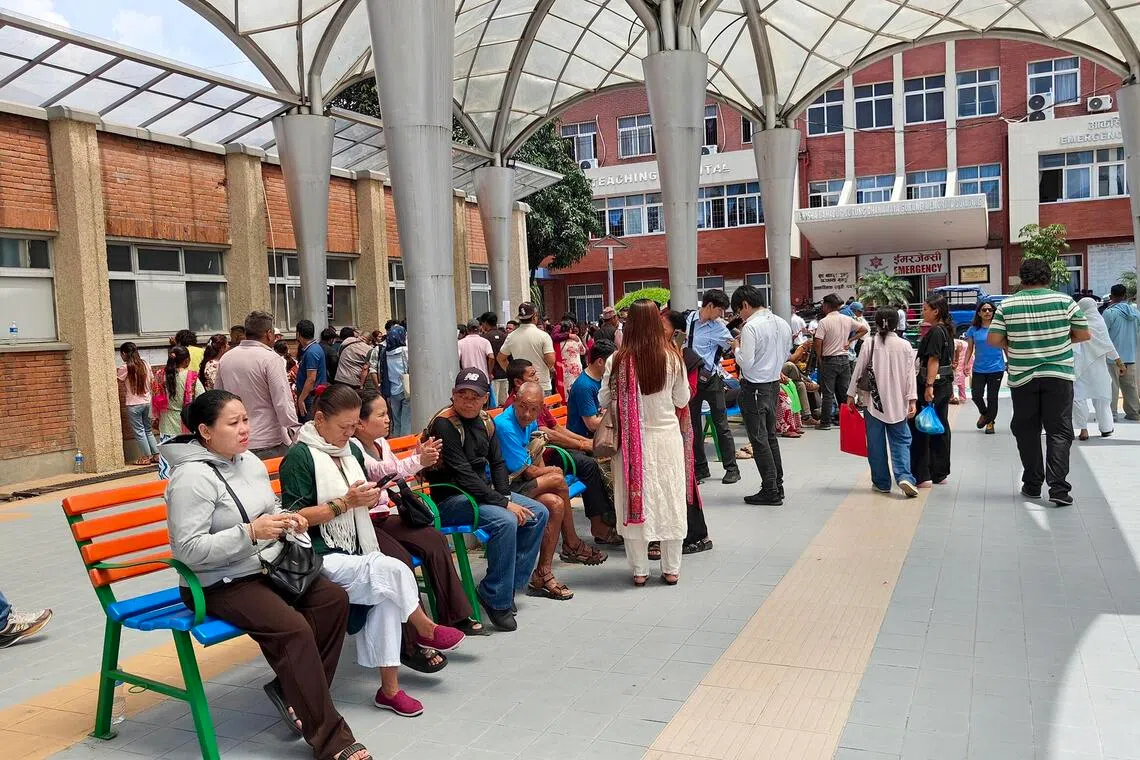
A gory exhibit has come up in Nepal’s capital city over the last two days. Several photographs of mangled corpses have been put up for identification on one of the gates of the Tribhuvan University Teaching Hospital (TUTH) in Kathmandu.It is a macabre sight that has come to haunt the Himalayan city since the devastating flash flood in the country’s border region on August 26. The death toll from Wednesday’s flood in northern Nepal has crossed 500, while hundreds still remain missing even as search and rescue teams comb through Bhotekoshi river system and its downstream areas for survivors and bodies.Outside the TUTH gate, families and friends of those reported missing gathered on the road desperate for any news on the whereabouts of their loved ones. Scanning the photos carefully on the gate was 36-year-old Dolma Tamang. She was looking for any news of her sister and her husband, who have been untraceable since the morning on August 26.When she last spoke with them on the phone, the two were passing through Rasuwa district on their truck to ferry goods from the Chinese border. Both their phones remain uncontactable now, forcing Tamang to run from one hospital to another in Kathmandu for the past three days, looking for any clue about the couple’s whereabouts. “It has been very difficult, my tears have run dry,” she told The Straits Times.Nepal’s security agencies have been rescuing hundreds, finding them caught under debris, inside tunnels and under broken buildings. Names of those rescued are being updated on a government website. On August 28 morning, rescue efforts took a brief pause sparked by fears that a barrier lake breach could unleash another flash flood. But by the evening, rescues had resumed and officials said there was no immediate danger, but the situation remains unclear.The fate of nine Singaporeans reported missing because of the flood has yet to be ascertained. In a public update on August 28, the Nepal Tourism Board said 121 foreign tourists had been rescued, including 85 Indians and 16 Chinese nationals. Three days on, the full extent of the tragedy has yet to unfold. At TUTH, one of the city’s two major public hospitals where the dead as well as injured are being brought, the list of those missing keeps growing. The number on August 28 afternoon just at this hospital stood at around 1,500. Hundreds of family members have been scouring Kathmandu’s hospitals with photos of their loved ones on their phones and even printed on paper, hoping to find them here. A section of a wall at TUTH has been taken up entirely by posters of those missing. A wall with posters of those missing at Kathmandu's Tribhuvan University Teaching Hospital on Aug 28. ST PHOTO: DEBARSHI DASGUPTAAs anguished families crowded outside the gate with photos of unidentified corpses, Bikesh Shrestha, 35, looked away for a moment. Although he was looking for his cousin Rakesh Shreshta, he couldn’t bring himself to look at the photos of the bodies. “I had to turn my eyes away,” he said, hugging and patting himself to avoid breaking down, while also hoping for his cousin’s miraculous return.A man looks at photos of unidentified corpses pasted on a gate outside the Tribhuvan University Teaching Hospital in Kathmandu on Aug 28. ST PHOTO: DEBARSHI DASGUPTAInside TUTH, Sushila Shrestha, 23, was looking for her 21-year-old brother, Bir Bahadur Shrestha, a driver headed to the Chinese border to ferry goods back into the country. He was passing through Rasuwa district when the flood hit the area.The fact that there has been no news of his whereabouts gives Sushila hope that he may still be alive. “I am convinced he will return, he has to return,” she said.Sushila Shrestha is looking for her 21-year-old brother, Bir Bahadur Shrestha, a truck driver headed to the Chinese border to ferry goods back into the country. ST PHOTO: DEBARSHI DASGUPTAMore than 4,400 police personnel have been deployed for search and rescue operations, while the Nepali Army and Armed Police Force have also been roped in. India initially sent 47 tonnes of humanitarian assistance that included temporary shelters, blankets, hygiene kits, solar lamps, medicines and food packets through a military transport aircraft. New Delhi has also offered Bailey and prefabricated truss bridges to Nepal, where dozens of small and big bridges have been destroyed. But Nepal’s Prime Minister Balen Shah has declined offers from countries like China, India and others to deploy search and rescue operations, based on Nepal’s experience after the 2015 earthquake, when the arrival of several rescue teams made coordination difficult. Instead, the Nepal government has requested financial assistance, routed through a single mechanism they will soon announce. International agencies and other countries will be approached for reconstruction and rehabilitation, government sources told the media. Family members and friends of missing foreign tourists, including those from India and the United Kingdom, have started flying into Kathmandu to try and trace their loved ones. Around 288 Indian nationals are among those reported missing.A group of men from the south Indian state of Tamil Nadu arrived in Kathmandu on an early morning flight from New Delhi on August 28 to look for members of a travel group who were on their way back into Nepal from a pilgrimage at Mount Kailash in Tibet but are now missing. Among them was a man from Coimbatore, who had come to help his friend already in Kathmandu trace his wife and son. “Whatever it is, we will face it together, you have to be strong,” he told his friend after landing. Rajina Lama holding a photo of her maternal uncle Durga Lama Dimdung who has been reported missing since Wednesday's flash flood in northern Nepal. ST PHOTO: DEBARSHI DASGUPTAThe missing Indian pilgrims were at the Gyirong border crossing between Nepal and Tibet, which was severely damaged in the flash flood. Viral visuals of the Gyirong Port being hit by mudslide and floodwaters have come to reflect the horrifying scale of the tragedy.Many of the missing Indians were embarking on or returning from the Kailash-Mansarovar pilgrimage to Mount Kailash and Lake Manasarovar along a popular route that passes through the Rusawa district, bordering Tibet, which was swept by the flash flood. The Kathmandu Post reported on August 28 that hospitals have begun running out of space to store dead bodies in several districts. Chitwan, a district further downstream adjoining the border with India, and known for its national park and elephants, has been hit badly, with roads blocked with piles of debris and silt. By Friday afternoon, 186 bodies had been recovered there, but hospitals in the district can collectively accommodate only about 30 to 50 bodies in their existing morgues. Authorities are now converting an unused building of the Industrial Enterprise Development Institute in Bharatpur into a temporary body-storage centre that is expected to accommodate around 250 bodies.Meanwhile, even at this difficult hour, some are putting aside their personal trauma to help others. Preksha K.C., a Kathmandu resident, has yet to hear from her maternal uncle, a 24-year-old intern reported missing from a hydropower station at Nuwakot district since August 26, but she has still chosen to volunteer at the TUTH help desk. “People come crying with various problems and questions all day… It is difficult but there has to be someone to address them,” she said. Preksha K.C. whose maternal uncle is missing, is volunteering at the help desk at Tribhuvan University Teaching Hospital. ST PHOTO: DEBARSHI DASGUPTA
‘My tears have run dry’: Families look for missing relatives in Nepal
Full Article
Original Source
Read the full article at Straitstimes →KhanList aggregates and links to publicly available news content. We do not host full articles from third-party sources. Always verify important information with original sources.