
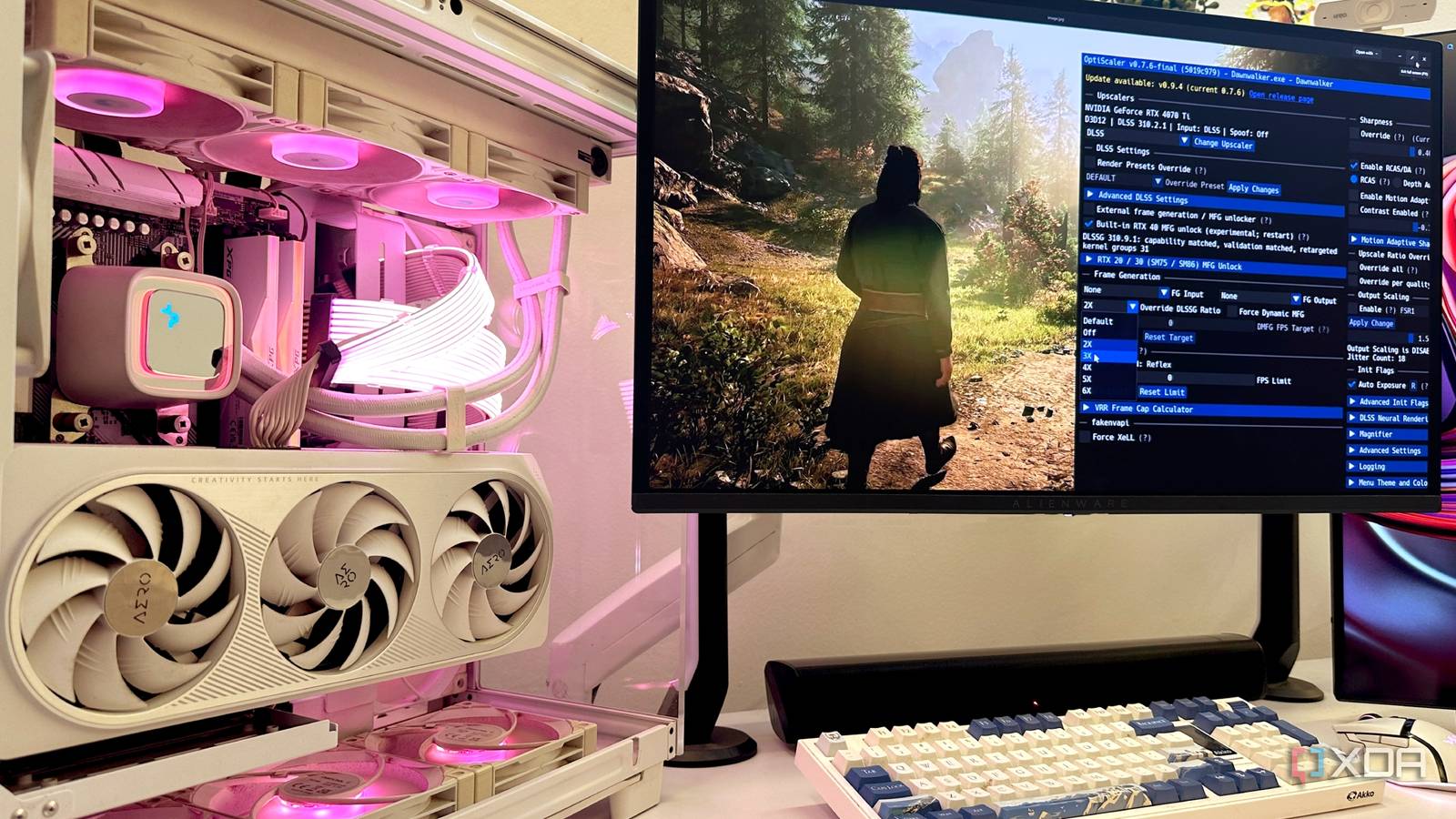
Published Sep 24, 2026, 12:00 PM EDT Gaming has been Samarveer’s greatest passion, and the Literature graduate in him takes immense joy in dissecting games for their themes, messages, and impact. Samarveer holds a deep appreciation of gaming, and considers the platform to be the most immersive and impactful across all media. He can be found engaging with gaming communities online, always ready to debate the finer points of ray tracing or itching to write an 8-page collegiate thesis on any game that impacts him emotionally. When I built my RTX 4070 Ti-powered GPU back in 2023, you could have mailed me at P.O. Box Cloud 9. I'd just bought one of the best GPUs on the market, and it could generate frames when I needed it to. Last week, however, I stopped using the word "beefy" for it. My RTX 4070 Ti is hardly ancient, but The Blood of Dawnwalker was the first game that made me feel like I was genuinely running into its limits. At 4K, even DLSS 4.5 wasn't enough to give me the sort of performance I wanted, and conventional frame generation only took me so far. Naturally, I started messing with things Nvidia never intended my card to have. What happened next was ridiculous enough to make me question whether we're being too quick to write off older GPUs. Thanks to the right mods and OptiScaler, I pushed Multi Frame Generation far beyond what the RTX 4070 Ti officially supports, and the results had me back at my old address in the clouds. My RTX 4070 Ti was starting to buckle at 4K The latest Unreal Engine 5 title exposed where my GPU was running out of road It had been a while since I contended with a fresh new Unreal Engine 5 title, and The Blood of Dawnwalker is exactly the kind of game I'd been looking forward to. Sadly, it also makes my perfectly respectable GPU suddenly feel considerably less respectable. At 4K with DLAA, my RTX 4070 Ti averaged just about 40 FPS. It's not completely unplayable, but it's nowhere near where I want a demanding modern game to sit on a card that I intend to use for another two full years. Using DLSS 4.5 at its Quality Preset is what pushed me past the 60 FPS mark, but the 1% lows were still comfortably dipping into 40 FPS territory. Then, I threw my final tool at the wall, and regular DLSS Frame Generation at 2x gave me around 90 FPS, with my 1% lows being consistently above 60 FPS as well. The problem, however, remained combat, where the frame rate would dip and stutter. The usual Unreal Engine 5 quirks aside, the game itself felt tough to stomach without Frame Generation, and even then, the base frame rate of around 65 FPS left much to be desired. DLSS 4.5 really helped me move on from 1440p to permanently gaming at 4K, but at 2160p, Dawnwalker was asking if I could make the big numbers on the frame counter feel useful. I just had no idea that my answer would involve 4x Multi Frame Generation. I somehow got 4x MFG running on my RTX 4070 Ti The results were far more convincing than Nvidia would have me believe The fun only started when I consciously stopped treating the RTX 4070 Ti like Nvidia's software wanted me to. I used OptiScaler to get Multi Frame Generation working, alongside the DLSS Libraries and RenoDX to throw in the DLSS 5 Neural Rendering DLL file for good measure. Just like that, my "unsupported" 40-series GPU was doing something it absolutely shouldn't. At 4K, I could now go all the way up to 3x Frame Generation instead of just 2x, which is exactly what I pushed my GPU to. My average performance jumped to almost 140 FPS, while the base frame rate remained at around 44 FPS. The trade-off, of course, was the latency, which climbed to over 30 ms. As was evident, the bigger the generated-frame multiplier, the less representative the headline FPS number becomes. The Blood of Dawnwalker | RTX 4070 Ti + Ryzen 5 7600X + 32GB DDR5 RAM | High | 2160p Metric DLAA DLSS Quality DLSS Quality + FG 2x DLSS Quality + FG 3x DLSS Quality + FG 4x Average FPS 43 fps 64 fps 96 fps 138 fps 160 fps 1% Low FPS 36 fps 48 fps 68 fps 95 fps 115 fps Base FPS — — 69 fps 44 fps 40 fps Latency 36 ms 24.5 ms 26.4 ms 31.1 ms 36.7 ms VRAM Usage (11.7GB max) 10.0 GB 9.8 GB 10.8 GB 11.3 GB 11.6 GB To me, 3x Frame Generation felt like the perfect sweet spot, especially considering 4x MFG pushed my GPU just 100 MB shy of running into its VRAM limit. With 3x Frame Generation, the foliage held stable, the sharpness was exactly where I wanted it, and combat and traversal both felt just smooth enough for me to enjoy playing the game without fretting about VRAM usage or GPU power draw. The base render rate was only 40 FPS, but visually, the jump was absurd. In trying to make 4K more usable for my PC and on my 3-year-old GPU, Multi Frame Generation finally became more than just an unachievable distant feature, and ended up giving me a ton of extra runway. My RTX 4070 Ti just got the second wind I was hoping for I can coast until the RTX 60 series now Successfully using Multi Frame Generation on an RTX 40 series GPU is nothing if not a second wind. My RTX 4070 Ti clearly has enough hardware to make 3x and 4x MFG useful, and the fact that I can push it even further with 6x makes the card feel considerably less obsolete. I know it won't behave exactly like an RTX 50-series GPU running native MFG, but I don't need it to, either. I needed it to get Dawnwalker running properly at 4K, and it does exactly that. That changes how I see this card's remaining lifespan. I bought an RTX 4070 Ti to last several years at 1440p, but I'll admit that the RTX 50-series became rather attractive just because Nvidia added another frame-generation multiplier. If an unofficial MFG mod can give me the extra headroom I need, I'm perfectly happy coasting along until the RTX 60 series gives me an actual hardware-backed reason to upgrade. RTX 40-series cards can also run DLSS 5's "exclusive" Neural Rendering through OptiScaler, DLSS Swapper, or ReShade, depending on the game. That said, I can't pretend Nvidia's approach doesn't annoy me. MFG is exactly the sort of feature that can extend the useful life of existing hardware, but Nvidia has positioned it as a Blackwell-exclusive feature. I understand the architectural argument, but it's hard not to wonder how much of this is also about giving people another reason to buy newer GPUs that are only different in software instead of hardware. After actually using it, that distinction matters less to me than the result. My 4070 Ti isn't suddenly an RTX 5090, and I'm not pretending otherwise. But if this unofficial implementation can give my supposedly aging GPU another couple of years, I'm absolutely going to take the extra runway. Gigabyte RTX 4070 Ti Super AERO OC The Gigabyte RTX 4070 Ti Super AERO OC is a big improvement over its predecessor, providing 16GB of VRAM and incredible performance for the price. Its understated white design is perfect for those building a high-end, sophisticated gaming rig. My 4070 Ti isn't ready to retire just yet The hardware ceiling is here, and Nvidia is using software-bound features to differentiate between generations. MFG isn't the only 50-series trick I've managed to squeeze out of this card. Neural rendering also works, with a couple of passes at 1440p giving me another glimpse at what Nvidia's newer hardware is supposed to have all to itself. Nvidia has said these features will eventually make their way to RTX 40-series GPUs, but "eventually" is doing a lot of heavy lifting when they already work today. I'd started believing that my RTX 4070 Ti was running out of tricks, only to end up finding more software features it can handle than Nvidia officially gives it credit for. The hardware ceiling is fast approaching every generation, and clearly, GPU manufacturers only have software-bound features to add between generations. Maybe the RTX 60 series will finally give me a compelling reason to upgrade, but until then, I'm perfectly happy making this supposedly aging GPU do things it was never meant to do.
My RTX 4070 Ti was heading for retirement until I unlocked Nvidia's restricted frame generation
Full Article
Original Source
Read the full article at Xda-developers →KhanList aggregates and links to publicly available news content. We do not host full articles from third-party sources. Always verify important information with original sources.