
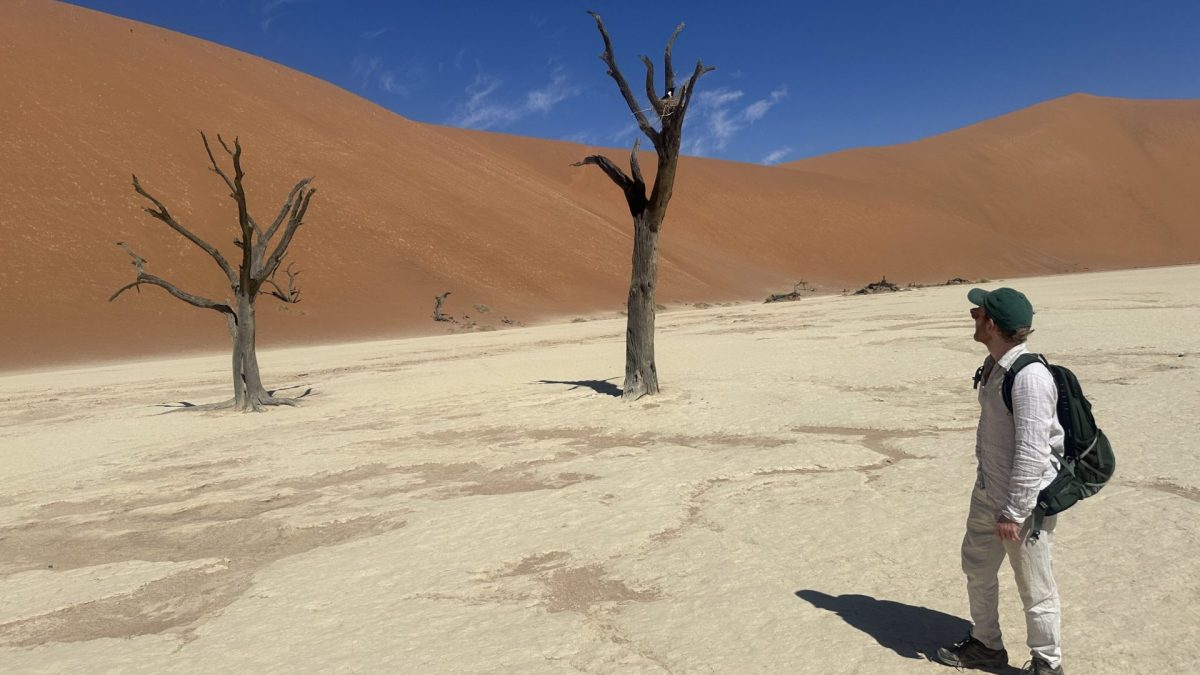
Arriving in Namibia, two things struck me: how lush and green Windhoek, the capital, is, and how empty the roads are. As I explored further, this verdancy fell away, replaced by arid desert and rocky coastline, but one thing remained near-constant: the lack of people. Namibia is the world’s second least-densely populated country after Mongolia, and only had about 1.3 million international tourists in 2025. The population is about 3.2 million – a third of London’s, but spread over a country more than three times larger than the UK. Shorts An ambitious, sustainable tourism growth strategy (including improved air links) and a place on Lonely Planet’s 2026 Best in Travel list could go some way towards changing that, but for now, it’s possible to explore the country free of hordes of tourists. It’s a safe country, where English is widely spoken and with no jet lag, and, as a gay couple, my partner and I felt accepted and welcomed, despite the UK Foreign Office advice noting conservative attitudes among its society. So, our only apprehension was about the endless drives on vast dirt roads in the blazing sun. After a short flight (just over two hours) from Cape Town to Windhoek, we picked up a 4×4 for less than £700 for nine days. This included a fridge and extra comprehensive insurance to cover driving on rugged roads and soothe my anxieties. Sunset over Swakopmund (Photo: Nikada/Getty) Our first destination was the Sossusvlei, in the Namib-Naukluft National Park, which bills itself as “possibly Namibia’s most spectacular and best-known attraction”. Here, the petrified trees of Deadvlei – a dried-up salt pan deep in the desert – are instantly recognisable, frozen in time and blackened by the sun over the course of about 700 years. With a few sealed roads offering respite from jarring dirt tracks, we stopped at the incredible Sesriem Canyon – a chasm filled with sand and a flowing river, lit up by rays of sunlight breaking through from above – before continuing to Deadvlei, an area only accessible by 4×4 due to soft sand. At this point there was the option to pay for a shuttle, but we instead paid a guide to teach us how to tackle the last 5km ourselves. He released air from our tyres, fiddled with settings in the car and talked us through the best route across the shifting ground. Namibia’s landscapes are breathtaking (Photo: Oscar Catt/Getty) After a fairly stressful drive, we arrived at the country’s supposed best-known attraction and saw not another soul. We wandered through the dunes and dead trees, accompanied only by the birds and hot wind. We spent 90 minutes alone in this otherworldly landscape, feeling as if we’d either been transported to another planet or were the first people to stumble across this place in millennia. Most visitors come here for sunrise, sunset and respite from the mid-afternoon sun – but the heat was a worthy exchange for isolation. Pride of lions drinking from a waterhole in Etosha National Park (Photo: Paula French/Getty) Next, we headed north to Etosha National Park, where we had booked a stay in a lodge within the park’s gates. These are all government-run and cheaply priced (camping can be as little as £20pp, while a double room or chalet costs about £85pp). They come with safaris that can be booked at check-in, and floodlit waterholes for wildlife viewing – at sunset, we watched wildebeest, gazelles and a rhino. Etosha felt noticeably busier, and the safari experience certainly less polished than in South Africa’s Kruger, for example. Rest stops on the dirt tracks are few and far between and rudimentary at best. There’s a large population of black rhinoceros in Namibia (Photo: Henrik Karlsson/Getty) The park’s main draw is the fact it’s home for four of the “Big Five”; the only one missing is the buffalo, but there’s a large population of black rhinos to track. We’d found the details of a local guide on a travel blog and contacted him on WhatsApp a few days before we arrived. For £70 plus another £30 or so in expenses and tip, he spent eight hours driving us around the park, where we spotted elephants, lions, rhinos and zebras. In the bush, we drove alongside a family of elephants, the elders blocking the young from the car and making their presence known in front of us as we reversed away slowly. We also spent a night at a private game reserve, Forest Camp, bordering the park’s eastern edge, which cost significantly more. But £500 seemed very reasonable for accommodation in a luxurious private lodge, dinner, breakfast, a two-hour game drive with drinks and snacks – getting us extremely close to white rhinos, lions, giraffes and more – and a morning bush walk. The desert meeting the water in Namibia (Photo: Pascale Gueret/Getty) Beyond the deserts and safari, Namibia has nearly 1,000 miles of shoreline. Much of this is taken up by the Skeleton Coast, a rough strip against the Atlantic where you’ll see beached ships rusting as they’re battered by spray. A few hours south, Swakopmund, the coast’s adventure hub, teems with tourists who come to skydive, quad-bike, ride horses and visit Walvis Bay, where towering sand dunes meet the ocean. As we approached the city, the roads gradually filled and the pavements packed out with pedestrians. Isolation over, I couldn’t help but feel a pang of desire to be back in Namibia’s vast, quiet swathes of nature. How to get there Airlines including Lufthansa, Ethiopian Airlines and British Airways/Airlink fly from the UK to Windhoek with one stop.
My quiet Namibia road trip was low-cost, sunny and jetlag free
Full Article
Original Source
Read the full article at Inews →KhanList aggregates and links to publicly available news content. We do not host full articles from third-party sources. Always verify important information with original sources.