
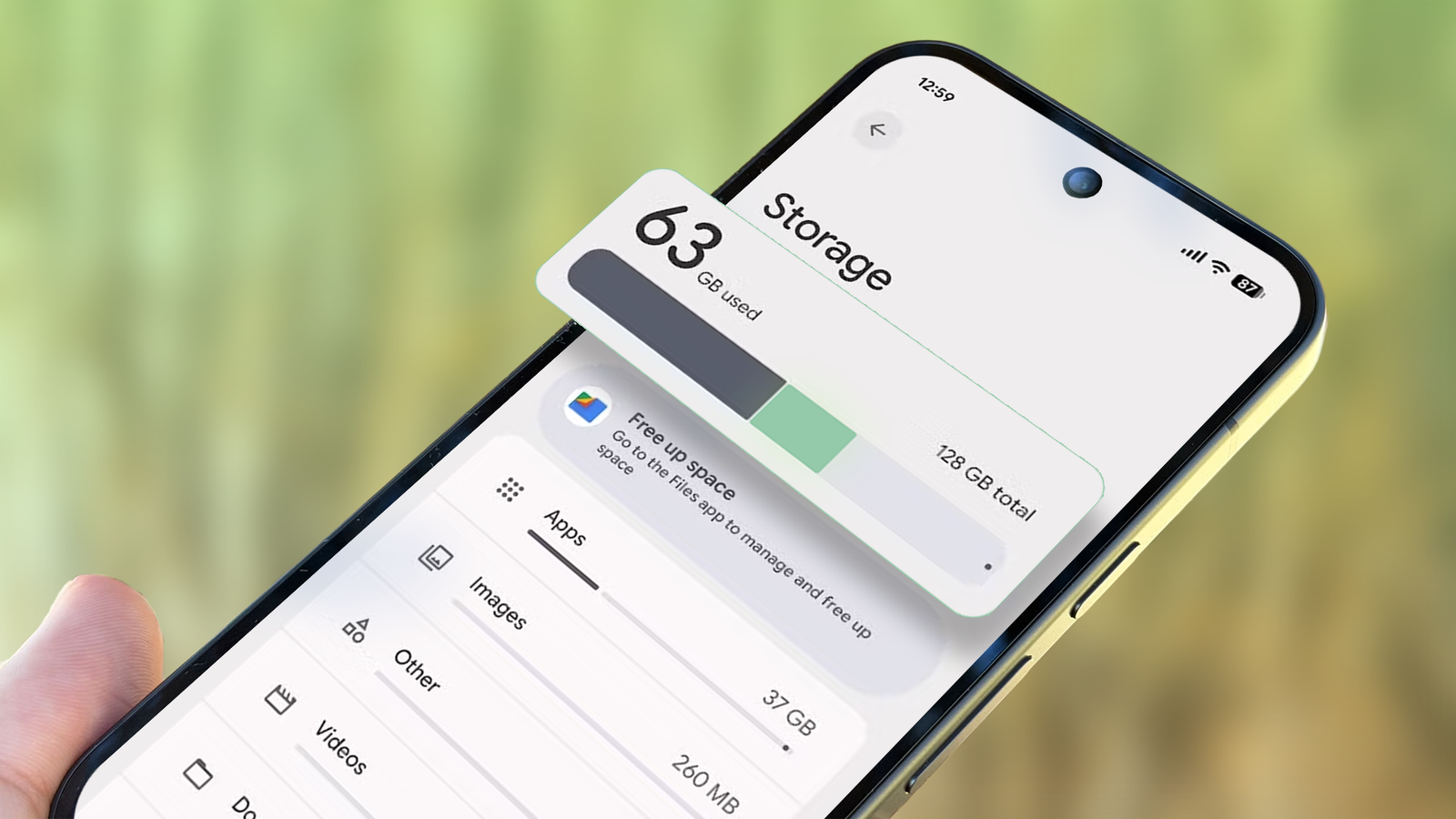
Published Sep 10, 2026, 11:15 AM EDT Jon Gilbert is a Features Writer for Android Police. I've covered Android since 2021, focusing on writing features and guides about Android apps and features that directly affect users. I've attended CES to uncover powerful hardware that isn't dominated by Google like the Mudita Kompakt. I trawl through Android news daily, hunting for stories that have real-world consequences. I hold a BA in History & Classics. While I regret buying my Google Pixel 10 Pro with only 128GB of storage, I've made it work through aggressive storage optimization techniques. Instead of uninstalling the largest apps whenever I reach the limit, I've identified settings that help me save space without losing data. Changing these settings has consequences for how your Pixel phone functions, but crucially, there is no loss of data involved. Here are the crucial Pixel settings I changed to save space on Android. There's no risk of data loss Smart storage clears backed-up photos and videos automatically when your phone's storage reaches its limit. It only deletes backed-up photos, so you don't lose any data. Smart storage not only frees up space when storage runs out, but also permanently deletes backed-up media that's been on your device for 60 days. The catch is that you must use Google Photos and Files by Google to use this feature. I back up my media in two places, but I still rely on Google Photos for simple backups. I always enable Smart storage after setting up a new Pixel phone, as it continually saves space over time. It's a true "set it and forget it" setting. Open Files by Google. Tap the three-line button in the upper-left corner of the screen. Tap Settings. Toggle on the Smart storage switch. If I've taken a lot of photos and videos in a short time, I can trigger this feature by opening Google Photos and tapping Free up space on this device. Speaking of Google Photos, there's a handy tool that reduces the storage space media takes up. Storage saver makes room in Google Photos for more backups For regular photography, it doesn't make a difference to quality Storage saver compresses photos and videos to reduce the amount of space they take up. Targeted towards saving cloud storage space, it doesn't compress local files on the device. By default, Google Photos saves photos and videos in full resolution and backs them up without compression. Storage saver compresses photos to 16MP and videos to high definition. Google states that these images are suitable for prints up to 24" x 16". Open Google Photos. Tap the profile picture in the upper-right corner of the screen. Tap Photos settings. Tap Backup. Scroll down and tap Photo and video quality. Select Storage saver. While this feature doesn't save space on the device, it helps my Google Photos storage allowance go further than before. It works best with the Smart storage feature. Unused apps are neatly organized for deletion No need to manually sort for old apps I'm constantly downloading and testing new apps, and unless they stick with me, I uninstall them immediately after. Still, a few always slip through the net. Rather than manually checking for old apps, I use the Unused apps feature. This tool identifies apps that were last opened more than six months ago. When an app hasn't been opened for six months, Unused apps removes permissions, stops notifications, and removes temporary files. It re-enables permissions and notifications when you open the app. While I usually keep one or two around for the rare occasions when they're useful, I always use this feature to clear out apps I've forgotten about. Open the Settings app. Tap Apps. Scroll down and tap Unused apps. Tap the trash icon to uninstall an app. Uninstall AI Core and Device Intelligence to remove AI models If you don't use them, you don't need them Last year, after realizing I wasn't using Gemini Nano features on my Pixel phone, I uninstalled the AI Core app to free up an impressive 7GB of space. This feature powers apps like Pixel Screenshots and Pixel Journal. Useful apps, but uninstalling them still leaves AI Core behind. You must uninstall it manually to remove the AI models. Device Intelligence powers proactive features like Magic Cue and Smart Recommendations. While it takes up less space (roughly 1GB), it's still a waste of storage for me, as I have never found these tools useful. Neither app can be uninstalled. However, disabling them, then clearing their storage and cache, will reduce their size to a few megabytes. Careful storage management can save gigabytes of space I don't receive annoying storage warnings anymore To test how much space I saved with these settings, I reversed them a month ago and used my phone as normal. After a month, I changed everything back and discovered that I had saved roughly 10GB of space. 8GB of that was from AI models, and 2GB was from unused apps and photos that I had backed up. So without these settings enabled, I'm wasting nearly 10% of storage space on my Pixel phone. Saving storage space doesn't have to be a hassle Immediately after setting up a new Pixel phone, I check all the storage and backup settings. Most of these run quietly in the background, so I'm saving space without doing any work. While there is always a call for a manual cleanup every few months, I no longer get storage warnings. And when storage is at a premium with modern Android, that's an achievement worth celebrating.
My Pixel was wasting 10GB of storage until I found these hidden optimization tricks
Full Article
Original Source
Read the full article at Androidpolice →KhanList aggregates and links to publicly available news content. We do not host full articles from third-party sources. Always verify important information with original sources.