
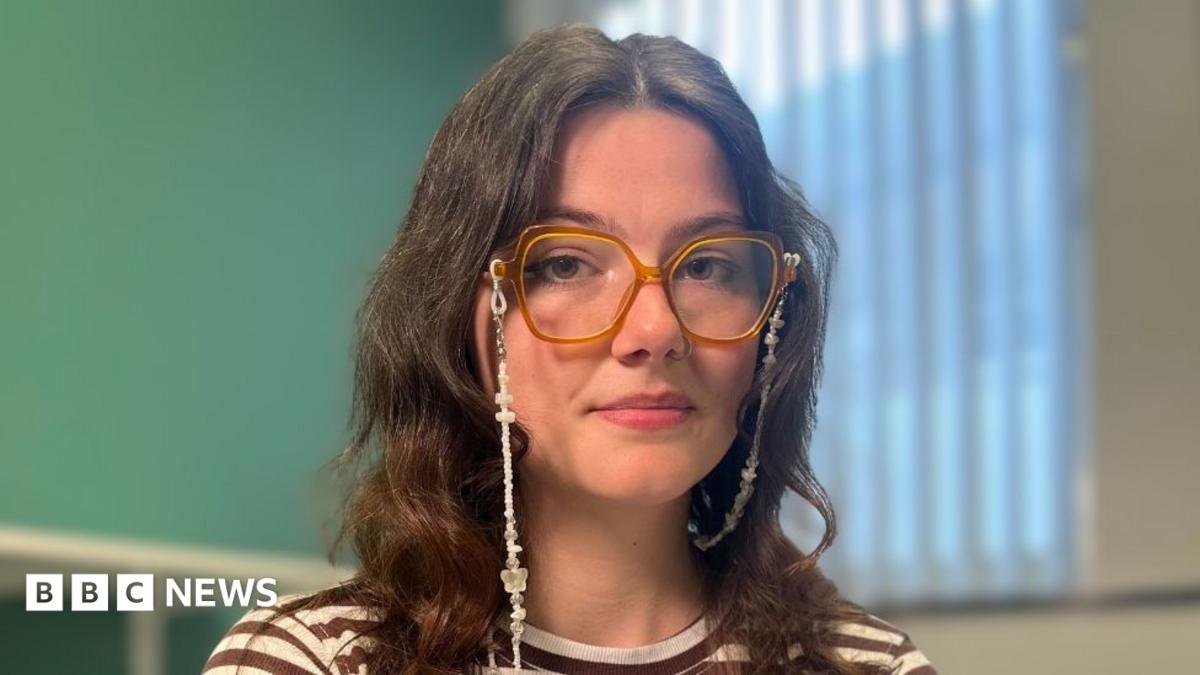
My physical deformity left me feeling invisible - but one surgeon saw meImage caption, Charlie kept her condition hidden for years and says it made her life "hell" at timesByHealth correspondent, BBC News NIAs a teenager at school, Charlie Clarke "felt awful" in her uniform, with a physical deformity leaving her so self-conscious that she hid from her classmates.At home, she wrapped her dressing gown tight around her chest, hoping it would conceal her condition - and didn't even tell her parents about it.Now 26, Charlie has lived with pectus excavatum - a congenital chest wall condition that can make the chest appear sunken or hollow - for years.As she awaits surgical treatment, she said the emotional and physical effects of the condition were "unimaginable and unignorable"."Having pectus excavatum, which is a disability and a deformity under my shirt, was at times hell," she said.Her worst memories from her teenage years are of hiding in the school bathroom during PE so other girls would not comment on her having "four breasts"."I got to a point where I felt awful wearing my school uniform because of how I looked, also because of how people looked at me and made comments about my chest," said Charlie, from County Down.Image source, Charlie ClarkeImage caption, Charlie didn't tell her parents about the severity of her condition for yearsThe condition, which affects one in every 200 people, means Charlie's heart and lungs are compressed, which triggers breathlessness and an increased heart rate that can cause her to lose consciousness.Charlie is one of 85 people in Northern Ireland who are waiting for surgery for pectus conditions.Many of them have been waiting for their operation for less than two years - but five have been on the list for longer than five years.The Department of Health said it acknowledged that some patients in Northern Ireland "have endured lengthy waits", adding that the volume of patients combined with "other demands on the thoracic surgery service have contributed to pressures on waiting times".But it said it had secured extra funding for more surgeries in order to reduce the amount of people on the waiting list, resulting in additional pectus procedures in the last three years.It also said it had agreed a further proposal "which should help to reduce both the number of patients waiting and the length of their waits". 'I was misdiagnosed'If diagnosed early, patients can often be treated without surgery.But getting that early diagnosis is key - and treatment depends on the type of pectus, how severe it is and the patient's age.Charlie said she was previously "misdiagnosed, including [being] told I had anxiety"."It wasn't until I had my shirt off in front of a clinical technician and she said they were unable to see my heart in a scan, it was compressed, and only then was I referred to a thoracic surgeon."That was when she was 23 years old, which is considered too old for non-surgical treatment.Image source, Charlie ClarkeImage caption, Charlie wants to raise awareness of the conditionA breakthrough came when Charlie met someone who truly understood her experience.Niall McGonigle, a Northern Ireland-based consultant thoracic surgeon, specialises in chest wall deformities.What makes his expertise particularly unique is that he suffered from a pectus deformity himself as a child and underwent surgery at 17."I was called freak and a mutant at school," he said."It drove me away from sports because of changing for PE - I was bullied."It is what started my interest in medicine... I was profoundly interested in surgery and specifically pectus."McGonigle said the condition was not recognised in Northern Ireland, and patients are often dismissed as asking for cosmetic surgery, which is not the case.Image source, Niall McGonigleImage caption, Niall McGonigle was inspired to become a surgeon after his experience with a pectus deformity"There is a lot of evidence to show there are restrictions on the lungs and heart, which can be debilitating," he said."If this is diagnosed early, patients can be treated with non-surgical services."But Northern Ireland doesn't provide this and our young people are having to go to England instead."McGonigle said Northern Ireland's limited pectus surgery service had been undermined by inconsistent funding.Charlie's surgery will involve two metal bars being placed in her chest and a metal plate in her sternum, allowing her heart and lungs to return to their natural positions.She said she was speaking out to raise awareness of the condition and to help others who have it, including her 11-year-old sister."I don't want her to have to wait this long and for her life to be paused and for her condition to become life-threatening," Charlie said.What is pectus excavatum?Pectus excavatum, also known as "funnel chest", is different for everyone. Most who have the condition were born with it.A patient's breastbone curves inwards, with a dip the ribs, which can leave the chest appearing sunken or hollow.It is usually more noticeable in childhood or teenage years.One treatment is vacuum bell therapy, using a suction device that sits over the sunken part of the chest to gradually lift the breastbone forwards.It works best in younger people with a flexible chest wall and a relatively shallow deformity.Another treatment, compression bracing, involves a specially fitted brace and is most effective in teenagers - but generally less so once the chest becomes rigid in adulthood.In its statement, the Department of Health said work it carried out in 2023 led to the commissioning of a service for "non-surgical bracing of pectus carinatum".It added it is understood this "can, in appropriately selected patients, negate the requirement for surgery"."The impact of this service will be evaluated, including its potential to free up theatre capacity for those conditions which can only be resolved surgically."Image caption, Vacuum bell therapy is a non-surgical treatment that works best for younger peopleLast month, patients and health professionals from across the UK met in Belfast to discuss the condition.Simon Kendall, of the charity Pectus Matters, said early treatment saves the health service money in the long term."If you get that treatment when the patient is young and chest wall is more flexible you can avoid the big operations in the future."More on this story
My physical deformity left me feeling invisible - but one surgeon saw me
Full Article
Original Source
Read the full article at Bbc →KhanList aggregates and links to publicly available news content. We do not host full articles from third-party sources. Always verify important information with original sources.