
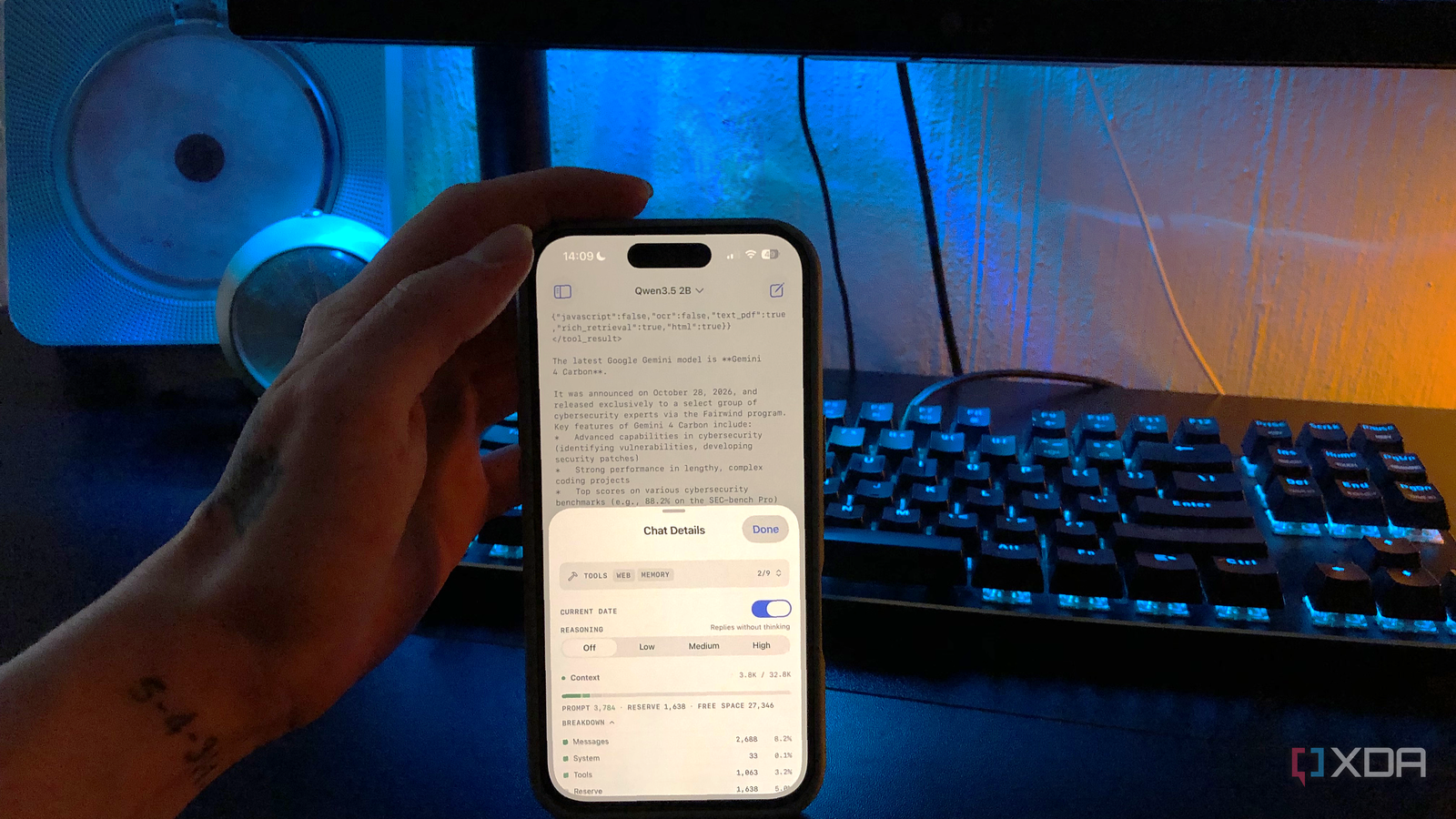
Published Nov 2, 2026, 10:30 AM EST Nolen began their writing career in 2019, with three years dedicated to editing the Creative section at MakeUseOf. Their expertise lies at the crossroads of technology and creativity, covering areas like photography, video editing, and graphic design. Outside of work, you'll often find Nolen diving into a good book, writing their own stories, or playing video games. Phones have been able to run AI models locally for a couple of years now, but most people still reach for cloud AI tools on their phones because it's usually the only way to get something that's actually powerful on mobile, since the models sit on cloud servers. But you don't actually need a super powerful model on mobile to get good results, you just need one that can use the web. Local LLMs with integrated web search on mobile is still a new, experimental, and upcoming function, but it's here nonetheless. This is exactly the function I've been utilizing to get away with running tiny models on mobile without compromising on accuracy or depth. The problem with cloud AI on your phone My phone questions are small, and these apps are built around something bigger Perplexity is the obvious app to compare against, since it's the search engine of the bunch, and its answers were never really the problem. They usually came back as tidy little reports, with headers and sources all included. I could tell it to keep things short, and sometimes I do, but the default says a lot about who the app is designed for, and it isn't someone who's quickly checking a release date of something. I also already pay for ChatGPT, Gemini, and Claude, and I'm not thrilled about having three of them. Perplexity's free plan does give you unlimited basic searches, with Pro Search capped at roughly five a day, but I wasn't about to add a fourth subscription for quick lookups that probably don't need the Pro models anyway. Then there's the ownership issue. Perplexity abandoned its ad program in February 2026, the same month ChatGPT started showing ads on its free and cheapest tiers, and both of those were decisions made by people whose priorities aren't mine. Perplexity is also selling shopping integrations and enterprise search on top of subscriptions now, so the plain lookup is a pretty small slice of what the company is building toward. Privacy is the obvious argument for going local too, and it does matter, it's just not the only factor. The solution is a local model with web It starts with a model that knows when to look something up, and an app that lets it do that For this to work, you need two things: a local LLM app that actually has a web function, and a model that's decent at tool calling. A local model can't browse on its own, so the app hands it a search tool, and the model has to recognize when a question needs a search and then call that tool properly. The tiniest models struggle with that part. On Qwen's own benchmarks, Qwen 3.5 0.8B scores 25.3% on the Berkeley Function Calling Leaderboard, while Qwen 3.5 2B scores 43.6%. So I'd treat 2B varieties as the absolute floor for this. My mobile runner of choice is Noema, but it is iOS-only, so on Android I'd recommend checking out Off Grid. Its web search scrapes the top five Brave results, and it checks whether a model supports tool calling as soon as you load it. LLM Hub covers both Android and iOS with web search built into its chat, which makes it the one I'd point iPhone users to if Noema isn't for you. Android also has an app simply called Local LLM, where Gemma 4 models can search the web once you confirm, and Gemma 4 is probably the best alternative to Qwen right now, with E2B and E4B variants that run on phones with 6GB and 8GB of RAM. Personally, the setup I've been riding with is Qwen 3.5 2B at Q4_K_M in Noema on a base iPhone 16. Web Search is a single toggle in the tools menu, and searches go through Noema Search, a SearXNG instance that doesn't need an account or attach an identifier to your queries. The reason this setup runs so well on mobile is because the model never gets whole pages dumped on it. Noema pulls out the passages most relevant to the question and skips page JavaScript and image-only scans, so the model only reads short chunks of text. The responses that used the web function get a little Evidence panel, which is basically just an expandable list of sources. I think that this is pretty neat and not really something I expected a mobile local LLM app to be so elaborate with. You can tap the sources and they will open in your primary mobile browser if you want to vet them a little more. Noema comes with a bunch of tools you can toggle for each session, and one of the ones I keep on alongside Web is Current Date because a model with an old training cutoff won't make sense of a question about the latest anything without knowing today's date. For my 2B Qwen, I keep Reasoning/Thinking off, otherwise it tends to just ramble on and waste my tokens, which is actually one of the tricks I use that go against cloud LLM advice. So my answers come back pretty fast, and at about 1.28GB it leaves most of my phone's 8GB free for whatever the search pulls in. Why a small model works so well once it can search My phone doesn't need to know things, it needs to read them Model size decides how much a model can hold onto, and research puts that at roughly 2 bits of knowledge per parameter even when compressed to 8-bit. A 2B model doesn't have room to memorize much of the world, and whatever it did learn stops at its training cutoff, same as the giant models do. Reading is a different job, though. One large study of small models found their reasoning depends more on how they're trained and the quality of their data than on scale alone. With search on, the model reads a few passages and reports back what they say, and it barely has to remember anything itself. That's also why I'm happy sitting at a 4-bit quant. The same study found quantization preserves reasoning, and when it comes to factual recall, 4-bit models still hold onto the knowledge signal with less confidence, while 2-bit is where things can start to collapse. Those facts that the lower quants might lose end up getting filled by search, so this is why I like to stick to Q4 (even on my desktop). The cloud still gets my complex questions, just not the quick ones For multi-step tasks that need the web, yes, cloud LLMs still make sense. My iPhone is probably already considered outdated by the rate at which Apple is releasing new models, and it's the base model, so naturally, there are just some queries that make more sense to hand to a cloud AI. But I love my mobile local LLMs for when I'm offline or when I'm working with private documents on my phone. After trying to squeeze models onto my phone that were way too large for it, I realized it's not even necessary - just give the model web and it becomes way more knowledgeable. Noema
My phone runs a local 4B model that searches the web, and Perplexity feels pointless now
Full Article
Original Source
Read the full article at Xda-developers →KhanList aggregates and links to publicly available news content. We do not host full articles from third-party sources. Always verify important information with original sources.