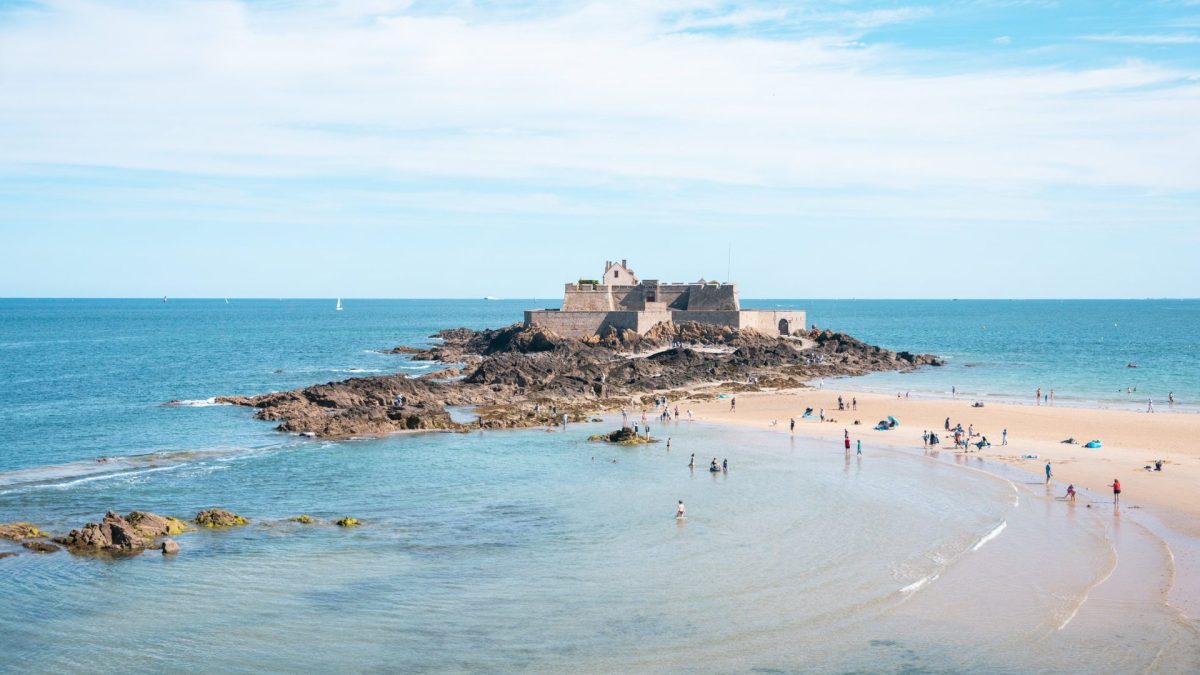
Saint-Malo is just waking when I walk the city walls. Salty air fills my lungs. The sea below smashes against the ramparts. There is barely another soul on my hour-long circuit of the 2km ramparts, past a stretch of the Channel dotted with islands that for now are only reachable by boat. When I return in the afternoon, everything is different. The outgoing tide reveals golden beaches and land bridges to islands that suddenly feel close. At Grand Bé, I follow the windswept path to the tomb of French writer Chateaubriand, the staccato shrieks of gulls in my ears. On Petit Bé, just beyond, the 17th-century fort crowns craggy rocks wreathed in blue periwinkles. Talk in Saint-Malo isn’t about weather, but tides, which sweep across the causeways and beaches at a galloping pace – often rising up to 13 metres in a day. The shifts are so dramatic that locals use an app, Ask Malo, to track the tide in real time. Shorts Saint Malo and its ramparts at dawn (Photo: Mathieu Rivrin/Getty Images) I arrived here early one morning, passing through the gates of the walled city, sunlight gilding the ramparts. Pulling my bag to Hotel Le Grand Bé – the former courthouse and later tax office, with a subterranean spa in what was the 17th-century vault – I was struck by a feeling I rarely associate with summer travel in Europe: rested. There had been no 4am dash to the airport, no security queues or frantic race to a busy boarding gate. Instead, I woke to a continental breakfast aboard a Brittany Ferries ship, having sailed overnight from Portsmouth. A growing weariness of budget flights led me here – and demand for no-fly holidays appears to be on the rise. Bookings for Saint-Malo with Brittany Ferries were up six per cent in 2025, while reservations made during a two-week period in April for travel this July and August were up 37 per cent year on year. While Europe and the UK swelter through a record-breaking heatwave, Saint-Malo and the wider Emerald Coast of northern Brittany have had some respite from the region’s oceanic climate. It’s warm enough for a dip in the seawater pool at Bon Secours beach or a stroll along the 3km sweep of Grande Plage du Sillon. Summers here mean lazy beach days, seafood hauled ashore that morning, and stories of the corsairs, the privateers sanctioned by Louis XIV to defend the city. Beyond its beaches, Saint-Malo has another draw. The city starred in Anthony Doerr’s novel turned Netflix drama All the Light We Cannot See. I join guide Isabelle Gendrot on a set tour of the intra muros, rebuilt after Allied bombs reduced it to rubble during the final days of the Second World War. Book in hand, she leads me through the gateway to Plage du Môle, the beach where Marie-Laure, the blind protagonist, first encountered the sea’s roar. Then on to Aleth, which was a German stronghold and the Allies’ intended target. A quiet beach on the island of Cézembre (Photo: Belinda Luksic) A 10-minute boat ride with Captain Taxi lands me on Cézembre, once home to hermits, later stationed by German troops and heavily bombed by Allied forces. Off-limits for decades, the island reopened in 2017 as a protected nature reserve and open-air war museum. A path winds above the beach, whose golden sands are a magnet for sunbathers, looping around rusted artillery sculpted by salt and wind into something approaching art. Cormorants and gulls ride the currents, their nests high in the sea cliffs. Across the Rance Estuary lies Dinard and the seafront grandeur of Hotel Printania, its stuffed clams as memorable as the waitresses in traditional Breton costume. After lunch, I stroll the Claire de Lune promenade — part of the Customs Officers’ Path that traces Brittany’s 2,000km coastline. The seawater pool at Plage du Prieuré is full, the beach below it sucked dry by the ebbing tide, leaving a seabed that shimmers silver like a mirror. Above it all are Belle Époque mansions, built in Dinard’s heyday as a fashionable seaside resort. Belle Époque mansions above the beach of Dinard (Photo: Guido Mieth/Getty) Back within the walls of Saint-Malo, life buzzes with cafes and crêperies, artisans and the quirky La Java, an 1820s bar crammed with dolls, carnival ephemera and vintage finds. At Café de L’Ouest, I feast on moules marinières overlooking the 14th-century keep, while Crêperie La Duchesse Anne offers the quintessential Breton pairing of a buckwheat galette and a bolée of dry cider. Down cobbled lanes, I hunt for local favourites, finding artisanal butter at Maison du Beurre Bordier, chef-blend spices at Épices Roellinger and all things buckwheat at Maison de Sarrasin. With a late ferry departure, I spend my final day exploring the countryside on an e-bike ride to Cancale, slurping a dozen briny oysters shucked fresh at the Port de la Houle seaside market. I make a final detour, leaving the coast for Clos-Poulet’s Malouinières, the 300-year-old summer mansions of the corsairs and shipowners who made Saint-Malo rich. Cafe de l’Ouest serves locally caught seafood (Photo: Belinda Luksic) Before I go, I enjoy one last indulgence at Hotel Le Grand Bé – a Breton kir, made with cider out on the terrace. The tide is clamouring, its urgency in my ears as I leave. By the time it swallows the causeways and beaches again, I will be tucked up in my ferry cabin sailing back to England, the tide bringing me home. How to get there The writer was a guest of Saint-Malo Tourism and Brittany Ferries, which offers Portsmouth to Saint-Malo crossings from £222 for a family of four, on foot, sharing a four-berth inside cabin (£340 with a car). A private Commodore cabin starts at £204pp on foot or £310pp with a car. Where to stay Hotel Le Grand Bé has doubles from £150 with breakfast.
My no-fly break to the jewel of France’s Emerald Coast was indulgent and easy
Full Article
Original Source
Read the full article at Inews →KhanList aggregates and links to publicly available news content. We do not host full articles from third-party sources. Always verify important information with original sources.