
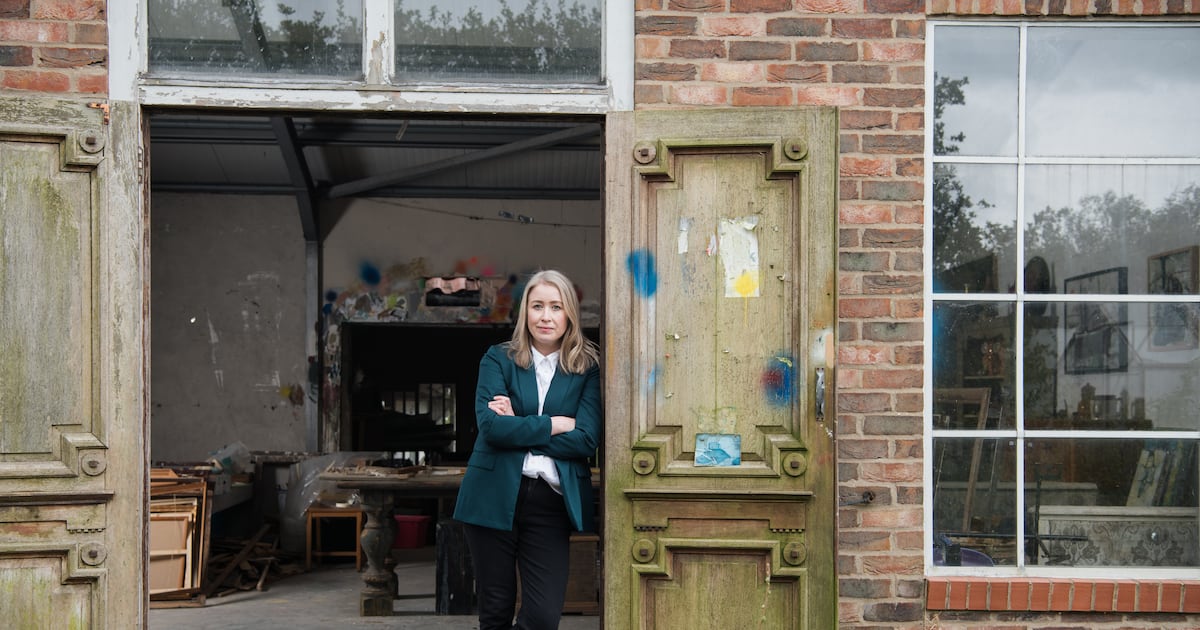
Seven years on, and I can already feel the grief rising. If you’re missing someone this Christmas, I see you. Mind yourselfLaura McDonagh: ‘The Irish do death well – a skill set borne out of necessity’. Photograph: Jo Ritchie It’s been seven years since my mum died suddenly at Christmas. And even though I needed to pause there to double-check my maths, I can already feel the grief creeping up on me. Every year, it announces itself just as the nights start drawing in and the TV ads vie to out-schmaltz each other. A grinning spectre in a red velvet cloak. Ah, I think, you again. Seven years is a strange amount of time. It feels – cliche alert – both a million moons ago and like yesterday. I struggle to conjure her face, but if I close my eyes I can picture her in fragments: her pearly complexion, her defiant chin, the daft high-pitched voice she used for the dog. She died from a brain haemorrhage and I still struggle with the disappearing-through-a-trapdoor nature of her passing. One minute she was here – asking about the kids’ swimming lessons and saying she didn’t think I should get a fringe cut in – and then, suddenly, she wasn’t. How does that even happen? But seriously, how? It’s impossible. I like the idea that our cells renew every seven years, even if it’s actually a myth. Because seven years after her death, I feel like a completely different person. There’s the obvious stuff: I’m older, more tired, definitely achier. I’ve had another child – a five-year-old who’ll soon be six, then 14, then 43, and on it goes, time making an absolute mockery of us all. I’m more pessimistic these days, more complicated. “Happy” and “sad” are no longer separate territories. Instead, they overlap – or perhaps it’s more that they blend, like two notes played together in a chord. READ MOREOver the years, I’ve tried different strategies for managing grief over the festive period. I’ve done denial, focusing resolutely on my husband, the kids and their preposterous wish lists – essentially, I’ve turned myself into Supermum to ease the gaping void of my own absent mother. I’ve done distraction, booking myself up with Christmas markets and nights out and wreath-making classes. Nothing worked. Denial made me snappy and resentful; distraction tactics emptied my bank account. It also meant I added “feeling exhausted” to plain old “feeling sad”. I’ve tried going all-in on grief. I run an art project with a photographer friend and we curate an online gallery of portraits and stories of people doing something creative after being bereaved. We’ve brought Projecting Grief to shopping centres and crematoriums; we’ve run workshops making memory tiles and paper forget-me-nots. It’s been a hugely positive force in my life since Mum died, allowing for conversations with a whole host of people channelling their loss into something positive: potters and painters, stand-up comedians and chefs, even a rocking-horse maker. A couple of Decembers ago, we did a pop-up exhibition in a local church. Was it lovely and life-affirming? Obviously. Did my grief vanish – poof! – in a puff of incense? Of course not. I’ve listened to all the podcasts, read all the books – Christ, I’ve even written one – and I still don’t have the answers. None of my rituals seem to work, and by “work” I mean declare myself done with feeling robbed. The famous “seven stages” model implies that grief can be completed; a process akin to levels on a video game or instructions for assembling a flat-pack bookcase. But like cells renewing every seven years, it’s something of a fallacy. In fact, psychiatrist Elisabeth Kübler-Ross developed the original five stages – denial, anger, bargaining, depression and acceptance – to describe the experience of people facing terminal illness, not grief. In the 1970s and 1980s, practitioners added to Kübler-Ross’s work, creating the impression of grief as a linear path of vacuum-sealed emotions. In reality, most people find loss an illogical, dizzying, contradictory experience. Feelings overlap and overwhelm – particularly in the first year, but also beyond. That’s just what feelings do. The Irish do death well – a skill set borne out of necessity given how much of it there was at one time. Communal and psychologically “healthy” traditions such as the wake rank highly in the global death charts alongside the Jewish custom of sitting shiva and Mexico’s marigold-strewn altars. Although Mum died in England, we found huge comfort in Irish traditions like laying her out at home, the endless sorry-for-your-troubles, the platters of sandwiches and the obligatory massive tea urn. We cried, we laughed, we sang Spuds Spuds Spuds by Farmer Dan in the kitchen after everyone had gone home (no judgment, please). Our English friends and neighbours had never seen the like. Four weeks later, the month’s mind in Sligo was a reminder of the power of connection and remembrance. I’d describe myself as a cultural Catholic these days rather than a true disciple (sorry, Mum), but I still think of the guard of honour my cousins formed outside the church door – and the sessions in the pub afterwards – with a deep sense of gratitude.[ Evolution of the Irish funeral: ‘Some people want to help weave their own coffin’Opens in new window ]About 100 people die every day in Ireland. For every one of those deaths, up to 10 people on average are “significantly impacted”. Those first 12 months, as anyone who’s been bereaved will know, are a kicker – all those sad little milestones. There’s evidence beyond my anecdotal experience that the traditions around death in Ireland help: a 2023 Ulster University study suggested that cultural practices such as having a wake contributed towards a lower rate of prolonged grief disorder (10.9 per cent in Ireland as opposed to 15.3 per cent in the UK). However, traditions can’t make grief – especially long-term or complex grief – vanish completely. Nothing can. Laura McDonagh and her mother Anne. And Christmas makes it harder. All that joy shoved in your face, the pressure on everything to be perfect. Seven years on, I still feel like I’m missing a layer of skin in December. Tiny things can set me off – a rash of candles on a windowsill; a warm, lifting line in a carol. A couple of days before Mum died, I watched my eldest son perform in his school nativity. He’s 12 now, but the date of my youngest’s Christmas show is already in the family calendar. Different school, different songs, and the grandson she never knew is a Wise Man rather than the Innkeeper. Nevertheless, I know I’ll feel it as soon as I walk into that draughty hall and settle into a plastic chair. A fatherless friend puts it best: “Ten years on, it’s not painful as such. It’s more that I wish he could see how his grandkids’ personalities are developing. I can imagine him laughing at the things they say. His quiet pride in their achievements and me as a father.” I totally get it. I’m not a big fan of those “it’s what she would have wanted”-type conversations, but she would have wanted to have been here. She would have wanted more time.[ Surviving Christmas: A guide to navigating the emotional hotspotsOpens in new window ]I predict some eyerolls – err, shouldn’t you be over this by now? Seven years is a decent stretch: the time it took to build King Solomon’s Temple; the length of Madonna and Guy Ritchie’s marriage. Enough time for an apple tree to bear a crop of fruit or a conifer to decompose. I should be pontificating about the healing properties of wild swimming or keeping a diary like a proper journalist. Go and see people, I should be telling you, but don’t stay out too late. Try to enjoy a night out, I might advise, but take it easy on the pints. Find ways to mark their absence – a little photo in a frame and a candle, a place set at the table – or, if it’s too painful, don’t bother. But I can’t write any of that because – and here’s the spoiler – nothing helps. Not really. And yet. I know I said before that grief has made me feel older, more tired, more complicated. That’s true. However, what I didn’t say is that it’s also made me a bolder, more authentic version of myself. It’s made me more aware of time and – here comes another cliche klaxon – how little we have of it. It’s helped me realise that acknowledging hard feelings is more effective than trying to outmanoeuvre them. All good, valuable, hard-won lessons – I’m grateful for them. And although nothing can eradicate grief completely, there are a few things I’ve tried that actually do help, a little bit. I can’t guarantee they’ll work for you, but you’re welcome to give them a go. I put the fairy lights up in November. I pull out of arrangements at the last minute and refuse to feel guilty. Instead of powering through the rough days, I let myself wrap a few presents in front of Gavin and Stacey while the kids are at school. “It’s what she would have wanted!” I tell myself melodramatically. In reality, she’d probably have told me to get a grip. God, she could be brutal (but she was brilliant, too).[ Grieving my parents abroad: ‘A different kind of hard in a world that never knew they existed’Opens in new window ]I also said that I’d done all the reading and it didn’t give me the answers I was looking for, but that’s not entirely true either. A single line from my back catalogue of grief books stands out, from Pema Chodron’s Things Fall Apart: “Nothing ever goes away until it teaches us what we need to know.” Talk about perspective-altering. How could I ever presume to know everything about my love for my mother, her love for me, what we meant to each other? How ridiculous to imagine I could ever fathom her not being here. How arrogant to think this sadness might ever go away. She might be gone from my sight, but there’s still so much she can teach me. Maybe you can use that to reframe an enduring grief, too?This Christmas, I’ll be busy. The kids’ lists for Santa are out of control: the five-year-old is after a “new wig” (?) and the 10-year-old “would like to meet Jude Bellingham”. I’ll be playing taxi driver to the 12-year-old and preventing the dog from eating an entire packet of uncooked stuffing balls like she did last year. But when we go out for a family meal, I’ll miss the woman who loved gossip and did excellent impressions and never knew what to order from a menu (“What are you having? Would I like it?”). If you’re missing someone this Christmas, I see you. Mind yourself. Go easy. Laura McDonagh is a second-generation Irish writer living in Newcastle, Tyne and Wear. Her book, Commonplace, will be published by New Island Books in February 2027 IN THIS SECTION
My mum died suddenly at Christmas. One minute she was here and then she wasn’t
Full Article
Original Source
Read the full article at Irishtimes →KhanList aggregates and links to publicly available news content. We do not host full articles from third-party sources. Always verify important information with original sources.