
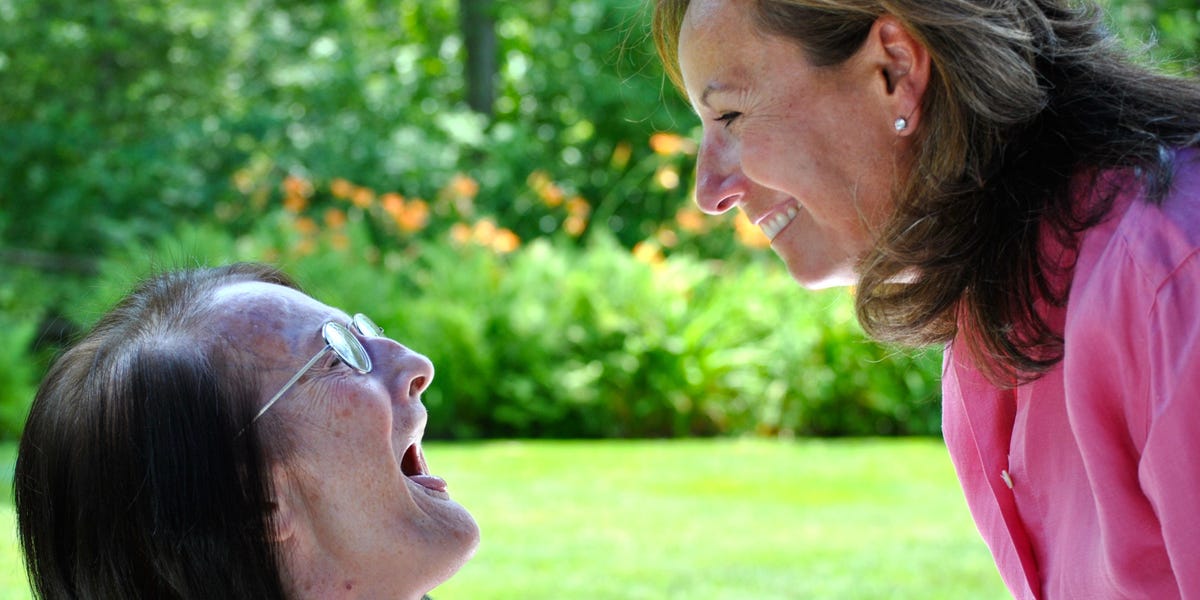
Karen Finocchio with her mother, Louise, 19 years after she was diagnosed with Alzheimer's. Courtesy of Karen Finocchio This story is based on an interview with Karen Finocchio, 56, a marketing and engagement consultant from Marblehead, Massachusetts. It has been edited for length and clarity.My mother, Louise, known as "Lulu," radiated light. She was caring, quick-witted, accomplished, and kind.She left a huge hole in our lives when she died on September 22, 2015, 20 years after being diagnosed with Alzheimer's disease.Dad, 87, and I think of her every day. However, I know she's with us. Every anniversary of her death, she appears as a sunset with vibrant colors that are out of this world. Louise "Lulu" Finocchio died of Alzheimer's disease in 2015. Courtesy of Karen Finocchio It doesn't matter what's been going on with the weather; Mom, who was 79 when she passed, inevitably shows up for us on the water in the harbor. We were her care partners for two decades. It was a privilege to be there for Mom, and it created an unbreakable bond. We had beautiful times together and challenging times.We made mistakes along the way, but never stopped learning. Here are my three main takeaways from the experience.We wish we'd picked up on the signs earlierMom was only 54 when she first developed symptoms of Alzheimer's.It took around two years for Dad and me to grasp what was really going on. She was a glass ceiling breaker in her career as an interior designer. She would travel all over Europe in the 1960s, buying for federated industries, which was uncommon for women.Exceptionally detail-oriented, she dotted every i and crossed every t. But she lost her business sense, resulting in missed substantive orders and bill payments. Finocchio's parents, soon after her mom's diagnosis. Courtesy of Karen Finocchio Dad shielded me a bit because I was still at university when it started to happen. Still, I was aware something was off. I'd get upward of five phone calls in an hour when she had no recollection of the previous conversation.Eventually, we persuaded Mom to see her primary care provider. At first, they lumped it in with menopause, but I dug in my heels and said, "There is something physiologically wrong here."All the time, her condition was getting worse as she became more forgetful and agitated.Mom was finally diagnosed in early 1995, at 58, after a slew of diagnostics, including MRIs.It was a relief in some ways. In a disease where you feel you have very little control, it at least gave us some agency. The earlier the diagnosis, the more options for treatment and planning.We understood Mom's needs better as time went byIt stayed a roller coaster ride after we found out. Mom would be good, then decline, then plateau. Some of the declines were steep; some were steeper.The latter were scarier because you wouldn't know when, or if, they would stop.Being able to Monday-morning quarterback, we struggled with our reactions to Mom's behavior.I used to correct her when she'd forget something. "Don't you remember that I told you we were going to such and such?" I'd ask. She'd get very sharp and defensiveThe truth is that no, Alzheimer's patients don't remember. I could have phrased things better. It wouldn't have been such a questioning or triggering delivery. Finocchio took this photo on the anniversary of her mother's death, saying that the annual sunsets brought her comfort. Courtesy of Karen Finocchio It also took me a while to accept some of the neurologist's advice. Mom would make comments like, "You're not my daughter." It was very hurtful.The doctors assured us that it wasn't my mother who was talking like that; it was the disease. It helped to come around to that way of thinking.They also educated us on how to identify and manage symptoms of agitation, such as constant movement and pacing.All of a sudden, she would come at you aggressively, almost like a small child who charges when they are mad.It got to the point where we could see the distinct switch in her eyes and prepare our stance. It prevented anyone from being hurt.I'm glad we kept an open mindThe internet was in its infancy during the early stages of Mom's illness. Dad and I would read the New England Journal of Medicine and the American Journal of Psychiatry to figure out who was doing research, where they were located, and whether she qualified.Mom participated in a series of clinical trials, including new pharmacological treatments. It's due to people like her that we know so much about Alzheimer's today.In 2004, at 68, she came under the care of Dr. Brent Forester, psychiatrist-in-chief and chair of Psychiatry at Tufts Medical Center.He pioneered a study into the effects of ECT on Alzheimer's patients to combat highly aggressive, combative behavior. Finocchio said her mother "exuded joy" on her wedding day in 2006. Courtesy of Karen Finocchio We quickly learned that what we initially perceived as "One Flew Over the Cuckoo's Nest" was so far from the truth. It was life-changing and gave Dad and me such precious extra years with Mom.Brent and his team brought back her sparkle and her smile. Even though the Alzheimer's was still there, these were pieces that softened the sadness.I'll never forget her trademark squeal when she saw me walk down the aisle on my wedding day in October 2006. Although she was non-verbal, she exuded joy. Finocchio with her mom after completing a half-marathon. Courtesy of Karen Finocchio It made me realize why trusting your care team is essential: they're best positioned to understand what each person living with the disease needs.My payback has been to promote awareness — such as publicizing a recent national carers' survey, speaking at conferences, and raising funds for the Alzheimer's Association by running half-marathons.It's been a literal and metaphorical journey, but I know Mom would be proud. Read next Business Insider tells the innovative stories you want to know Business Insider tells the innovative stories you want to know Business Insider tells the innovative stories you want to know Business Insider tells the innovative stories you want to know Jane Ridley is a correspondent on Business Insider’s Life team, where she tackles parenting, health, careers, and real estate with a reporter’s edge and a storyteller’s instinct.She’s known for her signature As Told To narratives — raw, first‑person accounts shaped from intimate, revealing interviews.Before Business Insider, Ridley spent a decade at the New York Post and six years at the New York Daily News, where she wrote exclusive, standout features.Born and raised in the UK, she moved to the US in 2005 after seven years at The Daily Mirror in London. Her reporting has taken her everywhere from Tokyo and Beijing to Sydney, Bangkok, Athens, and Madrid. as told to
My mom was diagnosed with Alzheimer's at 58. I helped care for her for 20 years and learned 3 important lessons.
Full Article
Original Source
Read the full article at Businessinsider →KhanList aggregates and links to publicly available news content. We do not host full articles from third-party sources. Always verify important information with original sources.