
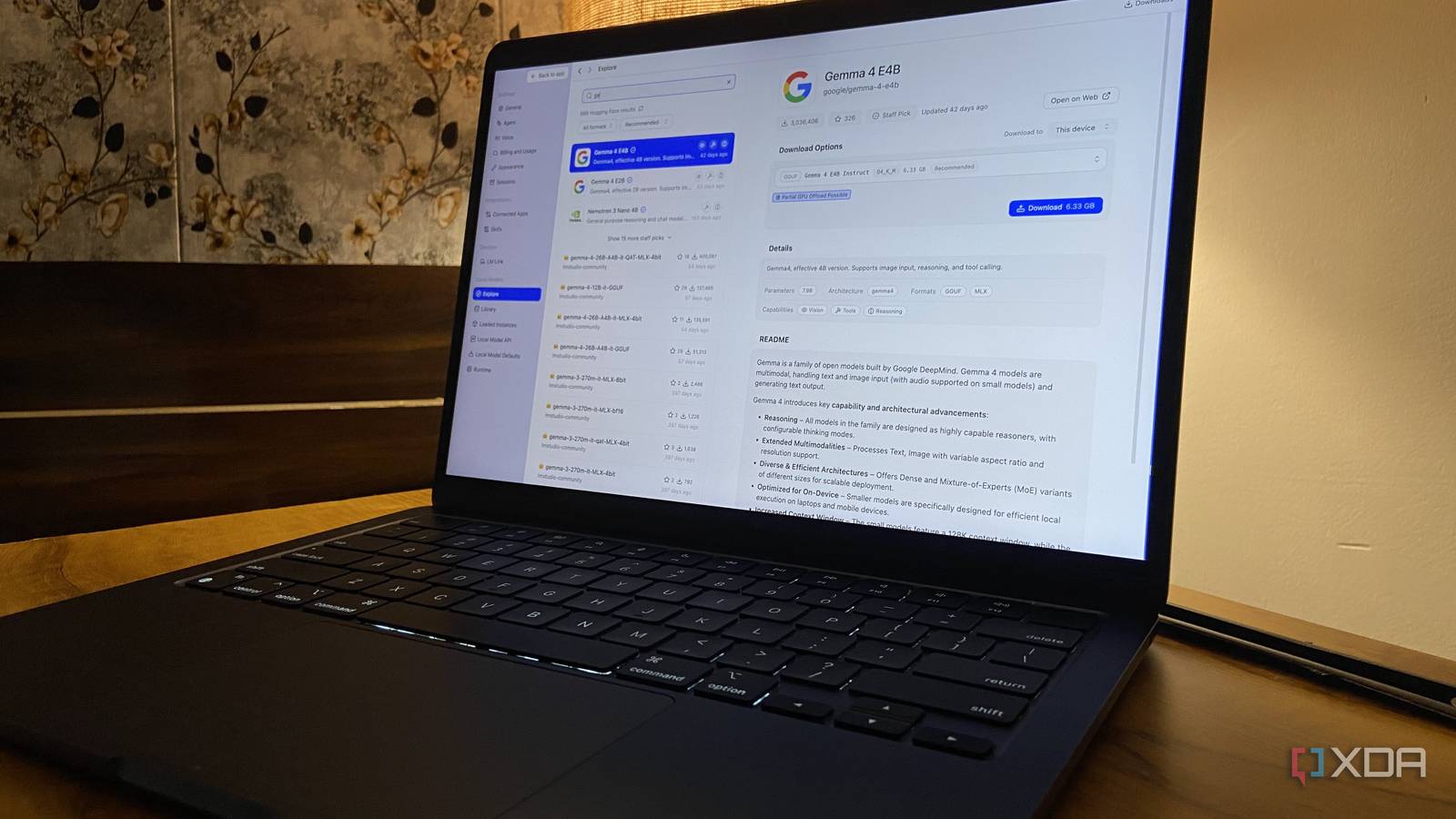
Published Sep 16, 2026, 12:30 PM EDT Abhinav pivoted from a career in banking to pursue his first love in writing. Even while working full-time, he continued contributing as an editor-at-large, a role he has held for more than 7 years. A lifelong tech enthusiast who has built three gaming and productivity powerhouse PCs since 2018, his passion for technology keeps him closely following the semiconductor industry, from NVIDIA and AMD to ARM. His MSc dissertation explored how artificial intelligence will reshape the future of work, reflecting his curiosity about the wider social impact of emerging technologies. From the looks of it, it doesn't seem like my M2 MacBook Air can do much besides running productivity software and casual web browsing. With an 8-core CPU, 10-core GPU and 8GB of unified memory, most people would write this kind of device off when it comes to any local AI inference. And yet, it comfortably runs a capable 4B-class model at nearly 30 tokens per second at Q4_0 quantization, and all I had to do to get it there was to find the right build. Google's quantization-aware-trained (QAT) build of Gemma 4 E4B comes in at just 5.15GB, which leaves enough room for macOS to run seamlessly alongside it. Recently, I've realized that three of the subscriptions that I've been paying for every month do jobs that this model can handle on its own. Grammarly charges $30 a month to fix what I don't get wrong Gemma 4 was the editor I needed all this time Grammarly is one subscription that has spent years trying to convince me that I needed help writing my formal emails correctly, but the problem is, my sentences are usually grammatically fine. What I needed was someone to tell me when I've used 40 words to say what could've been said in 20, or when a paragraph is technically correct but still feels bloated and out-of-place. This is one of the reasons why I was more accepting of Gemma 4 than I ever was of Grammarly. I could throw a paragraph at it and ask it to tighten the writing, and then have it return professional, concise, and conversational variations with an explanation of what it has changed, and why. Part of the reason why it feels right to use an LLM instead of a dedicated grammar-fixing service is because it feels like having an editor peruse my emails for tone and voice before they're sent to the recipient. Unlike a cloud-based assistant, it doesn't ask me for an account, a subscription, my credit card details, or even an internet connection for the times I'm on a flight or away from home. This probably goes without saying, but unlike Grammarly that costs $30 for a plan that I want, Gemma doesn't need anything besides the laptop I'm running it on. I was paying $8 a month to make sense of my own notes This job never needed a ChatGPT Go subscription This is going to be a fairly obvious entry into the list, but what makes it embarrassing, nonetheless, is how long it took for me to realize that most of the tasks I was using my ChatGPT Go subscription for could perfectly be managed by an 8B model. I would often dump a pile of notes from a testing session or the data I had collected over a week every Friday, which included half-formed sentences and numbers with no context, and ask it to pull out whatever mattered. Sometimes it would produce a summary, sometimes an outline, and other times, just a more organized version of whatever I had jotted down the first time. I'm not saying that it's not useful work, but it certainly does not warrant the capabilities of a model trained on a data center's worth of compute. Gemma 4, on the other hand, can do it all on an M2 MacBook, and the part that makes it worth using is that an internet connection is entirely optional. I don't rely on any sophisticated reasoning abilities just for summarizing my own material, especially when I already know what the notes say and just want them organized. Because this particular build carries Gemma 4's vision encoder alongside the text model, I can point it to a photograph of a written note or a screenshot that I took and expect it to work the same way. Querying my PDFs shouldn't cost money And shouldn't have me relying on a cloud provider either Local models are dime a dozen these days, which makes it slightly absurd that I was paying Adobe for the ability to ask questions about my own documents. Acrobat Studio is $24.99 a month, and the thing that this tier adds over the $19.99 tier is mostly the AI assistant that gets you to summarize and find information. For an embarrassingly long time, I simply assumed that a 4B model simply couldn't handle documents, but as it turns out, the problem was mine. I was working entirely with Ollama, which accepts text and images but has no way to accept a PDF, so every attempt meant extracting text the old-fashioned way first, which made it cumbersome enough to justify another subscription. If you use a harness with document support, like LMStudio or OpenWebUI, with the very same model, you'll find that it works. You can drop the file in, ask what you want to know, and the answers come back just as expected. Don't disqualify your hardware from running local AI before you give it a go The MacBook Air isn't an AI workstation by any means, but with smaller, much more capable models coming out, it absolutely does not need to be to save me some money otherwise spent on subscriptions. The right model for your hardware can easily turn into a capable private assistant and help you clean up your drafts, organize your information, or just help you understand your own notes better, like it did for me. Of course, this goes beyond tiny models. For workstation-class PCs, users have been able to replace services like GitHub Copilot with larger models like Qwen 3.8 27B, and if you let it, your hardware could do a lot more for you than you think.
My local LLM is small enough to run on my laptop, but smart enough to replace these 3 subscriptions
Full Article
Original Source
Read the full article at Xda-developers →KhanList aggregates and links to publicly available news content. We do not host full articles from third-party sources. Always verify important information with original sources.