
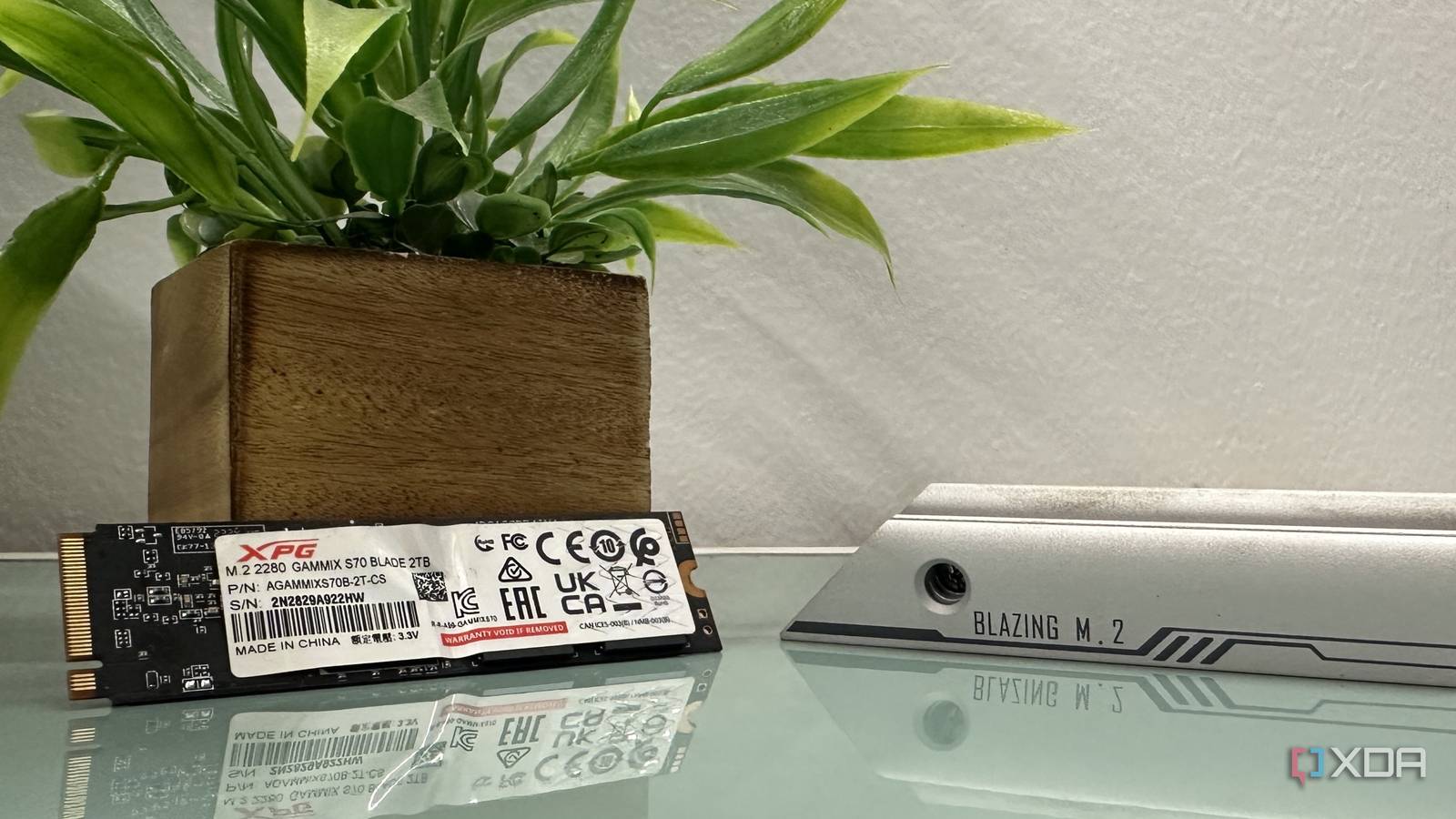
Published Aug 22, 2026, 12:00 PM EDT Abhinav pivoted from a career in banking to pursue his first love in writing. Even while working full-time, he continued contributing as an editor-at-large, a role he has held for more than 7 years. A lifelong tech enthusiast who has built three gaming and productivity powerhouse PCs since 2018, his passion for technology keeps him closely following the semiconductor industry, from NVIDIA and AMD to ARM. His MSc dissertation explored how artificial intelligence will reshape the future of work, reflecting his curiosity about the wider social impact of emerging technologies. Back in 2020, PCIe Gen 4 NVMe SSDs were the most popular choice to build your PC around, and the figures on the box sold carried enormous enthusiast appeal. As someone who was coming from SATA SSDs, reading sequential speeds on the box that went all the way up to 7,000 MB/s made the former look positively ancient. When I finally picked up the XPG S70 Blade, I had high expectations, and sure enough, the numbers and the proposition of the drive being up to twelve times faster than my existing storage solution fed into them. So, naturally, I felt a little surprised to see that my PC's boot times, game load times, and app launch time felt almost identical after making the switch. It was evident that the biggest leap in storage performance had already happened years earlier, and what was crucial to my user experience had very little to do with what the upgrade had to offer. My fastest SSD barely seemed to impact my experience The biggest performance leap had already happened I vividly recall the anticipation that had built up after I installed the Gen 4 NVMe SSD, which was, after all, cutting-edge in 2020. I hit the power button, watched the Windows logo pop up and fade away, and proceeded to sign in to launch every app that I had been using. A part of me had been expecting the desktop to feel noticeably quicker in every possible way, like it felt from jumping from a spinning HDD to flash-based storage. It took me perhaps less than an hour to realize the fault in my expectations. I had taken the twelve-times figure as a sign that the entire system would suddenly get snappier by that factor. What happened instead was that every one of the tasks I had listed had become about five, or perhaps six seconds faster than usual. NVMe SSDs were solving a problem I didn't have SATA SSDs had already bridged the chasm I'd argue that the biggest surprise coming from this shift came from how game loading times behaved. One of the first games I decided to launch with my new storage configuration was Grand Theft Auto V, because if there was any game on my library that could benefit from faster storage, it was the one that was infamous in its day for the lengthy loading times. Yet, the upgrade only put me in Los Santos about five to six seconds quicker. I don't mean to say that this wasn't a welcome improvement, but it was nowhere near night-and-day that I'd expected. I was introduced to PC gaming from an Xbox One X, which used a mechanical HDD. Anyone who has played any AAA title on a 2017 console would know that it was effectively a realm where loading times were frequently measured in minutes, rather than seconds. Moving to a SATA III SSD in 2020, therefore, effectively shaped my perception of what an "upgrade" should feel like, so it's natural that a SATA to NVMe jump paled in that comparison. When the rest of my library retold the same story, it was clear that the order-of-magnitude perceptual leap was HDD to SSD on random access, and that a SATA SSD is already fast enough to saturate my perception. The Gen 4 interface ceiling, on the other hand, never gets touched during ordinary use. The advantage genuinely matters in one particular workload High sequential speed is brilliant, just not where I thought To understand the real advantage a Gen 4 NVMe brings to the table over a SATA III SSD (like the one I was accustomed to), demands an understanding of how the two architectures are unique at the level of the interface each one speaks through. My old SATA SSD was tied to a connection designed back in the era of HDDs, and that link capped out somewhere around 550 MB/s. The Blade skips that bottleneck and talks to the system over the PCIe bus, which has the headroom to carry data more than ten to twelve times faster as advertised. Now, one might wonder why there's such a huge gap between the perceived speed and the speed at which data can travel, which is reported on the box. This happens because the number describes only one way of reading the data, and that is sequential access. This comes to matter in specific workloads, and that only relates to large, continuous file transfers. Every other aspect of the PC user experience, on the other hand, delves into random I/O performance. Booting into an OS, opening an app, or loading a game is all random access, and dependent on thousands of tiny 4K reads scattered across the drive and requested a couple at a time. In this specific type of workload, both drives collapse to a fraction of their rated speed and the gap between them nearly closes. 4K random read SATA III SSD (860 Evo) PCIe Gen 4 NVMe SSD (XPG S70 Blade) PCIe Gen 5 NVMe SSD (T700) QD1 (Booting and loading workloads) 40-45 MB/s 80-85 MB/s 80-90 MB/s QD32 (Synthetic benchmarks) 380-400 MB/s 1600-2500 MB/s 2000-2800 MB/s Sequential read 550 MB/s 7000-7400 MB/s 12000-12400 MB/s Another aspect that factors in NVMe SSD performance, in particular, is the role of CPU decompression. The Blade can push data across the PCIe bus at several gigabytes per second, but a game's assets arrive compressed, and the CPU that has to unpack them typically only manages 1–2 GB/s doing so. This essentially means that the drive ends up delivering data faster than the processor can feed it to the GPU, which enforces this ceiling. It's common to misread what SSD upgrades mean If a SATA-to-Gen 4 NVMe jump barely moves my daily experience, I am convinced that a Gen 5 drive at almost twice the price and twice the sequential speed will not either. In most tasks surrounding the everyday workload of the average user, random I/O speed becomes the determiner of the experience, not the headline bandwidth. It's not all that uncommon to see users make a purchase decision on the basis of the latter. Until such a point in time when the workload genuinely saturates the sequential throughput, purchasing the fastest SSD on the shelf becomes an exercise in chasing diminishing returns, and that's a lesson hard learned.
My first NVMe upgrade taught me the drive was never the bottleneck I thought it was
Full Article
Original Source
Read the full article at Xda-developers →KhanList aggregates and links to publicly available news content. We do not host full articles from third-party sources. Always verify important information with original sources.