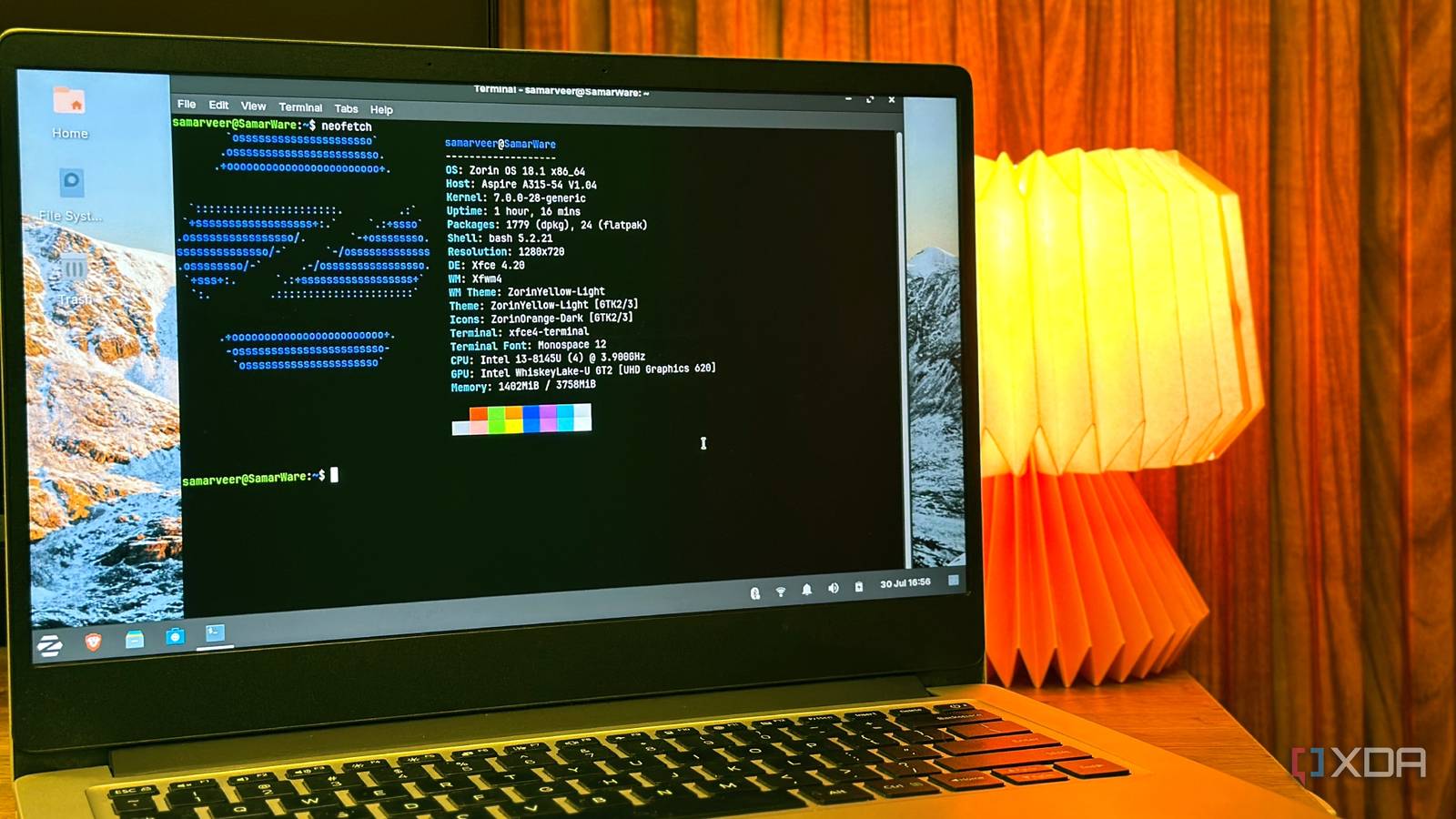
Published Aug 6, 2026, 12:30 PM EDT Gaming has been Samarveer’s greatest passion, and the Literature graduate in him takes immense joy in dissecting games for their themes, messages, and impact. Samarveer holds a deep appreciation of gaming, and considers the platform to be the most immersive and impactful across all media. He can be found engaging with gaming communities online, always ready to debate the finer points of ray tracing or itching to write an 8-page collegiate thesis on any game that impacts him emotionally. Summary I revived a sluggish laptop with Zorin OS Lite, making it fast, responsive and usable again. I stopped comparing Linux to Windows and judged it on what it actually solved for me. The right lightweight OS showed me software, not hardware age, was killing the device. Linux has always lived in the back of my mind as an operating that system enthusiasts couldn't stop recommending. For me, however, every conversation about switching from Windows to Linux always seemed to revolve around what I'd be giving up instead of what I'd gain. Since I've been perfectly happy with Windows on my main PC, I kept my distance. Fast-forward to last weekend, and my first Linux installation finally happened — but it wasn't a weekend experiment driven by curiosity. Instead, it happened because Windows had pushed a 2019 laptop to the brink of becoming e-waste. It made me stop comparing Linux to a polished Windows experience, and start comparing it to a machine that had become unusable and sluggish. This shift in perspective made my first experience with Linux turn out far better than I ever expected. Curiosity made me judge Linux before I even used it My biggest mistake was expecting it to behave like Windows On my regular, high-end desktop PC with a GeForce RTX 4070 Ti and a Ryzen 5 7600X, installing a new Linux distro would have made my brain immediately start treating it like a replacement for Windows instead of a different tool altogether. Running into an unfamiliar menu, shortcut, or application would have had me immediately asking, "Why isn't this like Windows?" all before I'd even given it a fair, honest-to-goodness chance. While Windows 11 took up over 50GB of my limited 256GB hard drive on the laptop, Zorin OS Lite takes up just over 17GB. A lot of people who try shifting to Linux unsuccessfully report these problems as well. I would've done the same thing myself, complaining about how installing software worked differently, and how familiar apps were missing. None of it would have been Linux's fault, but that's what would've dominated my first impression, simply because Windows would've remained my benchmark for everything. Looking back, I realize that curiosity would've turned my first Linux installation into a constant comparison exercise. It was the fact that I needed the laptop to feel usable again that I didn't spend my entire time measuring how closely Zorin OS Lite resembled the Windows experience. Instead, I got to discover what Zorin did and judge it on its own merits. If this had been an exercise in curiosity rather than necessity, I'd have already made up my mind before the desktop had even finished loading, and a couple of hours later, I might even have given up trying to operate a laptop that, for all intents and purposes, had come back from the dead. Windows had to stop being the benchmark first I had to appreciate Linux for what it could do In order to revive an old Acer Aspire running on an i3-8145U at 2.10GHz with just 4GB of RAM, I couldn't have afforded to be picky about the operating system. I had to take any operating system that could make the laptop usable again. Windows 11 had already exhausted my patience with some painfully slow boot times, with even just a handful of startup apps struggling to run five minutes after boot. This was a machine that was inching towards retirement every single moment, after all. That's what changed the way I experience Linux. As soon as I booted into Zorin OS Lite, I didn't nitpick the layout of the Start menu, or wonder why a particular setting lived somewhere else. Those things felt insignificant because the laptop was responding instantly to everything I asked of it. It's pretty hard to complain when the biggest problem I'd been trying to solve just up and disappeared. Instead of the gold standard to compare Zorin again, Windows became the problem I was trying to escape. Watching Zorin OS Lite suddenly make my laptop faster than it had ever been, was like watching an old friend recover from a long illness. The hardware's still the same as it was seven years ago, but this laptop is now more energetic than ever before. Every click feels immediate now, and every application opens without protest. Windows was the problem I was trying to escape instead of the gold standard that I'd measured the laptop against, and that made all the difference. Linux happened to be the solution that reminded me just how much life this aging laptop still has left in it, especially if the next option is to turn it into a headless Linux-based home server with its own built-in UPS. I'm actually glad that Linux wasn't my first choice The best way to judge a tool is to let it solve a real problem I'm pretty positive that I wouldn't have appreciated Linux nearly as much if I'd installed it on my gaming PC or even my newer, 2023 laptop, out of sheer curiosity. I'd have spent hours comparing software libraries, checking game compatibility, seeing what runs through Proton and what doesn't, and ultimately measuring every step of the way against an OS like Windows 11, which was already doing everything I needed. That would have been a rather unfair fight, too. Thankfully, that's not what happened here. Linux walked into a situation where Windows had already failed. It didn't have to compete with my daily driver or ask me to abandon years of habit. It had one simple job: breathe life back into a laptop I'd all but given up on. It did exactly that, and in the process, completely changed how I looked at Linux itself. Zorin OS A polished Ubuntu-based distro that's perfect for a Windows or macOS convert who yearns for a nice UI and default tools. The right software can outlive the hardware We've become surprisingly comfortable treating aging computers as disposable, when in reality, it's often the software that has outgrown the hardware instead of the other way around. An operating system should complement the machine it's running on, not constantly demand from it until replacement feels inevitable. My takeaway from my first Linux experience was that hardware never really wakes up obsolete one day. With the right software that respects the limitations of hardware instead of punishing them like Windows 11 did to my laptop, years of forgotten potential can suddenly come back into view.
My first Linux experience was born out of necessity instead of curiosity, and that made all the difference
Full Article
Original Source
Read the full article at Xda-developers →KhanList aggregates and links to publicly available news content. We do not host full articles from third-party sources. Always verify important information with original sources.