
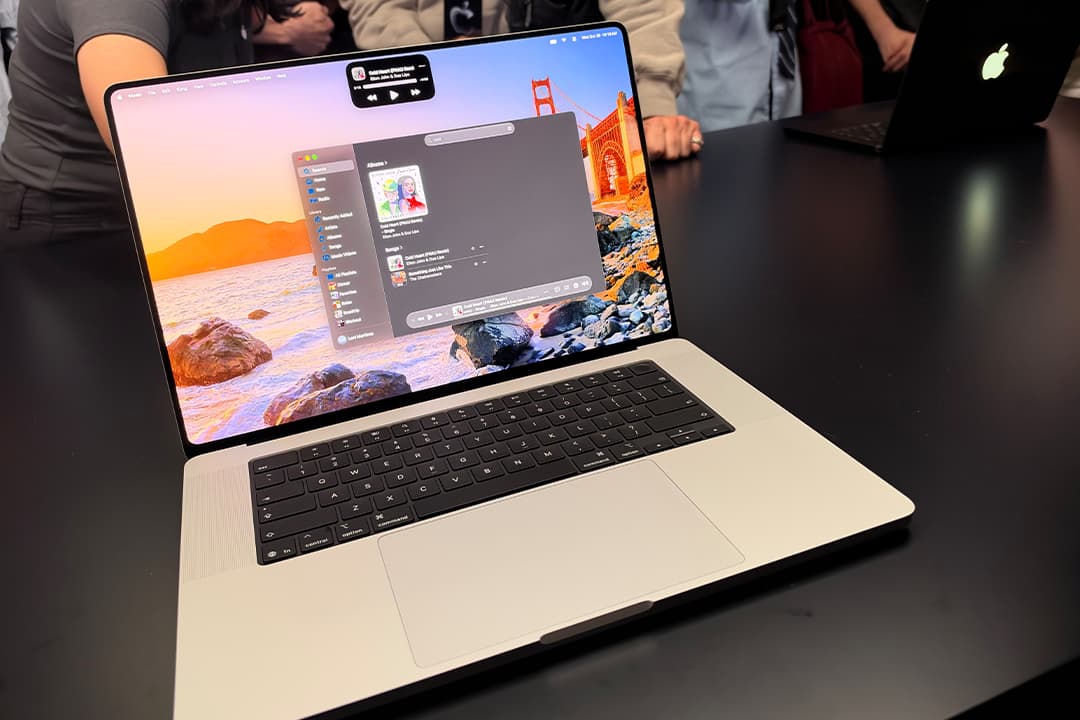
In a relaxed and intimate event in Los Angeles, Apple CEO John Ternus unveiled the first Mac laptop to use an OLED screen. Oh, and it’s also the first laptop from the company with a touchscreen – something many non-Apple laptops have had for years. Just as importantly – for the audience at the event at least – was the return of a backlit Apple logo on the laptop’s lid. The new laptop is also a touch thinner and noticeably lighter than current MacBook Pro models and has replaced the notch at the top of the screen where the camera sits with a much smaller cut-out. This includes Apple’s trademark Dynamic Island, which expands to display useful information like what music track you’re playing. My first reaction to the new machine was how bright, rich, detailed and contrasty the screen looks – Apple has coined a new word, so the official title is MacBook Pro with PROLED XDR Display. Here’s everything you need to know. Apple MacBook Pro with PROLED XDR Display David Phelan/The StandardDisplay Because OLED emits light from each pixel individually, it can deliver outstanding contrast and deep black shades. But it’s dimmer than regular LED screens. However, Apple has built this display with Tandem OLED, which puts two sets of light-emitting layers in the place of one, and the result is a spectacularly good effect – even in an extremely well-lit demo room. Brightness levels were measured at up to 1,000 nits of sustained brightness across the full screen on previous MacBook Pro screens, which use mini-LED. That level is the same on the new model, but peak brightness is much higher here – up to 2,000 nits instead of 1,600 nits.The contrast levels are also extreme. Apple says the contrast ratio is 10 million-to-one, against the already high million-to-one contrast ratio of a regular MacBook Pro. In short, the display looks awesome.TouchscreenApple has resisted putting a touchscreen on Apple laptops until now, so the change is a major one, though Apple was emphasising the OLED upgrade more. After all, the ergonomics of a device with keyboard and trackpad mean your fingers stay low, but touching a screen means a different movement. There’s something more intimate about a touchscreen, letting you touch the image you want to zoom in on or spin a camera in a 3D program.Of course, there are Apple specialities: when you touch your finger on the screen to close a window, for instance, the relevant icons grow so it’s easier to tap just where you need to. DesignDavid Phelan/The StandardThe lower weight is a benefit, and the 14-inch model is 170g lighter than the non-OLED model, though current MacBook Pro models are remarkably light already. Similarly, the change in dimensions is good to have but is not dramatically different from the current range. The other visual change, the return of the backlit Apple logo on the laptop lid, is great. Where the metal logo on other models gleams invitingly enough, the bright LED logo is unmissable, especially in a darker room.Processor The new model has the choice of M5 Pro and M5 Max chips inside, both of which are super-fast and offer professional and demanding users lots of power. For the rest of us, it’ll just be even faster than it is now. Is the Apple MacBook Pro with PROLED XDR Display worth it?David Phelan/The StandardThe MacBook Pro with PROLED XDR Display was the third new Mac computer announced this week, after the reveals of the first MacBook Pro with M6 chip and an upgraded iMac, also with M6 included. But Apple saved the best till last, building up to the new OLED model with its fast performance and improved design. All the new models became available to pre-order seconds after the latest one was announced and go on sale on Friday, 6 November. With all these changes, it’s no surprise that the price of the new model is higher than the rest of the range, starting at £2,899 – the latest MacBook Pro without OLED costs from £1,999.
My first impressions of Apple's first-ever touchscreen MacBook Pro – and how to pre-order
Full Article
Original Source
Read the full article at Standard →KhanList aggregates and links to publicly available news content. We do not host full articles from third-party sources. Always verify important information with original sources.