
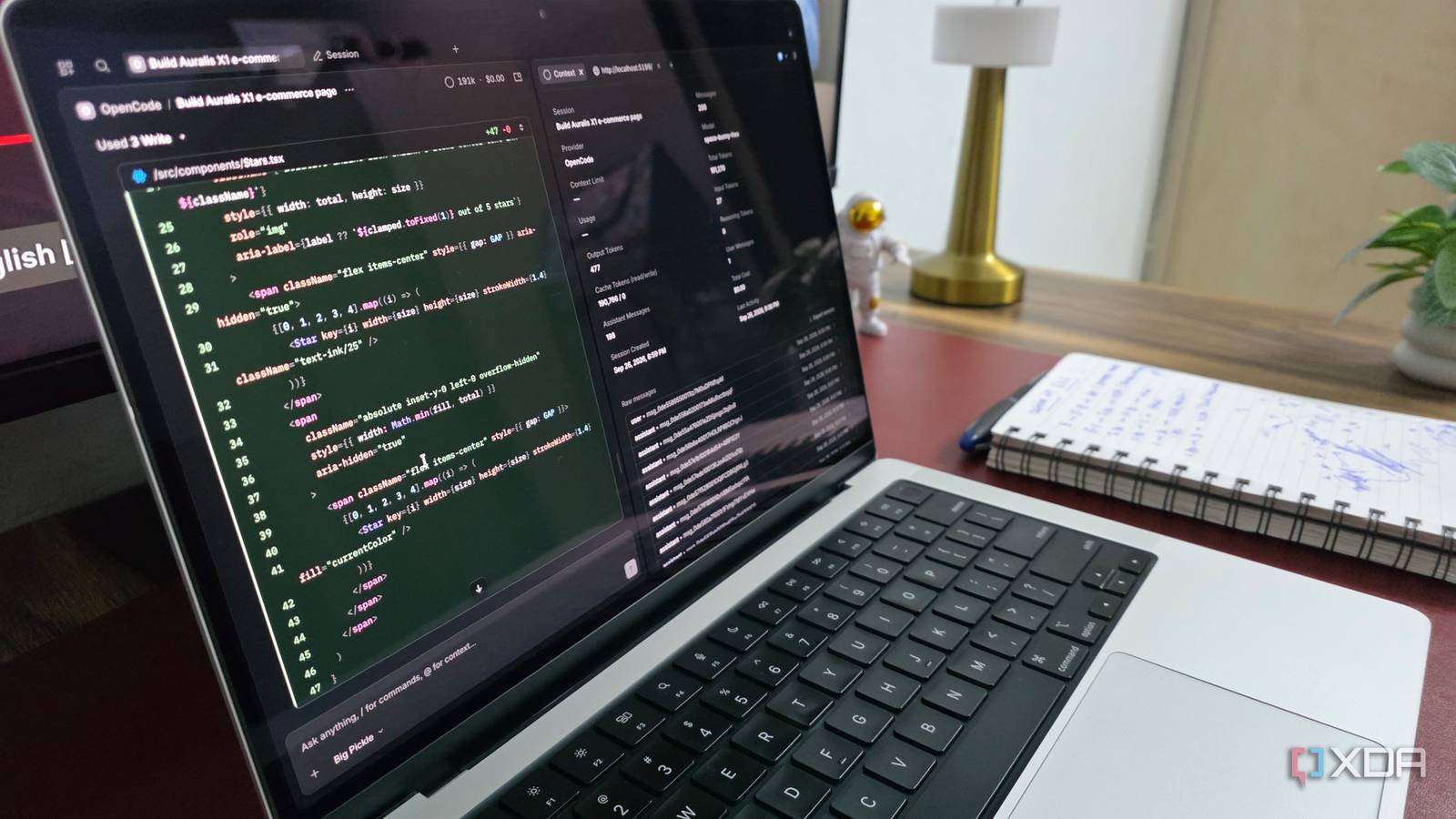
Published Oct 31, 2026, 6:01 AM EDT Parth, a seasoned tech writer, wields the keyboard (or pen) with finesse to unravel the intricacies of both Windows and Mac operating systems. He has covered evergreen content on mobile devices and computers for multiple publications over the last six years. You can find his work on AndroidPolice, GuidingTech and TechWiser. Whether it’s demystifying system updates, deciphering error codes, or exploring hidden features, Parth’s prose guides readers through the binary maze. When not immersed in tech jargon, you’ll find him sipping chai, pondering the next software review, and occasionally indulging in a friendly debate about mechanical keyboards. AI coding assistants have become capable, but I have always felt that there is a catch. Whether I am using Claude Code, Codex, or Cursor, I often end up working within a particular ecosystem. That’s why OpenCode immediately caught my attention. It’s a free, open-source AI coding agent that promises something different: the freedom to choose my preferred AI models, work across different environments, and even run everything locally for greater privacy. What is OpenCode, and why did I try it? An open-source challenger worth exploring OpenCode is a free, open-source AI coding agent. At first glance, it may look like another Claude Code alternative, but there is more to it than that. Unlike coding assistants tied to a particular AI provider, OpenCode lets you choose the models you want to work with. Having experimented extensively with Claude Code, Codex, and Cursor, I wanted to explore something that offered more freedom without compromising essential coding capabilities. I especially liked the idea of switching between AI models by task instead of relying on a single provider. The possibility of running coding agents locally for better privacy was another major reason I decided to give OpenCode a shot. I am no longer tied to one AI provider One interface, dozens of AI models One of my biggest frustrations with AI coding assistants is how easily I end up depending on a particular AI provider. With Claude Code, I am mainly working with Anthropic’s ecosystem, while Codex revolves around OpenAI’s models. Similarly, Cursor focuses on Grok models by default. In comparison, OpenCode supports more than 75 AI providers, including Anthropic, OpenAI, Google, xAI, DeepSeek, and OpenRouter. For example, I could use Claude for complex reasoning, Gemini for everyday development, and a different model for debugging or smaller coding tasks. I can finally keep my code private Local AI changes the privacy equation Privacy is another major reason I find OpenCode so appealing. Most mainstream AI coding assistants rely heavily on cloud-based models, which means portions of my codebase and prompts may be sent to external servers for processing. OpenCode gives me another option. I can connect it to Ollama, run a compatible coding model locally, and handle development tasks without sending my source code to an external AI provider. OpenCode has also helped me rethink how I spend my AI coding budget. I don’t necessarily need a premium Claude model for every little task. For straightforward jobs like generating boilerplate code, tweaking CSS, creating basic components, or fixing minor bugs, I prefer using the capable free models like DeepSeek or Beam through OpenCode. This approach lets me reserve my Claude Code usage and tokens for projects that genuinely demand stronger reasoning, complex debugging, architectural decisions, or codebase refactoring. I tried creating a complex website using the space-bunny-free model, and it did a solid job at first glance. Of course, free cloud models don’t offer the same privacy benefits as running AI locally, and smaller local models may struggle with demanding projects. Still, I appreciate having these choices within a single application. I can work from almost anywhere Open-source changes the cost equation Another thing I appreciate is its flexibility across development environments. OpenCode offers a terminal-based interface, a dedicated desktop app, and IDE integration. Whether you prefer working directly from the command line or using a more familiar graphical interface, there is an option available. Since I frequently switch between my Windows desktop and MacBook, having a consistent coding assistant across both platforms is a huge convenience. For example, I can start building a personal finance dashboard using OpenCode on my Windows PC and later continue working on the same project from my MacBook after syncing the project files. I can also launch OpenCode from VS Code without leaving my existing workflow. The dedicated desktop interface is useful when I don’t feel like dealing with terminal commands. This flexibility may sound like a small convenience, but it makes OpenCode much easier to incorporate into my everyday development routine. I get the power of a terminal-based AI agent without being restricted to the terminal. OpenCode’s open-source nature is another major advantage. I don’t need another expensive monthly subscription just to access the coding agent. Better yet, I can connect several capable free AI models for routine development tasks. For instance, if I need to adjust a dashboard’s CSS, generate a simple component, or fix a minor JavaScript error, I can use a free model instead of consuming my premium Claude Code allowance. A smarter alternative to closed ecosystems It’s easy to get comfortable with a coding assistant that works well and never bother looking elsewhere. However, experimenting with OpenCode has reminded me why it’s important to keep exploring alternatives. Between its open-source nature, support for multiple AI providers, local model integration, and powerful customization options, there is plenty to appreciate here. So, what are you waiting for? Keep experimenting, challenge your existing workflow, and give alternatives like OpenCode a fair chance. OpenCode OpenCode is an open-source alternative to Claude Code and Codex.
My favorite Claude Code alternative isn't Codex or Cursor: it's something way more powerful and open-source
Full Article
Original Source
Read the full article at Xda-developers →KhanList aggregates and links to publicly available news content. We do not host full articles from third-party sources. Always verify important information with original sources.