
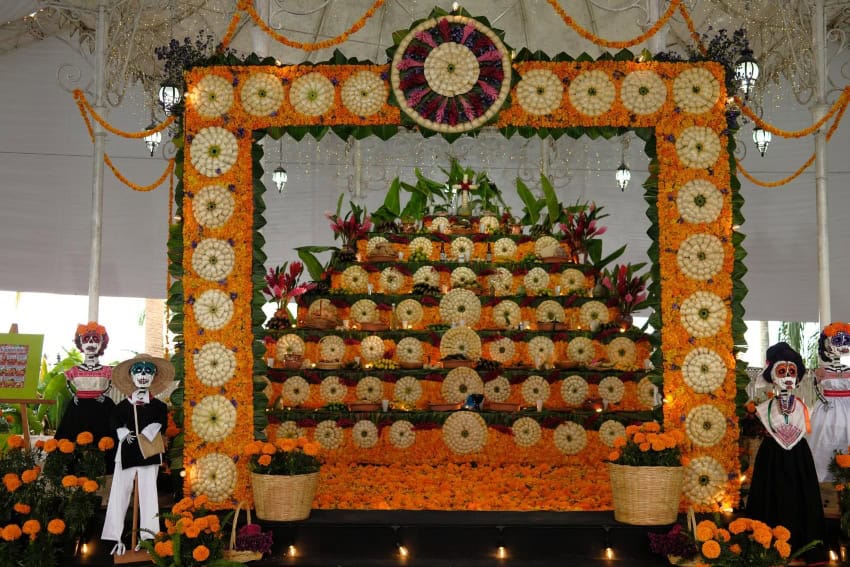
There are certain magical aspects of living in Mexico that simply cannot be replicated elsewhere — its foods, traditions and seasons. And because of Mexico’s vast geography and cultural topography, many of those elements can be heightened by being in the right place at the right time. In that regard, nothing compares to Día de Muertos: A time of year in which colors are blooming, communities are celebrating and honoring loved ones, and regional gastronomy, customs and superstitions are on display for everyone to be collectively immersed in. Beyond the obvious, increasing importance of the Mesoamerican holiday in Mexico for so many native families and local households, Día de Muertos means something especially personal for me and my family since it marks our anniversary of having moved to Mexico from California. The holiday always reminds me of arriving in Mexico after having gained dual citizenship and being received by festive parades, open-armed friends and relatives, and getting a dose of Mexico’s fullest, most complex flavors that have come to define what we most enjoy about living on this side of the border. An altar on display at Hotel El Encuentro, near the center of Cuetzalan. (Briana Chazaro) Building our own annual tradition My wife’s and my own appreciation for Día de Muertos extends further back, years before we had fully relocated to Mexico. In 2019, we visited my mom, who is Mexican-born and was living on my abuelo’s ranch in Oaxaca at the time. We spent a month traveling the state of Oaxaca with her. The highlight? A full week of Día de Muertos in Oaxaca City. I’ll never forget when we arrived, hopped off the bus, dropped our things off and went into the loud, colorful streets as Oaxaqueños had already kicked off their days-long celebration in the middle of the afternoon. A man wearing a Spider-Man mask saw us standing among the crowd, and as we soon found out would be a common occurrence and part of the local hospitality, he offered to pour out a shot of mezcal from the bottle in his hand. As an outsider, there is no warmer welcome on the planet than someone picking you out of the masses on the street and pouring you mezcal. It’s a spirit and energy that would come to embody every Día de Muertos holiday we’ve experienced — the sense of connection and togetherness. Since then, we’ve turned it into our own tradition to celebrate the holiday in different parts of Mexico as often as we can. Does having dual citizenship have any downsides? The regional nuances of Día de Muertos My wife recently shared a visual map with me that outlines the different kinds of pan de muerto that are prepared throughout Mexico, based on each state’s history and gastronomic influences. Her point, besides nudging me to pick up another round of pan de muerto for our house, was that Mexico offers more to try than we know, especially whenever Día de Muertos rolls around. It’s true. Everywhere we’ve been during this season has always presented a new way through which to experience and understand the multidimensionality of how the holiday is celebrated and revered. Nearby, in the town of Naolinco, Veracruz, and its surrounding mountain communities, the festival is largely centered on the cempasúchil. This year, the community of San Pablo Coapan welcomed thousands of visitors for its fifth annual Festival del Cempasúchil, in which the local cempasúchil farms open to the public with a festival-like array of activities, food and Instagrammable photo ops. The flower fields are decorated with playful calaveras that are decorated in Veracruzano style, ranging from a 25-foot-tall Jarocho skeleton to a human-sized fútbolero in the afterlife wearing a Tiburones Rojos soccer uniform from the 1990s (a team that no longer exists but certainly evokes memories for anyone who recalls the historic Veracruz team and grew up watching Liga MX). In the pueblo of Naolinco proper, just a few miles up the mountain, Día de Muertos is celebrated with “La Cantada” (or a townwide serenade), where locals go around singing from the cemeteries to the streets throughout the night. Major cities and regional rituals Of course, there are the more globally popular and large-scale interpretations of Día de Muertos that can be seen in Oaxaca or Mexico City. In both cases, the holiday draws countless international and domestic visitors who join in on the fun and traditions as local families honor their deceased relatives with a mix of humility and bombast. In both Oaxaca and Mexico City, expect massive gatherings of happy-go-lucky tourists and locals, as you’ll have to shuffle your way around the crowds and generally pay higher prices. The celebrations are bigger, louder and, to a degree, more capably geared toward tourism than other locales. I’d say for starters, both Oaxaca’s capital and Mexico City are a comfortable entry point into Mexico’s sprawling multiverse of Día de Muertos, as they provide broadly appealing and easy-to-navigate celebrations, both of which my family has enjoyed and experienced ourselves multiple times. Of course, we still have a bunch of places to visit on our wishlist that I’ve been told about by my Mexican family members and other travelers. In the Huasteca jungles, “Xantolo” brings the holiday to life with “La Viejada,” a regional masked dance in which townspeople dress up as elders (similar to Veracruz’s “El Viejo del Año Nuevo” custom at the end of every year) to remember their relatives. Indigenous customs from Huasteca to Campeche In parts of Michoacán, there is a lake procession where the Purépecha fishermen use torches to light their path across the water and celebrate with all-night vigils. Choo Ba’ak, a bone-washing ritual that happens every year in the Campeche pueblo of Pomuch, is part of Hanal Pixán (the Maya Day of the Dead) and offers an idiosyncratic version of the holiday unlike the contemporary mainstream version that is usually portrayed. National Geographic described the ceremony as such: “…families wash the tombs and clean the bones of their deceased. After the cleaning they keep the ossuaries, or the box where the bones are deposited, open so the skulls and bones receive sun and air, as dictated by tradition. Relatives also arrange, paint and adorn the ossuaries and cover them with an embroidered white tablecloth bearing the name of the deceased.” In Huaquechula, Puebla, unique altars — three to four stories tall, resembling a pyramid — are on display inside homes, with each layer of the altar representing a different aspect of life and death (the earth, the heavens and a celestial summit). The elaborate designs are typically defined by white cloth and marigolds. As a taxi driver in Oaxaca once told me, you’d need more than a few lifetimes to truly experience all that Mexico has to offer regionally for Día de Muertos. Day of the Dead decorations could be seen everywhere, even in the subtle details, in Cuetzalan. (Briana Chazaro) Our highlights from this year in the mountains of Puebla The Pueblo Mágico of Cuetzalan del Progreso is tucked away in the northernmost edge of the state of Puebla, high up in the Sierra Norte mountains. Unlike the majority of Puebla, which is commonly known for its arid plateaus and Talavera pottery in its state capital and surrounding areas, northern Puebla offers a microclimate and culture of its own that more closely resembles the humid, tropical and high-altitude Indigenous communities of Papantla in northern Veracruz, which is located just a few miles away on the other side of the mountain. It’s not what one might think of when thinking of Puebla. And yet, it’s where regional customs for Día de Muertos are flourishing. We drove roughly four hours north of Xalapa (or about five hours northeast from Mexico City) to experience it for ourselves this year. We weren’t disappointed, to say the least. The town’s architecture alone is worth the winding mountain curves that one must navigate to reach the small, ages-old village that is — because of its elevated location in the mountains — famously drenched in drizzly mist and rainfall. The narrow alleys and steep, cobblestone paths (which all lead to the gorgeous Parroquia de San Francisco de Asís and its Totonac voladores, who perform their flying ritual on a sky-high wooden pole at the center of the plaza) resemble a miniature version of Guanajuato’s capital city, without the overcrowded tourism and with a hyper-local texture. Flying globos de Cantoya into the night I was told by a couple of young locals that families don’t commonly celebrate Día de Muertos by visiting the graveyards overnight (which is the tradition elsewhere). Instead, they light “globos de Cantoya” (miniature hot-air balloons made from paper and other materials) and send them off into the night. One of the most defining aspects of Day of the Dead in Cuetzalan is the releasing of globos de Cantoya, or small paper balloons, in front of Parroquia de San Francisco de Asís. The tradition is meant to guide spirits back to the heavens after they’ve visited their family altars. (Briana Chazaro) From groups of high schoolers to older professionals who’ve mastered the craft, the town gathers on Día de Muertos weekend, as everyone takes turns setting up and sending off hundreds of their custom, artisanal balloons. The balloons — and their makers — vary in style, decoration and success (often, the small balloons will self-combust in flames and come burning back to earth, which can sometimes cause fires in the area). But generally, it’s a safe and spectacular tradition to witness in person. The tradition, as it was explained to me in the pueblo, is meant to represent a path back to the heavens for the souls who are visiting their altars to enjoy the ofrendas laid out. Each globe, as it ascends brightly and colorfully into the night sky, is meant to guide family members back to the spiritual realm. In recent years, Cuetzalan has turned the tradition into a legitimate state-funded festival, known locally as “El Vuelo del Quetzal” (The Flight of the Quetzal), and officially as Festival Internacional de Globos Artísticos de Papel. Surprisingly, the festival is only in its second year of formal operation, which helps it retain a charmingly niche, DIY feeling. Many altars around the pueblo of Cuetzalan were on display, including this one that features pan de muerto, garlic and other treats for returning spirits. (Alan Chazaro) Local flavors and looking ahead During the day, it is all preceded by local dances, voladores, Catrina costume contests and the general ambiance of a Pueblo Mágico worth its salt: excellent food, tianguis and a dense number of historic stairways and nooks to explore. Among the standouts in town, you cannot skip TAOL, which is led by Chef Adriana Márquez and offers elevated, accessible takes on local dishes, including tlayoyos, chilpozontle, itacate, pipián, coffee and more. It’s the kind of chic eatery that would draw lines out the door in Mexico City, but since it’s hidden behind an unassuming stone exterior in Cuetzalan, it is able to offer ample space and friendly prices for what I would consider among the best cuisine I’ve tasted this year. Paired with Día de Muertos activities and the hordes of costumed kids making their rounds on Halloween night to ask for their calaverita at local shops, which my son participated in, a few nights in Cuetzalan is a slept-on destination for late October and early November. Why I’m grateful my son is getting the Halloween-Día de Muertos experience I never had Though we elected to stay home last year to dedicate our time and resources to building and decorating an altar inside our home — with the help of my mom, who supplied many photos of our relatives — we’ve enjoyed going on the road to see how others embrace the spirit of the tradition. I’m already thinking about where we might end up next year and what it will impart. Alan Chazaro is the author of “These Spaceships Weren’t Built For Us” (Tia Chucha Press, 2026), “Notes from the Eastern Span of the Bay Bridge” (Ghost City Press, 2021), “Piñata Theory” (Black Lawrence Press, 2020), and “This Is Not a Frank Ocean Cover Album” (Black Lawrence Press, 2019). He is a graduate of June Jordan’s Poetry for the People program at UC Berkeley and was selected as a Lawrence Ferlinghetti Poetry Fellow at the University of San Francisco. His work can be found in NPR, The Guardian, SLAM, GQ, L.A. Times, and more. He is currently based in Veracruz.
My family always travels during Día de Muertos. Here’s what we’ve enjoyed most
Full Article
Original Source
Read the full article at Mexiconewsdaily →KhanList aggregates and links to publicly available news content. We do not host full articles from third-party sources. Always verify important information with original sources.