
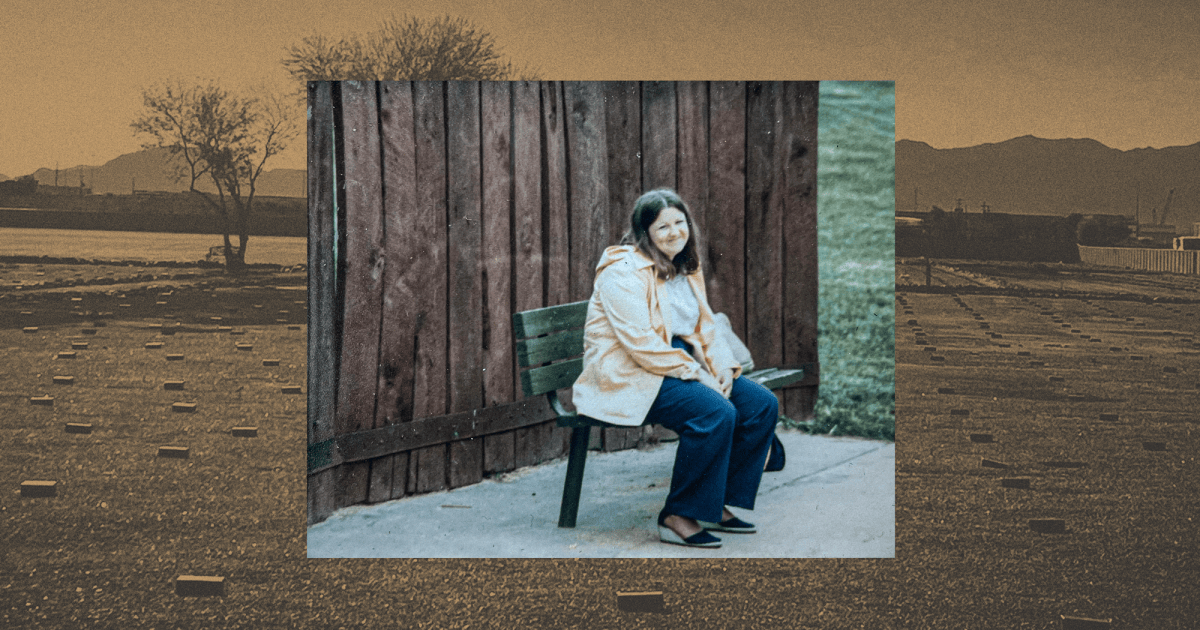
Get your news from a source that’s not owned and controlled by oligarchs. Sign up for the free Mother Jones Daily. On August 11, 2025, the certified letter arrived at my house, informing me that the Maricopa County Indigent Decedent Services Program was trying to locate a family member. “If we do not receive a response from you within 15 days from the date of this letter,” it warned, “our office will authorize to cremate the remains of Pamela Bunting Lewis.” I’d learned of my mother’s death on Friday, August 8, 2025, when the Maricopa County Indigent Decedent Services Program called my uncle, but by the time I heard from him and tried to call them back, they had closed for the weekend. While I had been completely estranged from my mother for more than twenty years, I felt sick as I imagined the worst, reading about the record-high 118-degree temperatures. I knew she had been unhoused and wondered if she succumbed to the heat. I’d spent most of my life hiding from her because her untreated mental illness had first created a rift, and then an unbridgeable chasm between us. I had finished grad school, gotten married, had a daughter who was 10 years old when the letter arrived. I was afraid of my mother and had kept my whereabouts hidden. But there was always a part of me that longed for some miracle of healing—both of her mind and our relationship. I had known that this was extremely unlikely, but news of her passing somehow reconnected us. On Monday, August 11, the Coordinator of the Indigent Decedent Services Program informed me that I was legally “responsible” for my mother’s remains. What this meant was baffling and did nothing to answer my questions about what had killed her. My mother died in Mesa, about 17 miles outside of downtown Phoenix, which has the highest rate of heat-related deaths in the nation; unsheltered people experiencing homelessness comprise about 40 percent of those heat-related mortalities. It would take two more phone calls to finally discover from the county-contracted funeral home that my mother died in a hospital from ovarian cancer. The Indigent Decedent Services Coordinator offered me the option of making a verbal “statement of abandonment,” which would trigger an invoice from Maricopa County for the amount from the funeral home: the price for cremation and other costs. Once the statement of abandonment was made, my mother’s body would be cremated in time for a chain gang of prisoners to inter her ashes at White Tanks Cemetery, a potters’ field. As estranged as we were, I was still her daughter, and knowing she had died alone was bad enough, but this kind of anonymous burial was more than I could face. In shock, I gathered more information before confirming that I would take financial responsibility for all the costs. Completing her death certificate was challenging since I didn’t know much about her. She had been adopted at birth, and I hadn’t seen her since 2010. I couldn’t even describe whether she had tattoos or what she looked like at the time of her death. Still, I wrote an awkward online obituary on which four kind strangers left heartwarming comments. The entire process took nearly three weeks and required numerous phone calls and one video call so the funeral director could see my face. I paid the funeral home $1,771.76, and received her ashes via the US mail on August 30. She apparently had no personal property when she died in Mesa. I yearned to glimpse how she might have lived before she died. But it took about seven months of grieving to get emotionally strong enough to travel. After my daughter was settled in her first year of middle school, I flew to Phoenix on March 11 and tried to retrace my mother’s steps as an unhoused, 73-year-old woman, whose formal diagnosis was manic depression, before the disorder was renamed bipolar. I longed to know her better, now that she could no longer hurt me. Even though she had died with no belongings, not even a photograph, it turned out that she was part of a community. A few people even cared about her—and mourned her passing. What I hadn’t expected was that the complicated emotional experience of reckoning with this last encounter with my mother, would teach me more about the lives of the most vulnerable among us, than my years spent working in social services ever did. Maricopa County Indigent Decedent Services Program buildingCassandra Lewis My mother suffered with serious mental health issues for as long as I can remember. She acted out violently when I was a child in her care and occasionally had full psychotic breaks. During the first terrifying episode, she took me wandering on the railroad tracks and told me that God wanted us to die so that we could reunite with her first adoptive father who killed himself when she was 10 years old. At first, I did what she told me and stood on the tracks waiting for the train, and stared at the sun until I saw spots. Then terrified, realizing that we could die, I pretended to hear God’s voice too and told her that he wanted us to live. She didn’t believe me, but I was able to break away from her grip. Hearing a train in the distance, I ran from the tracks and into the woods. Fortunately, she chased after me. We slept that night on a construction site and wandered back to her adoptive parents’ home the following day. I was 7 years old. In better moments, she was a sought-after elementary school teacher for “gifted and talented” students. She appreciated theater, liked to sing, patiently drove me to and from ballet classes, and cooked Beef Stroganoff on my birthdays. As I grew up and witnessed the pain she was in—and the pain she inflicted—I repeatedly urged her to accept mental health treatment. For about eight years, she underwent therapy, saw a psychiatrist and a social worker, and took her antipsychotic medicine. But as with so many people who struggle with mental illness, as soon as she would feel better, she would stop and then experience severe and often violent mood swings, sometimes psychotic breaks. As with so many people who struggle with mental illness, as soon as she would feel better, she would stop and then experience severe and often violent mood swings, sometimes psychotic breaks. It wasn’t until a brutal altercation on Mother’s Day when I was 14 that I made the difficult decision to leave her house and move in with my dad. He had left almost a year before, and a couple of years later, he married a woman I came to love as the mother I never had. I still saw my biological mother and stayed with her on weekends and holidays, fearing, as her therapist had cautioned that she’d kill herself if I completely severed ties. But once my father remarried, her therapist, my father, my stepmother, and I all became her enemies; she targeted us with threats and harassment. She’d also been physically abusive to her 86-year-old adoptive mother. Despite the restraining orders I’d taken out against her in California, where I was living, she showed up uninvited at my paternal grandmother’s house when I was visiting her. Facing my mother in the Delaware courtroom in March 2010 was the last time I ever saw her. I had to cut off ties to survive. I also believed, naively, that there was a social safety net in place that helped people like her. She sent emails to my publicly listed email address and letters to me that arrived at family members’ homes. I would read each one, hoping that she’d accepted mental health treatment. But it never happened. Still, these missives allowed me to trace her movements. She had lived in Northern Virginia; Washington, DC; the Boston area; Salem, Massachusetts; Las Vegas; Newark, Delaware; and finally Mesa, Arizona, where she relocated around 2013, a few years after her adoptive mother’s death and serving time for violating a stalking order filed by her former therapist. Once she landed in Arizona, she mostly lived in highway motels, occasionally “camping out.” At times, my guilt over being unable to help her has been almost unbearable. It also led me to working for nonprofit organizations serving people in similar circumstances—unhoused and justice-involved. One of them was a nonprofit in New York City that helped people experiencing homelessness find jobs. But I’ve come to realize that our well-intentioned work was misguided: the problem for our clients wasn’t their lack of professional experience or proper etiquette or understanding how to budget or eat nutritionally. Our clients were the victims of the larger housing crisis, but my organization often implicitly blamed the poor for being poor. I had hoped to be part of compassionate intervention for other people’s families. But I kept wondering: What kind of social safety net really existed for people like my mother? Hiway Host Motel in Mesa, one of the places where the author’s mother lived in the “shadow realm”Cassandra Lewis “The bottom line is that the deinstitutionalization was a promise that was not kept, in the sense that the community mental health services did not step up,” said Dr. Deborah K. Padgett, a professor at the Silver School of Social Work at New York University. Deinstitutionalization in the early 1960s was supposed to end the horrors of large psychiatric hospitals by providing psychiatric patients access to smaller community-based care centers. But while hospitals closed, the funding for the community mental health centers, which were supposed to provide essential services, was cut during the Reagan administration. Suddenly people who were used to institutionalized settings were put out on the street and forced to turn to hospital emergency rooms when they were in crisis. For most of these people, their only hope was to be added to long waitlists for limited outpatient centers that are, according to Padgett, “understaffed and overburdened.” The cascading consequences are ones we still see and which my mother certainly lived. The unhoused population skyrocketed, in part because so many were untreated for mental illness. “Among homeless people in this country, only about 30 percent have a serious mental illness like schizophrenia or bipolar disorder,” Padgett explained.Even as most people who suffer from mental illness are not violent, the statistics mattered less than “tough on crime” rhetoric. When I worked in New York City attempting to help unhoused people secure full-time employment, I witnessed how even with New York’s Right to Shelter laws, the cost of rent and the cost of living were too high for people to move out of the emergency shelter system. Moreover, mental health resources were insufficient. One client who had been on a waitlist for anger management therapy ended up in prison. A Motel 6 in Scottsdale, one of the addresses from which the author’s mother mailed some of her letters.Cassandra Lewis Lazy 8 Motel in Tempe, one of the inexpensive motels where the author’s mother lived, which were all within 20 miles of each other.Cassandra Lewis Kendra’s Law, a New York State statute that calls for providing treatment to people with histories of mental illness and violence, was named after Kendra Webdale, who died in 1999 after being pushed in front of a subway by a man with a history of mental illness. “The part of that story that doesn’t receive enough attention was that he was trying to get help,” Dr. Padgett said. “He was on waitlists. This isn’t someone who was just blatantly refusing help.” Padgett is the lead author of Housing First: Ending Homelessness, Changing Systems, and Transforming Lives, which she coauthored with Dr. Benjamin Henwood, and the founder of the Housing First model, Sam Tsemberis. It documents the history and practice of the Housing First approach, the idea that before any social service needs are addressed, people need a stable place to live. “It was specifically for people with serious mental illness,” Dr. Padgett said of the Housing First model, “not anyone else, even though that’s a minority of homeless people.” By first treating people with dignity and providing the stability of housing, the idea is that individuals would then be able to start working on the other aspects of their life, such as obtaining medical and mental healthcare, job security, fulfilling family obligations. Tsemberis created the Housing First model in 1992 when he founded Pathways for Housing, a nonprofit organization in New York City. Housing First has now been adopted by many nonprofit organizations nationwide and internationally. Despite 34 years of data that proves how effective Housing First programs are, and despite the 2025 Point-in-Time Count that shows the first decrease in homelessness since 2016, Trump and DOGE have gutted the US Department of Housing and Urban Development (HUD) budget and are targeting Housing First policies. The stage was set in 2024 when the US Supreme Court decided a case from Grants Pass, Oregon, in which the city wanted to be able to clear out a park where unhoused people slept. In a 6-3 decision, with liberals dissenting, Grants Pass v. Johnson determined that arresting people for sleeping outside does not violate the Eighth Amendment’s cruel and unusual punishment clause. On July 24, 2025, Trump issued an Executive Order that called for “ending support for ‘housing first’ policies,” greenlighting the arrest of the unhoused and the institutionalization of mentally ill people. HUD announced a radical cut to funding and an extreme policy change in June 2026, for the FY2026 Continuum of Care (CoC) Program competition, when state, local, and nonprofits compete for federal dollars. Steve Berg, Chief Policy Officer at the National Alliance to End Homelessness explained that over the past two decades, programs have been able to “count on HUD and the HUD funding to really be focused on best practices.” Now “they are moving away from best practices and they’re doing it in a decidedly disorderly way.” The NAEH estimates that these policies will result in a devastating cut of at least $1.23 billion for permanent supportive housing for formerly homeless people, which could push them back into homelessness. By drastically reducing money for both existing permanent housing and for additional temporary programs, the NAEH estimates that at least 97,000 formerly homeless people are now at risk of losing their housing. Additionally, by capping the funds that CoC programs can receive for new programs in communities with higher rates of homelessness, 43 percent of the total unhoused population nationally will be affected. Today the US implements “sweeps” in which law enforcement abruptly dismantles and trashes tent encampments, including identification, photos, medications, and other belongings, while adding to the requirements that people in need will have to wait for Supplemental Security Income (SSI) for low-income adults who are disabled, blind, or 65 and older. I emailed Dennis P. Culhane, a social science researcher at the University of Pennsylvania, whose expertise is in homelessness and assisted housing about a 2025 study he co-authored entitled, “US Sweeps Versus Japan’s Public Assistance,” that shows how Japan dramatically reduced homelessness by applying a Housing First approach. What the could the US learn from Japan? “The US should emulate this and reduce barriers to SSI,” he replied, “and add a rent supplement given that the maximum payment amount is below the fair market rent for an efficiency apartment or a shared living situation.” Key Campus Urban FarmCassandra Lewis After I learned of my mother’s death and before I traveled to Arizona seven months later, I spent some time reading about housing advocates at the center of the homelessness crisis there. One program I found used to be called the Human Services Campus, a coordinated group of social service resources for people experiencing homelessness in downtown Phoenix. Around the campus grew an encampment of unhoused people spanning a 19-block area known as The Zone, where unhoused people would sleep, often shielding themselves from the sun with tarps, keeping their belongings close by while they went to social service appointments and watched over each other. Some opted to sleep during the day and remain awake and vigilant at night. No one thought the tent encampment was ideal, but its very existence hung between two powerful interest groups: the nearby business owners who wanted a hardline, enforcement approach and blamed the city for not just arresting everyone, and advocates who wanted to help their unhoused neighbors find housing and other social resources in ways that did not add criminal charges to the barriers the people were already facing. The business owners filed a lawsuit against the city in August 2022. The city argued that the problem was the lack of affordable housing and enforcing camping bans only criminalized homelessness and caused more problems. On March 27, 2023, Maricopa County Superior Court Judge Scott Blaney ruled The Zone was “a public nuisance” and that homelessness was “voluntary.” He gave the City until early November to dismantle the encampment, which displaced nearly 1,000 people. The unsheltered people scattered to smaller encampments, farther away from the social service resources. As an AZ Central investigation found, homelessness in Maricopa County began to “surge.” Twenty years ago, the Human Services Campus was founded by local government and nonprofit leaders as a 13-acre space where people experiencing homelessness could find social services. Today, it is a collaboration of 13 nonprofit and governmental agencies serving people experiencing homelessness. After The Zone was dismantled in 2023, the campus infrastructure remained but was renamed Key Campus and is overseen by the nonprofit Keys to Change. After I arrived in Phoenix, I went there and met with Kim Beaudoin, the Marketing and Communications Manager at Keys to Change, who gave me a tour of Key Campus. Crossing the street towards the security entrance, I noticed signs stating, “THIS AREA IS CLOSED TO CAMPING TO ABATE A PUBLIC NUISANCE,” with instructions to visit the Brian Garcia Welcome Center. We walked through the security entrance where a man with a metal detector waved us into the fenced Key Campus. The Welcome Center is the first stop for anyone experiencing homelessness, open 24 hours a day, seven days a week all year round. A client is either referred to a specific service provider on Campus or connected to services elsewhere. The services offered are practical: employment, legal services, showers, heat relief, pet care, storage to secure belongings during job interviews, and even a mail center so that clients applying for jobs can provide a stable address and receive mail. Inside the gate, each building is colorfully painted for easy navigation. The temperature was already about 90 degrees, and we stood in the shade outside a large magenta building operated by Central Arizona Shelter Services (CASS), which manages the 600-bed shelter for single adults. Families are referred to other social services elsewhere when they visit the Welcome Center. As we continued our walk, I noticed that Black and Brown people were overrepresented. A mural painted on the backdrop to the outdoor pavilion read, “We Rise Together.” We ducked out of the heat and entered the Lodestar Day Resource Center, where many clients sat or stood near phone charging stations—for someone living unhoused, finding a safe place to charge your phone can make all the difference. Then we walked by the Homeless ID Project, which helps people obtain their IDs, and the Arizona Department of Economic Security, which enrolls clients in state benefits. We exited out the back door of the Lodestar Day Resource Center towards the new Respiro Emergency Shelter that holds 95 beds for single adults. In the parking lot were cars painted with the name “Elaine,” an appointment-based transportation system for clients. Adjacent to the parking lot was one of three locations of the St. Vincent de Paul Urban Farm, a clean, well-kept fenced area that held chickens and is operated by the same organization that runs campus meal distribution services. “When we say it could happen to anyone, we literally mean It could happen to anyone.” Back inside the teal administrative building, Beaudoin introduced me to Amy Schwabenlender, the CEO of Keys to Change, who has led the organization for for more than eight years and worked in nonprofit social services for 20. Keys to Change spent more than $20 million in 2025. This year, 60 percent of its revenue comes from government sources, three-quarters of that was federal, including a HUD contract and money from the 2021 American Rescue Plan Act, whic channeled $350 billion through state and local entities to ease pandemic hardships. “When we say it could happen to anyone,” Schwabenlender told me as we sat at the table beside her desk, “we literally mean It could happen to anyone.” She described who “anyone” could be. An 85-year-old woman, for example, who had never before experienced homelessness and who is clearly unemployable. What services would she need as opposed to the 34-year-old man with a job but no apartment or car? For such radically different people “we need housing choices,” she said. “Nothing works for everybody. So, we need options, and we need choices.” After I told Schwabenlender about my mother, she offered to have one of the case managers look up her information in their system. She later emailed that my mother “had engagements with the City of Scottsdale Outreach and Community Bridges (CBI). The CBI program was called New Faces Day Center.” Scottsdale Public Library, where the author’s mother spent much of her time. Tall, skylit ceilings, art, and comfortable chairs with a view of the outdoors made for a luring place to hang out, the author says.Cassandra Lewis Scottsdale Public Library view from window of the amphitheater.Cassandra Lewis The social safety net that we have in place for the homeless starts at the federal level, where funding is distributed to states and local communities and nonprofits via HUD, Medicare and Medicaid, SNAP, and the independent federal agency the Institute of Museum and Library Services. All are being slashed by the Trump administration. The administration has just implemented a work requirement of 80 hours a month for people to continue receiving Medicaid and made it even more difficult for people with mental illness to keep their healthcare. I asked Jennifer Snow, the National Director of Government Relations & Policy of the National Alliance on Mental Illness (NAMI), how the cuts to Medicaid and new work reporting requirements will affect individuals who are experiencing mental illness. “If people with mental illness lose access to Medicaid health insurance due to paperwork, their health care needs don’t just magically vanish,” she replied, adding that without Medicaid the ability to access routine health care—yearly physicals, for instance, and updating vaccinations—would disappear and be replaced by trips to the emergency room. “Hospitals will face the brunt of those emergencies and those costs will add up. And when a hospital closes due to rising costs from uncompensated care,” she continued, “that hospital closes for everyone, not just people who rely on Medicaid.” Everything I saw seemed to underscore the same problem of misplaced priorities. In his 2023 book, Poverty, by America, Princeton sociology professor Matthew Desmond wrote, “The United States could effectively end poverty in America tomorrow without increasing the deficit if it cracked down on corporations and families who cheat on their taxes, reallocating the newfound revenue to those most in need of it. Instead, we let the rich slide and give the most to those who have plenty already, creating a welfare state that heavily favors the upper class.” And this was before the Big Beautiful Bill and the second Trump administration. In a 2025 report for the National Alliance to End Homelessness, researchers Dennis Culhane, Matthew Fowle, and Joy Moses co-authored the study, “How Much Would It Cost to Provide Housing First to All Households Staying in Homeless Shelters?” They estimated what it would cost to offer a Housing first placement—either rapid rehousing or permanent supportive housing—to every household that passed through a US homeless shelter in a year. Using 2022 data, they found that the system had the capacity to place only 16 percent of those households. Housing everyone, they estimated, would take an additional $9.6 billion on top of the roughly the $5.45 billion that was allocated at that time. Compare this to the approximately $170.7 billion DHS received for immigration and border enforcement through September 30, 2029. In his 2026 Pulitzer prize-winning book, There Is No Place for Us: Working and Homeless in America, Brian Goldstone notes there isn’t a city, county, or state in our country where someone working full-time and earning minimum wage can afford a two-bedroom apartment. He explores this “shadow realm” of people missed in the narrowly defined annual Point-in-Time counts. “Recent research reveals that the actual number of those experiencing homelessness in the United States, factoring in those living in cars or hotel rooms or doubled up with other people,” he writes, “is at least six times larger than the official figure.” “Recent research reveals that the actual number of those experiencing homelessness in the United States, factoring in those living in cars or hotel rooms or doubled up with other people, is at least six times larger than the official figure.” Later that day, I visited the Community Outreach Program office and a church that once housed the New Faces Day Center that has since closed. I connected with Pastor Jackie Parks who had served New Faces and now works at a similar program called Community House. She said she had worked with my mom and described someone who struggled with alcoholism but had gotten a job and a car. I found this hard to believe but was hopeful, and she asked if I could send a picture. The only photo I had of my mother was the one I used in her obituary, likely taken in the early 1980s. Later, I texted it to Parks, and she confirmed that it was the same person. “I always loved Pam,” she wrote. On the phone she told me, “A lot of people are estranged. We try to be a family to them because we haven’t been traumatized in the same way, we can have those boundaries.” It was comforting to talk with someone who understood the complexities of estrangement and homelessness. I thanked her for being there for my mother. The conversation gave me the courage to return to the Civic Center Scottsdale Public Library, which I’d visited the previous day in search of Kate DeLaPointe, the kind librarian who had left this glowing comment on my mother’s obituary page: “Dearest Miss Pam, all of your many friends at the Scottsdale Public Library miss you every day. You were someone very special.” My mother had written about this library in one of her cards in 2013. I could immediately see why she spent most of her days there. With its high, skylit ceilings, art gallery, and comfortable chairs facing the expansive windows to the amphitheater and palm tree populated park outside, it was a beautiful sanctuary where people were treated with dignity. I watched the friendly librarians patiently assist people at the computer stations. A tall, slim, charismatic woman with auburn hair and blue eyes, DeLaPointe explained that my mom had visited the library most days of the week and that she and my mom were on a first name basis and “exchanged pleasantries.” She said that my mom also “brightened” their days. “We appreciated your mom,” she said reassuringly. I struggled not to cry as I thanked her for helping my mother when I could not. She had established a place for her that was likely the closest thing she had to a home. Libraries are a special refuge, especially for people who are struggling with severe poverty. I reached out to the American Library Association to see if I could learn more. Dr. Julie Ann Winkelstein, the co-chair of the organization’s Social Responsibility Round Table’s Hunger, Homelessness and Poverty Task Force, and author of Libraries and Homelessness: An Action Guide, responded. “Across the United States, there are public libraries making meaningful differences in the lives of people who are unhoused,” she emailed me. “In particular, the connections that are created can mean that the library feels like a safer place than other public spaces. These connections can change lives—of both the people who are unhoused and the people who staff the libraries.” The dirt road entrance to White Tanks Cemetery.Cassandra Lewis I wish that my mother and I could have had a healthy relationship. I wish her granddaughter might have known her and that I wouldn’t have had to protect our safety by hiding. Throughout our estrangement, I dreamed of someday earning enough money to buy a home for her. Instead, I only provided a space in my home for her ashes. I decided to visit the potter’s field where she might have ended up, White Tanks Cemetery in Maricopa County. A slatted chain link fence shielded the view. All was silent except for my footfalls and the rhythmic click and release of a spray system on the neighboring farmland. The 80-degree desert air smelled sour. Eventually, I discovered signage affixed to the fence—a map of 24 lots and instructions for how to look up someone’s grave, “a final resting place for those individuals who pass away within Maricopa County and are abandoned, unclaimed, unidentified or indigent.” When I pushed open the gate, the first thing I saw was a portable restroom. Beyond it, a pathway lined with stacked rocks in an otherwise flat and desolate dirt space punctuated by a few scattered trees, and most noticeably, bricks marking each gravesite. Names, if known, were engraved on them. A few gravesites had been personalized—a statue of a robed figure stood in the middle of one lot, and some metal flower garden ornaments decorated another gravesite, but otherwise, the grave markers were all the same. White Tanks Cemetery in Maricopa CountyCassandra Lewis Many people in that “shadow realm” like my mother find shelter in inexpensive motels. My mother had listed four as the return addresses of some of her letters, including the one that evicted her two years before she died. All of them were within 20 miles of each other: a Motel 6 in Scottsdale, a Hiway Host Motel in Mesa, a Lazy 8 Motel in Tempe, and the Hotel Bixby in Scottsdale—the last known address before she died. The hotel front desk attendant at Hotel Bixby with whom I spoke a week after her death told me that she hadn’t seen my mother for “three or four months.” I later learned when I visited the records department in the labyrinthine complex of the Banner Desert Medical Center that my mother was admitted to the hospital on July 30, 2025, and had died on August 6, 2025. She had stayed there only a week before she died. Where was she between the time when she lived at Hotel Bixby and when she died in the hospital? I will never know. Hotel Bixby Scottsdale has a pool and healthy-looking palm trees and an air-conditioned lobby with upbeat Spanish music playing in the background. There are 147 rooms and it is referred to as a 3-star hotel. I spoke with the front desk attendant named Genesis. She started working at the hotel after my mother disappeared, but she told me that the hotel offered extended stays for weeks or months with fluctuating rates of around $300-$350 a week, depending on the season. It had the benefit of not requiring residents to check out and check back in every 28 days like other hotels. She confirmed that many of their residents were “struggling with homelessness” and had problems with “bad credit,” or “are families who can’t afford an apartment.” Apparently Ruby, the front desk attendant with whom I’d spoken on the phone on August 14, 2025, no longer worked there. But during our conversation she told me she was saddened by the news of my mother’s death and expressed her condolences. “She had talked about you a lot to us,” Ruby told me. “I know that she was always hoping that you might come get her.”
My Estranged Mother Died Unhoused and Alone. Then I Retraced Her Steps.
Full Article
Original Source
Read the full article at Motherjones →KhanList aggregates and links to publicly available news content. We do not host full articles from third-party sources. Always verify important information with original sources.