
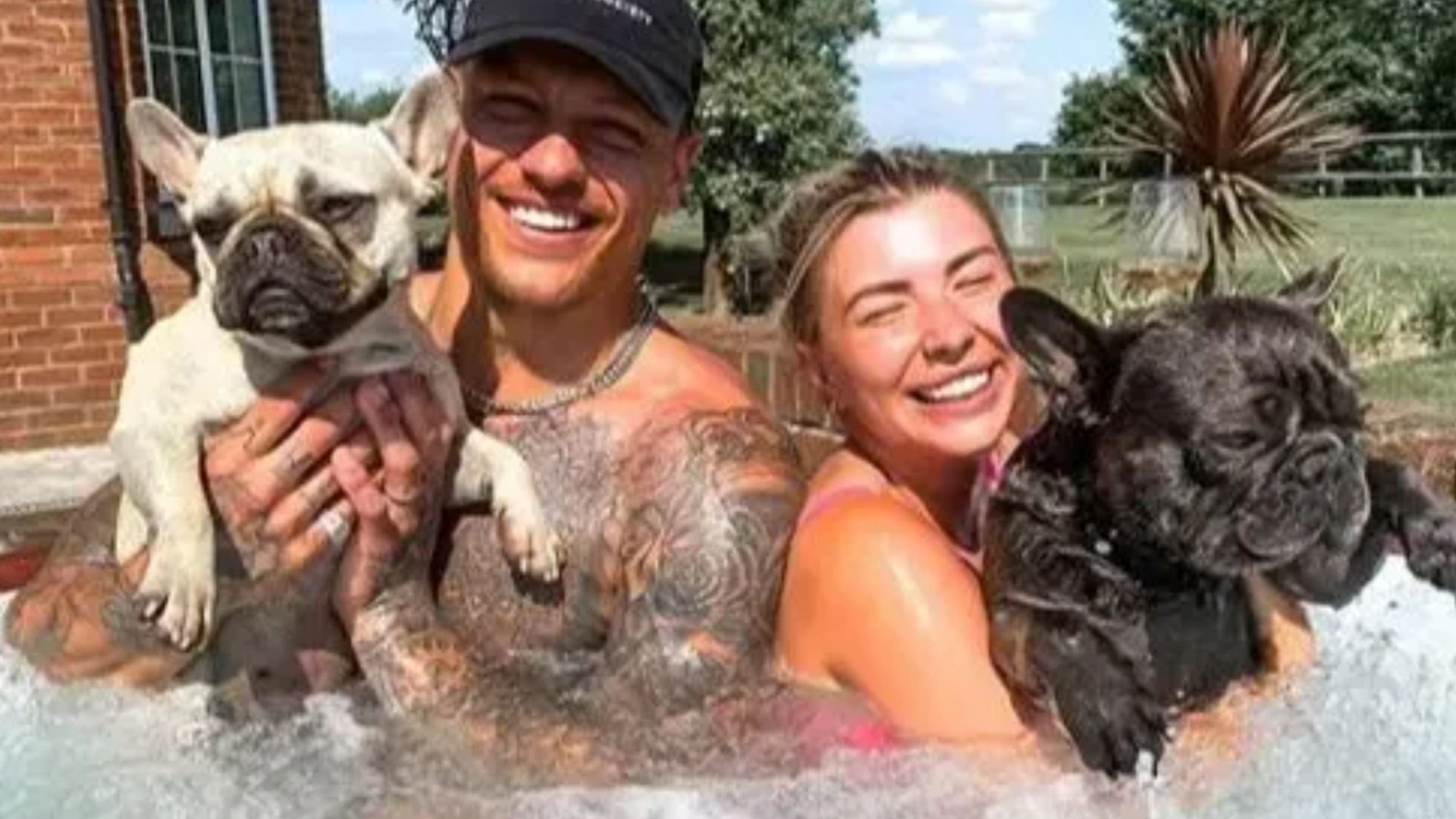
CHOKING back tears, Love Island favourite Olivia Bowen begs those considering a “designer pet” like her: “Please don’t make the same mistake as us.” The ITV-dating show runner-up, 32, was forced to put down her French bulldog Reggie after he struggled “every single day of his life” due to misbreeding, which left him barely able to hold up his head. Love Island stars Olivia and Alex Bowen had to put down dog Reggie (left) due to misbreeding Credit: The Bowen Home/Instagram Olivia broke down in tears begging others ‘please don’t make the same mistake as us’ Credit: RSPCA Olivia and hubby Alex, who met on Love Island in 2016, bought the dog as a puppy because of his “cute, squishy face”. But unbeknown to them, and the many thousands who buy them, those “extreme features” have dire consequences for animals’ health. The RSPCA warns the nation is on “the tip of an iceberg of a breeding crisis” due to animal lovers opting for flat-faced animals, which receive millions of likes on social media and are popularised through celebrities. For Reggie, his flatter face was causing him to “literally suffocate from the inside”. It was due to the soft tissue being “compressed into a skull that was far too small” because he was bred for those “fashionable features”. The initial hints were him being “quite snorty” and “cute” snoring when he was two – but that was an indicator of his ill-health. Interestingly, nearly 71 per cent of brachycephalic dog owners – those with flat faces – incorrectly believe their pet is in stellar health. Olivia faced vet bills exceeding £9,000 and surgery, including one to open his airways, failed to help give him a good quality of life. Then spinal problems emerged, leaving him struggling to stand, and they faced “the hardest choice possible”. “Surgery didn’t stop the heavy breathing noises. It didn’t stop him from being sick. It just helped in a way that he could actually manage,” says Olivia, who appears in RSPCA documentary The Hidden Cost of the ‘Perfect’ Pet. “Reggie’s health issues unfortunately just kept getting worse as he got older… seeing him like he was at the end was so traumatic. “He really struggled with his alignment – his back, spine and hips all seemed to be affected – and over time he became increasingly unsteady on his feet. Towards the end his mobility deteriorated significantly. “By the time we made the heartbreaking decision to have him put to sleep, he could no longer lift his head properly. “His head was almost permanently down, looking towards the floor. He also struggled to lift his feet and would drag them along the ground to the point that they would bleed. “The vet was like, ‘You honestly just cannot keep him going in the pain that he’s in. He’s in such bad pain’. “I don’t think you’re ever going to feel like you made the right decision but I think at the end of the day, all we wanted for Reggie was for him to feel at peace and finally be comfortable. “He struggled every single day of his life because of how he was bred. I’ve looked into why this has happened to Reggie and it’s horrendous.” The RSPCA described it as “unnatural selection for the wrong reason” – that reason is the masses of people wanting a cute pet and breeders are able to make a fortune achieving that. One UK-based breeder sold a Frenchie puppy, which had extreme facial features and rare pinky, fluffy fur, for a staggering £738,700 to a former NBA basketball champion. Another charged £200,000 for their desirable bulldog to sire puppies. Such a fee was demanded due to it stemming from bloodlines of two famous mutts, known for their excessive skinfolds, which actually cause infections and irritation issues. Both of those ‘notable’ dogs died young because of their extreme conformations. Another boasted about having made £74,000 from his bulldog’s first litter and claimed “if he gave me 10 to 20 litters that will be in [the] million”. Dr Rowena Packer, Senior Lecturer at the Royal Veterinary College (RVC), explains that the desirable features show the “hallmarks of neoteny” – where an animal has features like a baby. “We’re hardwired to find this combination of features really cute and it makes us want to care for these seemingly helpless animals,” she adds. These unnatural features make these brachycephalic breeds – like Frenchies, English bulldogs, pugs, Boston Terriers, Boxers and Shih Tzuss – look “less dog, more human baby”. Olivia adds: “The big forward facing eyes, that’s a baby. The rounded face, that’s a baby. Even the chubby body, the folded skin, the lack of a tail. “We don’t consciously realise it but our brains see a baby and this is partly why pugs, frenchies and persian cats have been bred to look the way that they do… it turns out our brains have been hijacked.” Reggie, whom Olivia bought from a breeder in late Oct 2016, came home just before Christmas. By his seventh birthday, he was dead due to his breathing issues. “He struggles to lift his head, see or swim properly,” Olivia says. “This looks extreme to some but the reality is that this and pugs are all part of the same problem.” Additionally, Frenchies are 16 times more likely to suffer life-threatening, obstructed labour compared to a normal dog. This means that some in their litters “don’t make it very long” – those who die are “treated as collateral damage by breeders”, Olivia says. Reggie (right) struggled to lift his head and vomited regularly before his death Credit: Instagram Olivia received pet bills for thousands of pounds before she was advised to put Reggie down Credit: RSPCA One in 10 don’t survive their first 24 hours and half of the deaths are caused entirely by severe genetic birth defects, caused by breeding for fashionable looks. “We only ever see the winner of the genetic lottery,” Olivia says. “We see the picture-perfect puppies who look great in a photo but what about those who are left behind? “It’s the silent cost of putting looks before welfare. Animals bred to look a certain way but die within hours of being born. “By locking in fashionable looks, breeds have also locked in genetic health struggles. You can’t have the look without the health issues. They are stapled together in the DNA.” On one popular website The Sun saw brachycephalic puppies selling for thousands – including Frenchies and pugs with unusual colouring for £3,500; wire-haired dachshunds for £5,000 and chunky English bulldogs for £7,500. The RSPCA says breeding the ‘perfect’ pets – perfect in their appearance, but with damning health conditions – is happening at an “unprecedented scale”. And it’s not just confined to dogs. Designer breed bubble eye goldfishes cost £15 to £50 each because of their googly orbs. But their unnaturally overinflated eye sockets and their lack of a dorsal fin, which helps them stabilise themselves and turn, causes massive harm. It dramatically shortens their lifespans too. Bubble eye goldfish live for between five and 10 years, unlike healthy goldfish which can survive 20 to 40 years. RSPCA’s head of reptiles Fred Bark says: “Someone has gone out of their way to create this animal that looks a certain way. Everything else has gone out of the window. “They have been born into a body that just really limits them and does, in certain cases, make them suffer in quite a great deal.” Sphynx cats, which are hairless, are falsely claimed to stem from the times of Ancient Egypt. In reality, they were first bred in Canada in the 1960s and now sell for £2,000-plus per kitten. “They were sold as ‘moon cats’ because of how weird and alien they looked to people at the time,” Olivia explains. Sphynx cats have the shortest lifespan of any breed studied, living for 6.6 years on average and require a “massive amount of care” due to their health issues. Heather Morris, who rehomed two of them, Jelly and Custard, now two, after they were given to multiple owners and were at one point “literally being handed around on a high street” as their keeper tried to get rid of them. The cats are “incredibly hard to care for” according to the RSPCA because of how they have been bred. Heather says it’s “essentially, like having just added two more kids” to her care-taking duties. The temperature of Sphynx cat Jelly (above) has be monitored at all times Credit: RSPCA Bubble eye goldfish die young, struggle to eat, hold up their heads and swim because of their bred features Credit: RSPCA Sphynxes need to be bathed once a week, wear sunscreen whenever it is hot, have their ears cleaned daily and eyes too. Additionally, the cats’ temperature and the home temperature needs to be constantly monitored otherwise they can suffer from fatal hypothermia. RSPCA branch manager Nat fears the UK is at “the tip of an iceberg of a breeding crisis” after seeing an “explosion” in flat-faced cats being surrendered to them after the kitten stage. Her branch alone had 10 Scottish folds, which sell for £1,600 each as kittens, alongside Ragdolls, which sell for £2,000, and Persians and Burmese that are flogged for £1,500. In 2025, cats with extreme traits accounted for six per cent of the RSPCA’s intake. In the first four months of 2026, that number has tripled to 18 per cent. Despite being an Instagram feed favourite, the iconic sausage dog shape – long backs, short legs and barrel chests have terrible consequences. “One in four of them will suffer from serious, highly painful spinal issues,” Olivia says. “We buy them without ever realising they have extreme traits and are quietly struggling every single day.” Nearly 71 per cent of owners believed their brachycephalic dogs are healthy, according to an RVC study. Of that figure, 30 per cent considered their dog to be in “the best possible health” and 40.9 per cent thought they were in “very good health”. “How do you even fix a crisis that no one even realises is happening?” Olivia adds. Veterinary surgeon Dr Rory Cowlam warns there is a “crisis” in French bulldog breeding. He explains that owners buy the dogs, believing they won’t need serious surgery for 10 years, but sadly, that is rarely the case. “You go to the vets at [the age of] one or two and your dog is collapsing on walks, unable to breathe in the heat or struggling to eat properly,” Dr Cowlam says. “Then suddenly you’re being told they need airway surgery. Without this surgery, they are literally suffocating from the inside.” These ops cut away excess tissue in their nostrils that block their airways. Brachycephalic obstructive airway syndrome is a “disorder caused by breeding for flat faces”. Frenchie Milo having an operation to open his airways Credit: RSPCA Deciding to put down Reggie was ‘the hardest choice’ possible for Olivia Credit: Instagram It’s due to their soft tissue being compromised and compressed into a skull that is far too small for them. The ill-health of Milo, a three-year-old Frenchie in the RSPCA’s care, highlights how damaging it can be. The dog vomited after exercising – running up and down a corridor – for just over two minutes. Healthy dogs can safely run nonstop for between 15 minutes and an hour. Milo had airway surgery but “this isn’t a cure,” Dr Cowlam insists, explaining that he will never breathe or run like a normal dog due to how he was bred. Dr Cowlam adds: “His quality of life is already capped by his genetics and the tragedy is even being here on the operating table is a massive risk.” Olivia and the RSPCA urge people to research animals before buying them and prioritise breeds that are “healthy and happy in real life, not just cute in photos or popular online”. By only buying natural breeds without extreme features, it will encourage breeders to focus on them instead. Olivia, who knows full-well having lost her beloved Reggie, says: “It’s a vicious circle, and it needs to stop. “After seeing what Reggie went through, I would never want another dog or another family to have to experience what we did.” You can watch the RSPCA’s new documentary The Hidden Cost of the ‘Perfect’ Pet on YouTube. For information on how to rehome an animal in need, click here.
My ‘designer’ dog struggled daily until he died… don’t miss hidden ‘crisis’ signs, warns Love Island’s Olivia Bowen
Full Article
Original Source
Read the full article at Thesun →KhanList aggregates and links to publicly available news content. We do not host full articles from third-party sources. Always verify important information with original sources.