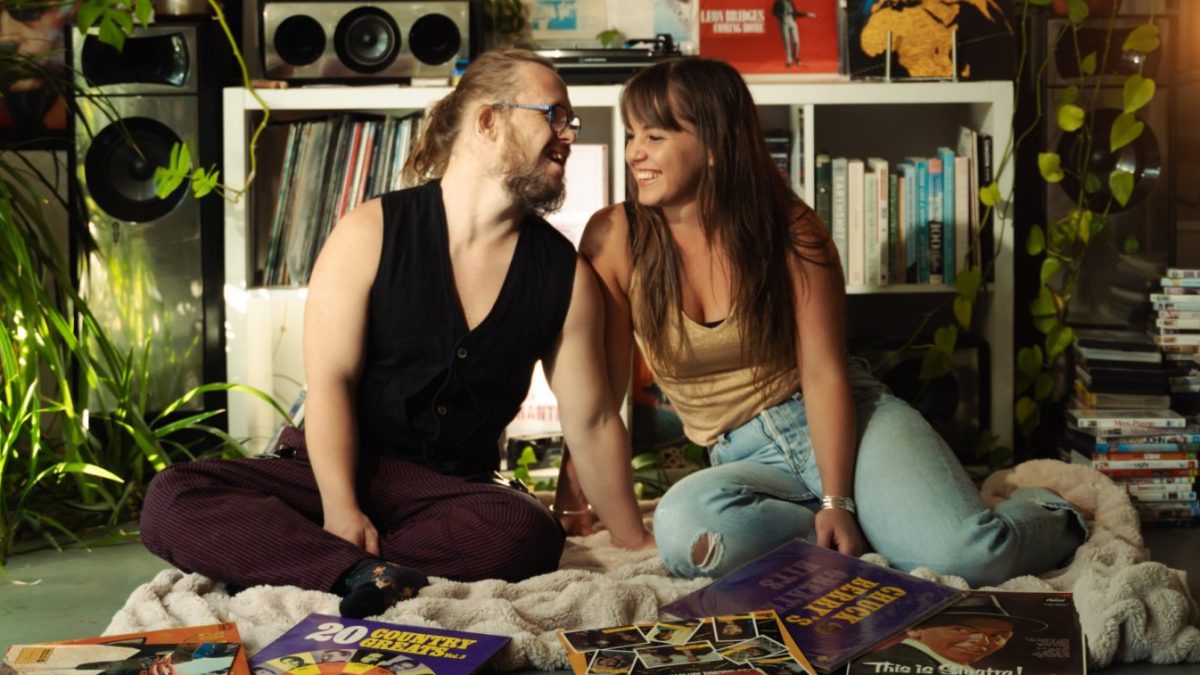
Maitreyah Guenther, 28, grew up alongside her big brother Kayah, 31, who has Down’s syndrome – an experience Aitch’s new Netflix documentary Don’t Be Afraid has just brought to millions of screens. This August, Maitreyah and Kayah tell their own story in Glass Child, a dance-theatre show about their bond, at the Edinburgh Fringe. Here, Maitreyah describes the joy, the rage and the fierce love of growing up as Kayah’s little sister. As told to Olivia Palamountain. I was nine years old when my parents sat us kids down to announce that Kayah had Down’s syndrome. Until that moment, he was simply my big brother – the funny, music-loving boy who danced around the house with me to Michael Jackson. I didn’t know his experience of the world was different from mine; he was just my normal. At first, all I understood was that something had shifted. Slowly, things I had never thought to question began to make sense: why people stared at us wherever we went and, later, why school was so cruel to him. My parents met while working as support workers for young people with Down’s syndrome, back when care too often meant an institution. So when Kayah was born, they were unwavering about raising him at home. There are three of us – Kayah, our middle brother, then me – and family life was a team effort: we had to be tight-knit, because help and healing were hard to find in the outside world. My parents championed Kayah from the start, and the rest of us followed suit. Shorts School is where I lost some faith in humanity. For a while, we went to an alternative Steiner school, where children learn at their own pace – exactly the sort of place you would expect to be inclusive. Instead, it was so horrible for Kayah that one night, when Mum went to kiss him goodnight, he told her: “I want to die. Nobody likes me.” That was the final straw; my parents pulled all three of us out. Later, we attended the same high school, where he was in the support unit, shoved in a corner. A girl once pushed him into a bin. People regularly used words like “retard” and “spaz”, and I struggled with that language day in, day out. I remember standing on the stage at graduation, just grateful I’d never have to hear those things again. I was a very quiet girl, and there are times I regret not standing up for Kayah more. But often the bullying happened when I wasn’t there, and I would only hear about it afterwards – Kayah once told me someone had thrown water over him but he didn’t know their name. He has a stutter and struggles to speak up for himself; you have to pry things out of him. I’ve learned to be his voice. Dance has always been our shared language. As teenagers we choreographed little routines for school performances, and when I was 15 we met Gavin Webber and Kate Harman of Australian dance-theatre company The Farm – mentors first, and now the directors and co-creators of Glass Child. The show grew from a simple desire: to turn our lives, the positive and the negative, into an art form. To offer our story to the world and hopefully leave people better for having seen it. ‘There are three of us – Kayah (right) , our middle brother (left), then me (middle) – and family life was a team effort. We had to be tight-knit, because help and healing were hard to find in the outside world’ (Photo: Supplied/Maitreyah Guenther) It was my dad that came across the term “glass child”: the sibling of someone with a disability, whose own needs are often looked through or set aside. And yes, Kayah came first. He learned to walk and talk later, and required extra help with things that come easily to most children – his needs were simply greater than mine. I accepted this as I’d never known any different. And if I ever felt frustrated, I’d remind myself: he will never drive a car or have a family of his own, things I’ll get to do. The hard part of growing up with Kayah was never Kayah himself. It was coping with how awful people could be – watching someone you love treated badly by the world. Somewhere in the making of the show, that term flipped upside down for me. I realised Kayah helps me to be seen in ways I’m not, and I do the same for him. We are both the glass child. We are a mirror for each other. Here’s the thing: Kayah has an angelic love I’ve never experienced anywhere else, and he is so generous with it. People don’t realise how smart and receptive he is. His memory is astounding and he is deeply wise – I always say he’s already enlightened. He writes me cards by gathering inspirational quotes from the internet and joining them together; somehow they always make sense. And he is forever talking about how to become a better man. But most people see the face, and the stereotype takes over: they see what they’ve been told to see, not the human inside. Even now, when I mention I perform with my brother who has Down’s syndrome, the first reaction is usually, “Oh, that’s so cute.” If those people came to the show, that’s not the word they’d use. In fact, it’s quite the opposite. There’s a lot of rage in the show, plus plenty of love, gentle moments and Kayah’s comedic side – that’s just him, 24/7, without even trying. ‘I was nine years old when my parents (top) sat us kids down to announce that Kayah (middle) had Down’s syndromes,’ says Maitreyah (right) The rage goes back a long way. I remember being six or seven, at school, watching a group of kids running away from someone – and realising, as I got closer, that it was Kayah. He was slower; they knew he was never going to catch them. I suppressed so much of the pain I felt on his behalf growing up. Most people only ever see the quiet, polite me, but there is an anger underneath – baggage I had been carrying for years. I found healing in writing – poetry, and a book I’m working on – putting my pain into words and into dance. Making the show brought a sense of relief. Finally, I was turning it all into something beautiful. There is a moment on stage where I say aloud all the derogatory words people have used and the pain they have caused, imploring the world to see Kayah for who he is. It’s not easy to hear and the audience usually goes dead silent. What I want to say to society is simple: teach your children about disability. So much of the cruelty comes down to a lack of awareness; it just isn’t talked about enough. Even now, I’m always on guard. We were travelling recently and, at the top of a waterfall, a group of young boys started mocking Kayah; I only found out as we walked away. You think it ends with school; it doesn’t. But I’m changing, too. These days I have the confidence to confront people and call out their behaviour – the older I get, the more lionessy I’m becoming. Still, the stares and the comments weigh heavier on my heart than on Kayah’s. He notices everything, and yet he is endlessly forgiving. I asked Kayah recently what he wanted from the world, and his answer was simple: for people to see us – our anger and our love – and to feel our pain. That is all either of us has ever wanted, really. Not to be looked at, or looked through, but seen. Glass Child is at Summerhall (Old Lab), Edinburgh, 6-16 August, 1.30pm
My brother has Down’s syndrome – I still have to confront people who laugh at him
Full Article
Original Source
Read the full article at Inews →KhanList aggregates and links to publicly available news content. We do not host full articles from third-party sources. Always verify important information with original sources.