
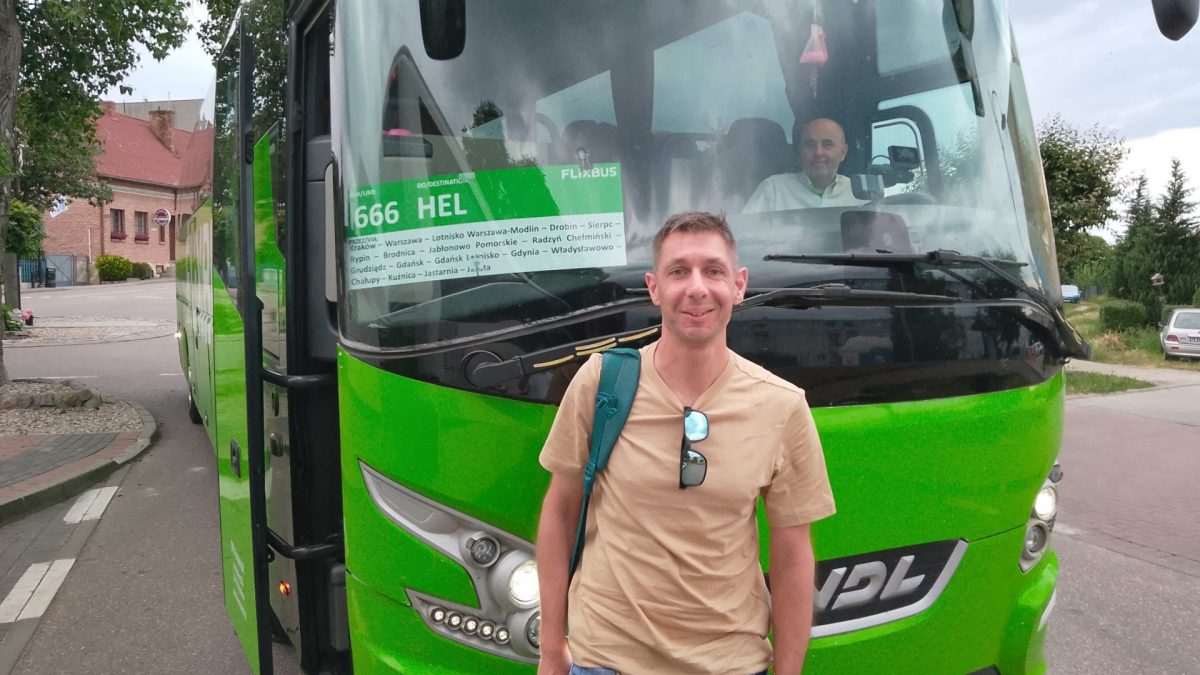
I’ve been to hell and back. Sorry, Hel and back. It’s not a place of fire and brimstone but a rather laid-back holiday town, near the tip of a narrow peninsula of the same name, on Poland’s Baltic coast. It certainly gets the thumbs up from the solidly built older woman with dyed red hair and as little English as I have Polish, who I meet at a bus stop midway through the journey. “Whoa!” she exclaims, when she finds out where I’m heading. And the road to Hel – a 14-hour journey taking in the cities of Kraków, Warsaw and Gdansk – is not as bad as one might expect. Shorts That’s largely thanks to the arrival of Flixbus’s new route from Kraków, 486 miles south of Hel. Launched on 25 June, the route is so new its drivers are still learning it with the help of the sat nav. It’s mischievously been given the number of the beast, 666 – much to the annoyance of some local Christian groups. A gaggle of travellers board alongside me at Kraków’s main bus station in the early morning, pre-rush hour hush. A dozen or so in total, all Polish except for me, they range from grungy students decked out à la Kurt Cobain circa 1992 to smartly turned-out ladies of leisure. “You won’t see anything but the motorway,” I’ve been warned by Ewelina Morawska, sales manager at Tribe Kraków Old Town, where I stayed before hitting the road. But almost immediately on leaving Poland’s second city I spot a duo of raptors sitting totem-like on top of the fence posts that separate the steadily flowing traffic from fields of ripening wheat. The. beach in Hel (Photo: Irena Sowinska/Getty/Moment RF) Not long after, I see a stork strutting about a layby where we pull in for an unscheduled break. It’s immediately grounding to be away from the tourist crowds of Kraków, where American accents seemed to outnumber Polish ones. Our first real stop is Warsaw, roughly four hours in, where perhaps half the passengers disembark and a similar number board. After landscapes of little more than farmland since leaving Kraków, the capital’s modern office towers appear, not unlike the London skyline, although with just 10 minutes’ break during a driver swap there’s no time to explore. The plains between here and Gdansk (Poland’s mountain ranges don’t stretch this far north) are only broken up by the appearance of small towns like Brodnica, where a single passenger disembarks. In between, the single lane road is dotted with small Christian shrines, some draped with ribbons like miniature maypoles. Port Hel in Pomerania (Photo: Manfred Gottschalk/Getty) The only English spoken onboard is uttered when all the other passengers have disembarked amid the closely packed caravan parks of Władysławowo, the gateway to the narrow, 22-mile-long Hel Peninsula. “Last one!” the driver says to me, happily. Most of my fellow passengers had been heading for the major cities along the way, route 666 being quicker than the cheaper trains and cheaper than the faster ones. The full journey starts at £19 one way, rising to £29 at peak times. Despite the lack of other people alighting with me, Hel is a popular holiday spot for Poles; the town draws between 600,000 and 800,000 tourists each year (including just 397 foreign tourists in 2025). Yet, it wasn’t always so. Throughout the Cold War much of it was off limits, having been one massive defensive bastion protecting Poland’s north. This year marks 30 years since holidaymakers were welcomed back. Wiejska street in the summer (Photo: Piotr Patkowski/Getty) While the peninsula’s defensive role is still visible, with enough gun emplacements and defensive structures to keep Rambo busy even in his prime, the resort town’s attractions are reminiscent of the sort you’d find at the British seaside – kiss-me-quick hats notwithstanding. Among the 19th-century, half-timbered fishermen’s cottages of the pedestrianised main Wiejska Street it’s easy to find a plate of fish and chips and accompanying pint of beer for the equivalent of a tenner, after which I pick up a suitably kitsch fridge magnet and freshly made doughnut. By the harbourside is a small seal sanctuary, and slightly further south, a 135ft-tall working lighthouse. Its spiral staircase leads to views that show just how underdeveloped the peninsula remains, with little visible apart from trees and beaches. The visitors I see during my stay in late June can be counted on one hand, versus the thousands who descend during the school summer holidays. The beaches on the peninsula’s north coast are of light, golden sand so deep I risk sinking up to my ankles – perfect when summer temperatures hit their average 21°C in July and August. I walk east from here and along a boardwalk over the dunes, which culminates – or perhaps begins – at the symbolic “start of Poland”, a 2013 monument known as Kashubians’ Mound after the ancient people who populated the region. A historic brick ‘Checz’ restaurant in winter (Photo: PATSTOCK/Getty) Whether you take the bus to or from Hel, it’s worth it for the easily missed attractions along the way: the hulking brick-built castle at Radzyń Chełmiński, the River Vistula in Warsaw and again in elegant Grudziąd, the cranes of Gdansk’s famed shipyard and glimpses of the Baltic Sea. All of which means you’ll want a window seat. A seat reservation starts at an additional £1.49: a small price to pay for an encounter with the devil and the deep blue sea. How to get there and around The writer was a guest of Flixbus and the Polish Tourism Organisation. British Airways flies from to Kraków and easyJet to Gdansk (Hel’s closest airport). Ryanair and Wizz Air fly to both. Staying there Tribe Kraków Old Town has B&B doubles from £106 and Hotel Hel from £126
My 14-hour bus trip to Hel delivered me to a perfect resort of golden beaches
Full Article
Original Source
Read the full article at Inews →KhanList aggregates and links to publicly available news content. We do not host full articles from third-party sources. Always verify important information with original sources.