
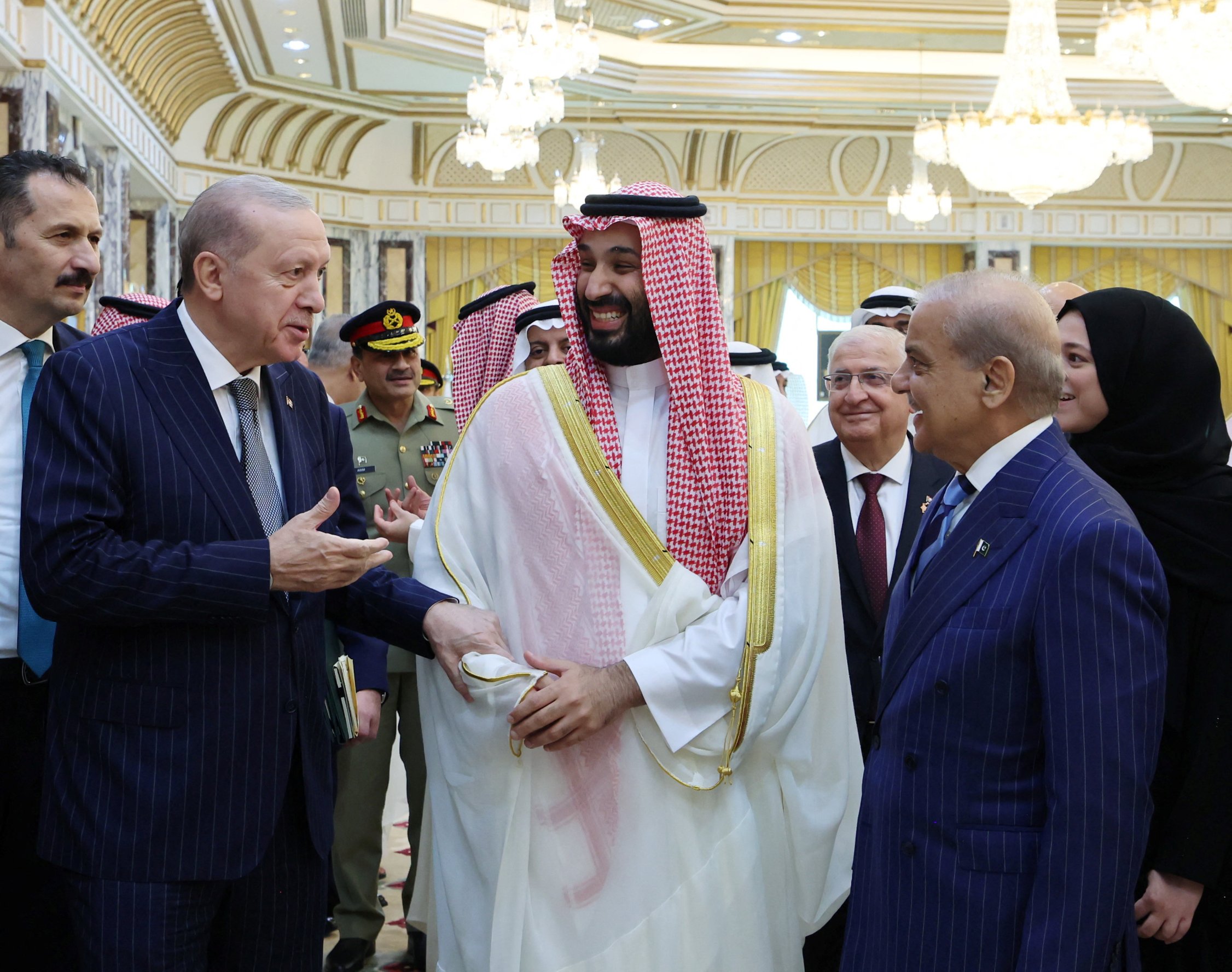
First published in Deník N. The new defence agreement from Mecca signals a growing effort by Saudi Arabia, Turkey, and Pakistan to strengthen deterrence and deepen military cooperation beyond the United States, as they prepare for a world less reliant on Washington — but with Iranian and Israeli aggression still shaping the region, the pact has yet to face the test of geopolitical reality. Turkey has Nato’s second-largest army and a rapidly growing defence industry. Saudi Arabia is home to Islam’s holiest sites and one of the world’s largest oil exporters. Pakistan, meanwhile, is the only Muslim country in the world with nuclear weapons. In response to the instability most recently brought to the region by the US-Israeli war with Iran, the three predominantly Sunni Muslim countries are now seeking to deepen defence cooperation to provide deterrence and, in the event of an attack, could in theory also draw Ankara and Islamabad into a prolonged and costly conflict. The mutual defence agreement, signed on 7 August in the Saudi city of Mecca, is sometimes compared to Nato, specifically to its Article 5 on mutual defence. Even Turkish foreign minister Hakan Fidan drew that comparison. However, beyond the premise that an armed attack against one member will be regarded as an attack against all three, and the inclusion of Nato’s second-largest army, the new agreement has little else in common with the Western alliance so far. Above all, it is unclear to what extent it actually commits the signatory countries to specific military action in the event of an attack. While Nato operates within an integrated military command structure, details of the arrangements resulting from the trilateral agreement between Riyadh, Ankara, and Islamabad are likewise unclear. A new ministerial committee and a secretariat based in Saudi Arabia are planned. Unlike Nato, which was created in response to the expansion of the Soviet Union, the agreement is not directed against any particular country, according to Turkish vice-president Cevdet Yilmaz. Whatever political representatives may declare, it is entirely clear that the agreement was created in response to current developments in the region — particularly the US-Israeli war with Iran, which is affecting Gulf countries including Saudi Arabia. The three predominantly Sunni Muslim countries have also long shared concerns over Israel’s aggressive regional policy. As Saudi deputy minister for public diplomacy Rayed Krimly, cited by Reuters, said on social media, the agreement does not seek to create a new military axis or sectarian bloc. “Nor is it linked to any nuclear ambitions or arms race,” he added. “The Mecca agreement neither cancels nor replaces any existing bilateral or multilateral agreements between these countries, or with other countries or organisations,” Pakistani foreign minister Ishaq Dar added, saying that his country regarded it as a purely defensive pact. Although it is not a Nato-like structure or a new regional religious bloc, the alignment of three of the Muslim world’s most influential states signals a significant shift in thinking about the region’s security architecture. It is far more than merely an agreement on paper, as Tehran has sought to portray it. And this is why it is important to explain what the Mecca agreement means for each country, who else might join, what its announcement has prompted in Israel, and what limitations it carries. Saudi Arabia as a stabilising force The ceremony in Mecca was attended by Saudi crown prince Mohammed bin Salman, Turkish president Recep Tayyip Erdoğan, and Pakistani prime minister Shehbaz Sharif. Alongside other formalities, the three politicians at one point prayed together facing the Kaaba, Islam’s holiest site — creating a powerful image of unity. And it was not a coincidence that the agreement was signed in Saudi Arabia. The country is among those most affected by the ongoing US-Israel war on Iran. It has repeatedly faced drone and missile attacks by Iran, as well as by groups backed by Tehran in the region. It has also been significantly affected by the blockade of critical oil routes — the Strait of Hormuz and the Bab al-Mandab Strait in the Red Sea. For Riyadh, the new agreement strengthens both its own influence in the region and its deterrence against Iran, which has threatened the country with further attacks should its conflict with the United States continue. “The Saudis should understand that an agreement with Turkey and Pakistan on paper will not bring them security, just as their unilateral dependence on the Americans has failed,” Ebrahim Rezaei, a member of the Iranian parliament’s national security and foreign policy committee, wrote on X. “Change your policy so that you do not have to beg others for security,” he told Riyadh. But the agreement still provides Saudi Arabia with an additional layer of protection beyond its long-standing security partnership with the US, whose ability to protect its partners has been loudly questioned after recent months of fighting. Rather than a departure from Washington, it represents Riyadh’s diversification of its options: After all, taking greater responsibility for its own security also corresponds with Washington’s long-standing demands. The announcement of the security agreement came just weeks after the United States and Saudi Arabia signed a deal intended to allow the kingdom to develop its own civilian nuclear programme. US president Donald Trump subsequently added a condition that would commit Riyadh to normalising relations with Israel — something the country has long rejected without the opening of a clear path towards a Palestinian state. It may therefore ultimately have been Washington itself that brought Saudi Arabia closer to Pakistan and Turkey, although a similar agreement had been discussed long before. And so Riyadh’s rapprochement with Ankara and Islamabad runs counter to Trump’s vision of normalising relations in the region. According to Middle East analyst and former Israeli military intelligence officer Dennis Citrinowicz, however, current developments do not necessarily determine how relations between the countries will evolve in the future. In this case, Riyadh is not acting in defiance of Tel Aviv, although this is sometimes interpreted that way in Israel. "If Israel were to make dramatic progress on the Palestinian diplomatic track, it is entirely plausible that Saudi Arabia would once again show interest in advancing normalisation. This agreement does not fundamentally change that calculation," Citrinowicz said. For context, it is worth recalling that Saudi Arabia concluded a similar mutual defence agreement with Pakistan as early as September 2025, and with the six countries of the Gulf Cooperation Council shortly after the turn of the millennium. Neither agreement, however, has significantly helped Riyadh defend itself against Iranian strikes in recent months, while Pakistani representatives in particular said last year that the agreement did not include a nuclear umbrella. As Allison Minor, director of the Middle East Integration Project at the Atlantic Council’s Rafik Hariri Center for the Middle East, noted, Pakistan has in recent months deployed thousands of soldiers and drones, as well as advanced air-defence systems to Saudi Arabia. “At the same time, Riyadh is using this turbulent period to assert its own leading position in the region: by hosting the signing of the new security agreement together with another powerful regional actor — Turkey — Saudi Arabia is positioning itself as a symbol of regional stability at a time when the other powers — Iran and Israel — are seen as destabilising forces,” Minor said. Turkey’s expansion on all fronts The new security agreement allows Turkey to strengthen its geopolitical role as the leading architect of security not only in the Middle East, but also in South Asia, and to combine its military influence — based on Nato’s second-largest army, a growing defence industry and increasing arms self-sufficiency — with Saudi money and Pakistani nuclear deterrence.
‘Muslim Nato’ could see Saudia Arabia, Turkey, and Pakistan clash with Israel or Iran
Full Article
Original Source
Read the full article at Euobserver →KhanList aggregates and links to publicly available news content. We do not host full articles from third-party sources. Always verify important information with original sources.