
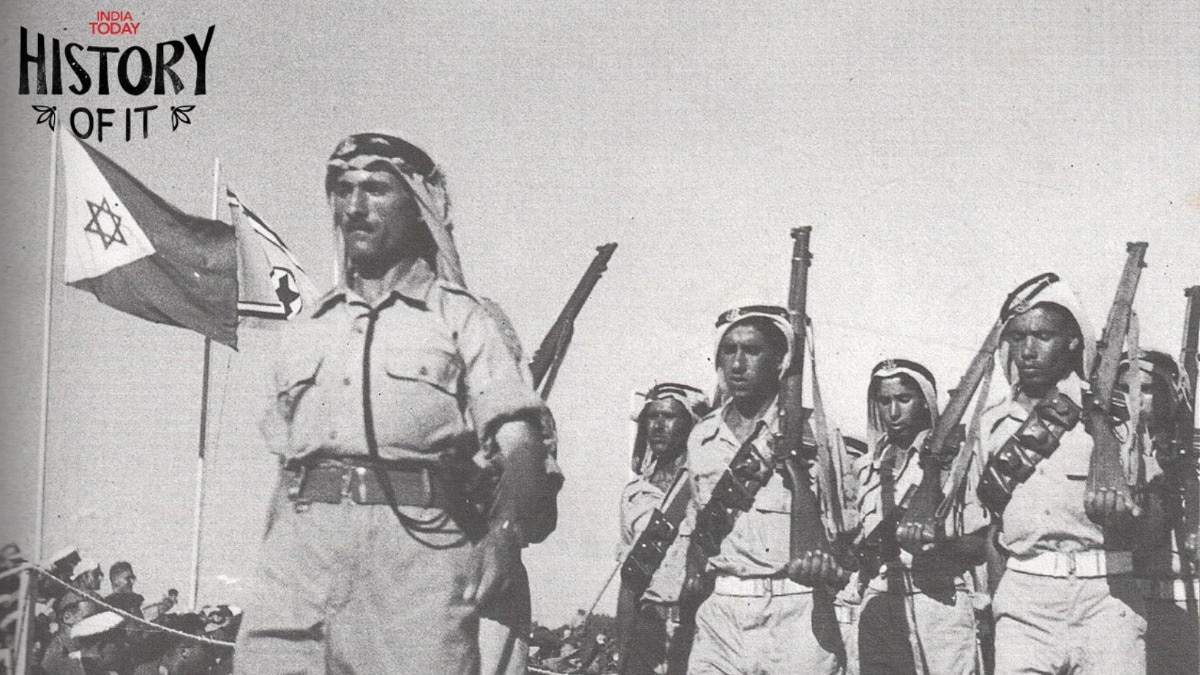
"In the Bible it is said that this land is intended for the Jews, and the Holy scripts must not be disagreed with. I and my men want to live in peace as loyal citizens to the Jewish state," Sheikh Hussein Ismail Abu Yusuf, the chief of the Muslim Bedouin Al-Haib tribe in Galilee (northern Israel), told Yigal Allon, a commander of the Palmach, the elite Jewish fighting force in British-ruled Palestine, in early 1948.Months before Israel declared independence in May 1948, Abu Yusuf sought an alliance with Jewish forces. Around 70 young men from his tribe were subsequently trained to serve alongside the Jewish forces. It was an extraordinary declaration from a Muslim Arab chief at a time when Jewish forces were fighting Palestinian Arab groups, months before Israel even existed.When Abu Yusuf made the decision, British rule over Palestine was nearing its end, and Jewish and Palestinian Arab forces were fighting over the territory's future. While much of the Arab world opposed the creation of a Jewish state, there were some Muslim Bedouin tribes in the region who chose to support the Jews. The Yusuf-led Al-Haib tribe was among them.The tribe's members provided intelligence, helped Jewish fighters and joined a military unit that took part in the war leading to Israel's establishment. While the story challenges today's perception of Jewish-Arab rivalry in the Middle East, it also reveals how the conflict and conquest divided the Jews and the Arabs and also the Arab communities. Nearly eight decades after Israel's creation, relations between Jews and Arabs have become central to its politics.The October 27, election left Israeli Prime Minister Benjamin Netanyahu's bloc with a projected 53 seats and his rival Gadi Eisenkot's bloc with 48, both short of the 61 needed for a majority in the 120-member Knesset. Arab-led parties, projected to win a record 19 seats, have emerged as potential kingmakers. This, even as several Jewish-led opposition parties have been reluctant to rely on the support of the two Arab parties of Israel. The deadlock and allegations of foreign funding to boost Israeli Arab voter turnout have brought Jewish-Arab relations in Israel into focus. That makes the story of Muslim Bedouins all the more striking and worth recalling today.BEFORE ISRAEL WAS BORN, A WAR HAD BEGUNThe demand for a Jewish homeland in Palestine had gained momentum in the early 20th century. It grew stronger after the Holocaust, in which Adolf Hitler's Nazi Germany and its collaborators murdered around six million Jews during World War II. The genocide and the plight of Jewish survivors intensified international support for the establishment of a Jewish state.On November 29, 1947, the newly formed United Nations General Assembly adopted a resolution proposing the division of British-ruled Palestine into separate Jewish and Arab states. Interestingly, India was among the 13 countries that voted against the UN partition plan.The Jewish leadership accepted the partition plan, but Palestinian Arab leaders and neighbouring Arab countries rejected it.At the time, Palestine was under British rule, and tensions had been growing between its Jewish and Arab communities over immigration, land and competing claims to the territory. Jewish groups sought to establish a national homeland, while Palestinian Arabs opposed the growing Jewish demands and feared losing control of their lands.Following the UN resolution, fighting broke out between Jewish military organisations, including the Haganah, and Palestinian Arab armed groups, including local militias and fighters.The Haganah, the main Jewish military organisation, and its elite fighting force, the Palmach, played important roles in defending Jewish settlements and conducting military operations. The conflict intensified as Britain prepared to withdraw from Palestine. This set the stage for Israel's declaration of independence in May 1948 and the subsequent war with neighbouring Arab countries.On May 14, 1948, David Ben-Gurion declared Israel's independence. The following day, armies from Egypt, Transjordan (now Jordan), Syria and Iraq entered the war. Lebanon also participated.The war continued into 1949. Israel survived and secured territory even beyond what the UN partition plan had proposed for the Jewish state. For Palestinians, the war became the Nakba, or catastrophe, during which around 7 lakh people fled or were expelled from their homes.But, the fighting was not just a simple case of every Arab standing against and fighting every Jew. Some Arabic communities supported Jewish forces, others fought against them, and some tried to remain neutral. Among those who chose the Jewish side were the Muslim Bedouins of the Al-Haib tribe. They lived around the village of Tuba in the Galilee region, then part of British-ruled Palestine, in an area that is now the town of Tuba-Zangariyye in northern Israel.WHY A MUSLIM TRIBE CHOSE THE JEWISH SIDEThe Al-Haib tribe's decision to support Jewish forces in 1948 was a result of years of friendship, tribal rivalries and political calculations.According to the archive of the Palmach, the elite Jewish fighting force that later became part of the Israeli army, the Muslim Bedouin Al-Haib tribe had maintained friendly relations with neighbouring Jewish settlements for years. Even during the Arab Revolt of 1936 to 1939, when Palestinian Arabs rebelled against British rule and growing Jewish immigration, the tribe refused to participate in attacks on Jewish communities.Its chief, Hussein Ismail Abu Yusuf, had also sold 500 dunams (roughly 70 standard football fields) of land to the Jewish National Fund. The land later became part of Kibbutz Kfar Hanasi, a Jewish settlement in the Upper Galilee region near the Jordan River (in northern Israel).The tribe was relatively small, with around 400 members, including women and children, in 1948. However, its armed men knew the mountainous terrain of Galilee well, which made them potential valuable allies. The Al-Haib tribe also had longstanding differences with the Arab Higher Committee, the principal political body representing the Palestinian Arab national movement.According to the Palmach archive, Abu Yusuf believed Jewish forces would emerge victorious in the approaching war. His decision was also shaped by pressure from Syria.Syrian representatives reportedly offered to settle past hostilities if he moved his tribe to the Golan Heights, a territory then under Syrian control. But Abu Yusuf rejected the proposal. Instead, he approached Jewish forces and sought an alliance that would secure his tribe's future.The Palmach archive recorded that the Muslim chief wanted to formalise this relationship through a "blood covenant", binding his tribe's fate to that of the Jewish community.HOW THE JEWISH COMMANDERS TESTED THE SHEIKHThe proposed "blood covenant" soon paved the way for a meeting between the Muslim tribal chief and the Jewish military leadership. In early 1948, Amihud Shwartz and Mano Friedman, two men from the Jewish settlement of Rosh Pina, helped arrange a meeting between Abu Yusuf and Palmach commander Yigal Allon, with assistance from Yeruham Cohen, who was familiar with the Arab communities of Galilee.Abu Yusuf told Allon that he wanted his people to live peacefully in the proposed Jewish state. But the Jewish commanders did not accept his assurances without checking them. According to the Palmach archive, they asked the sheikh to describe the positions of Syrian forces beyond the Bnot Ya'akov Bridge, which was an important crossing near the Syrian frontier.Abu Yusuf gave a detailed account.The commander compared his information with intelligence gathered from other sources. It matched.This convinced the Jewish leaders that the sheikh could be trusted. The meeting produced an agreement to establish a military unit from the tribe's young men. The unit would operate under the Palmach's Yiftach Brigade. The alliance offered Abu Yusuf's tribe a place alongside the side he expected to win. The alliance gave the Jewish forces access to men who knew the region, understood local Arab communities and could gather intelligence that Jewish fighters would struggle to obtain.THE 70 MUSLIM BEDOUINS WHO JOINED JEWISH PALMACHThe alliance led to the formation of the Pal-Heib Platoon, a military unit comprising Muslim Bedouin fighters who would serve alongside Jewish forces. Isaac Hankin was appointed its commander, working alongside Mahmud Al Ubaid, a Bedouin fighter who later served in the Israel Defense Forces' Minorities Unit.Hankin began training young men from the Al-Haib tribe. Their initial duties involved strengthening the village's defences by digging trenches, building shelters and preparing positions against possible attacks. Around 70 selected tribesmen subsequently received military training. They learnt combat techniques, weapons handling and how to operate in small groups.The unit conducted intelligence operations ahead of Operation Matate, launched on May 3, 1948, just 11 days before Israel declared independence. The operation was part of a bigger Jewish military campaign to secure strategic routes and positions before the expected intervention of neighbouring Arab armies.The Al-Haib fighters helped gather information about Arab positions and movements, using their familiarity with the region and its people. But their decision to join Jewish forces was fraught with risks because it earned them the enmity of the Arabs.A day after David Ben-Gurion declared the establishment of Israel on May 14, armies from Egypt, Transjordan (now Jordan), Syria, Lebanon and Iraq launched the first Arab-Israeli war. The fighting continued for months. Israeli forces fought Arab armies on several fronts. The Al-Haib tribe provided intelligence and military assistance in Galilee.WERE THE AL-HAIB BEDOUINS THE ONLY ONES?It must be noted that the Al-Haib tribe was not alone in supporting Jewish forces. Israel-based historian Muhammad Youssef Suwaed, in his papers, noted that while some Bedouin tribes fought alongside Jewish forces, others supported Arab armies or remained neutral.In December 1948, Sheikh Awdah Abu Muammar of the Mas'udin tribe in the Negev (in present-day southern Israel) wrote to the Israeli military commander in Beersheba, seeking food, clothing and weapons to protect his people against fellow Bedouins cooperating with Egyptian forces. In a letter reproduced by historian Hillel Cohen in the book, Good Arabs, the Muslim chief pledged, "We obligate ourselves before Allah the supreme to be loyal to the Israeli government, its leaders, and its governors."The cooperation between Muslim Bedouins and Israel did not end with the 1948 war. Some Muslims continued to serve in Israeli military units, while tribal leaders maintained ties with the country's security establishment. Even today, several of these nomadic communities continue to pledge their allegiance to the state of Israel. During Hamas's October 7, attack on Israel, Muslim Bedouin bus driver Youssef Ziadna risked his life to rescue around 30 Jewish Israelis from the Nova music festival massacre. He drove through gunfire to bring the people to safety.In another incident, four Bedouin cousins, including Ismail Alqrinawi, rescued around 40 festival goers before saving two people trapped near Kibbutz Be'eri.The Al-Haib tribe's story is a lesser-known chapter of Israel's creation. The 1948 war was fought between Jewish and Arab national movements, but the loyalties of those caught in it were a result of local friendships, tribal rivalries and the struggle for survival. It was a war in which some Muslim Arabs fought alongside Jewish forces against fellow Arabs, which shows that some of the divisions were never about being Jews and Muslims.- Ends
Muslim Bedouins, the unlikely allies who helped Jews fight Arabs, create Israel
Full Article
Original Source
Read the full article at Indiatoday →KhanList aggregates and links to publicly available news content. We do not host full articles from third-party sources. Always verify important information with original sources.