
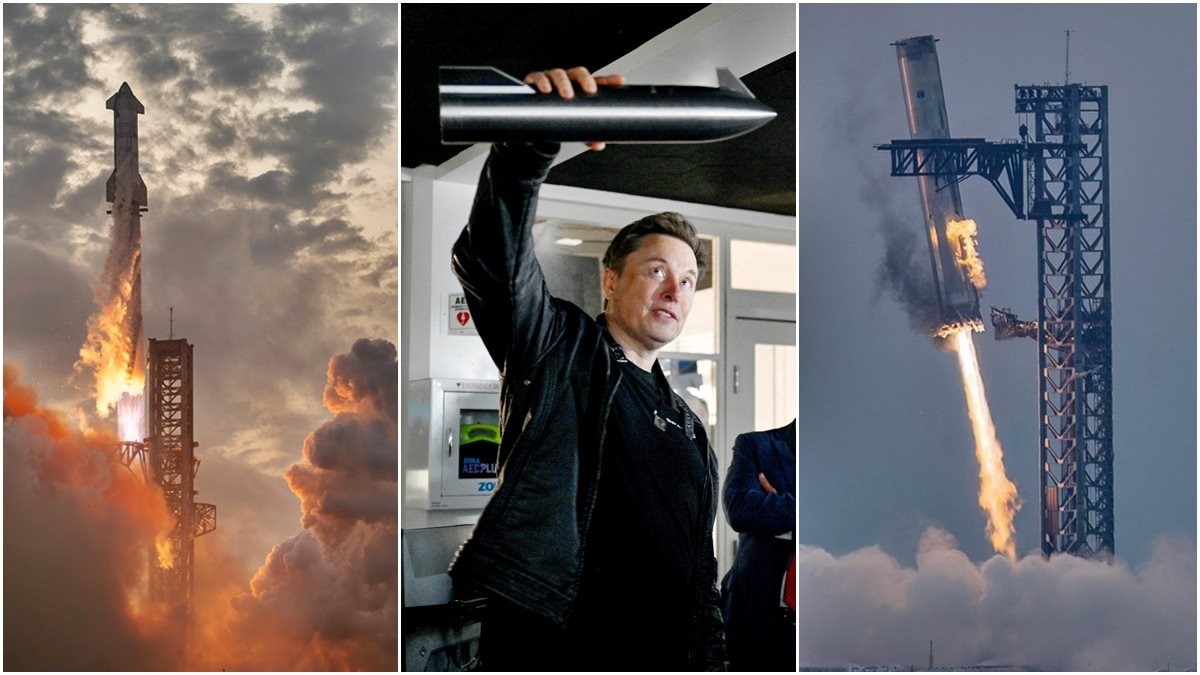
Elon Musk's Starship is about to face a test that could determine how quickly SpaceX can turn its biggest rocket from an experimental machine into a working space transportation system.SpaceX is targeting September 22 for Starship's 14th test flight, and this time the goal is bigger than simply reaching space. SpaceX's mega rocket Starship lifts off for a test flight from Starbase, Texas. (Photo: AP) The company wants Starship to complete its first orbital test, deploy a new batch of Starlink V3 satellites and demonstrate key parts of a flight that could eventually make the giant rocket fully reusable.That makes Flight 14 a crucial step in Musk's plans for using a reusable rocket, the Moon and, ultimately, Mars. TEST FLIGHT TO ORBITThe previous flight, in July, reached space and successfully deployed 20 Starlink V3 satellites.The Starship upper stage also survived atmospheric re-entry and splashed down in the Indian Ocean, providing engineers with valuable data after it was recovered by SpaceX. But it did not complete an orbit, and the Super Heavy booster was lost during its attempted landing. Elon Musk gestures as he walks through a hallway. (Photo: AP) Flight 14 is designed to do better, and go even further.The mission is expected to last nearly 10 hours, with Starship flying at roughly 275 kilometres above Earth and circling the planet about six times before splashing down in the Pacific Ocean west of Chile.The mission remains subject to final regulatory approval.WHY DOES ELON MUSK WANTS STARSHIP TO WORK?Starship is a SpaceX rocket being developed as a fully reusable system made up of the Super Heavy booster and the Starship spacecraft. That makes it different from a usual rocket.That capability is central to Musk's ambition to increase how much can be carried into space while making launches more frequent. SpaceX's mega rocket Starship makes a test flight from Starbase. (Photo: AP) It is also important to SpaceX's Starlink business, because the larger V3 satellites are designed to expand the network's capacity.The stakes for SpaceX, however, extend beyond satellites and that's where Nasa comes in.The space agency is developing a version of Starship as a lunar lander for its Artemis programme.SpaceX's Starship HLS is planned for Artemis-III and Artemis-IV, while Nasa has said the upgraded Version 3 vehicle is expected to form the basis of the lunar lander for Artemis-III in 2027.THE MOON AND THEN MARSNasa's lunar programme gives Starship an important role beyond SpaceX's own ambitions. An artist's concept of a Moon lander designed abd built by SpaceX. (Photo: Nasa) Before astronauts can use it, the lander must demonstrate that it can operate safely and eventually land on and leave the Moon.For Musk, however, the longer-term destination has always been Mars.That makes Flight 14 less about one launch and more about proving whether Starship can become the reusable transportation system on which those ambitions depend.- EndsPublished On: Sep 18, 2026 13:04 IST
Musk, Moon and Mars: Why Starship's next launch is the most critical yet
Full Article
Original Source
Read the full article at Indiatoday →KhanList aggregates and links to publicly available news content. We do not host full articles from third-party sources. Always verify important information with original sources.