
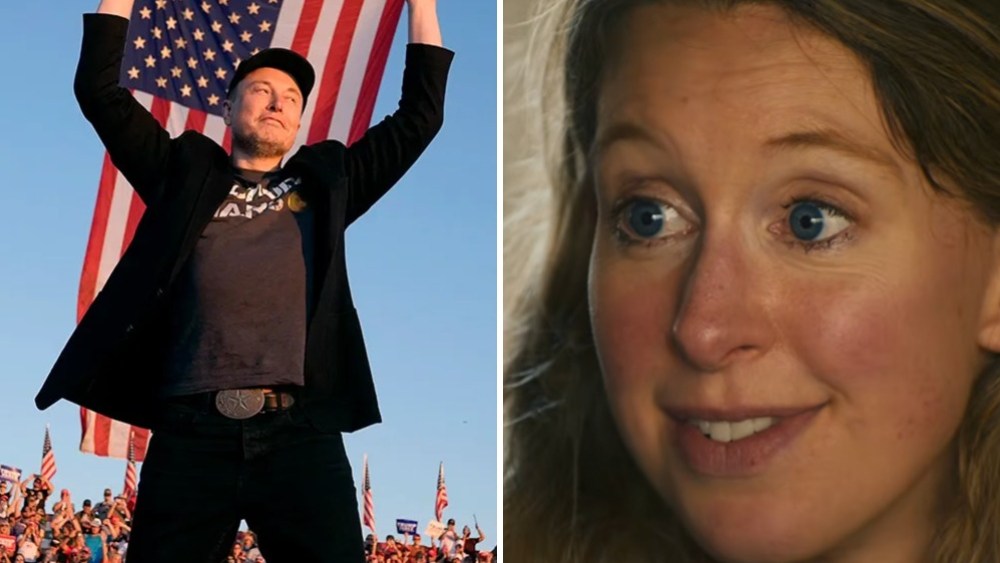
On Monday afternoon, Variety Doc Dreams NYC took over Firehouse Cinema in downtown Manhattan for a lively and informative series of talks highlighting contenders for this year’s Best Documentary Oscar. At the top of the ticket was a conversation between Variety’s co-president and co-editor-in-chief Ramin Setoodeh and Alex Gibney, the Oscar-winning filmmaker behind “Musk,” a nearly four-hour cinematic investigation into the world’s first trillionaire. Gibney told Setoodeh that he began production on “Musk” in 2022, back when he “had no idea… that combo of tech power and financial power was then going to merge with political power.” Musk, of course, used to be a left-wing darling due to his takeover of the electric car company Tesla, with the industrialist even inspiring Robert Downey Jr.’s Tony Stark character. But his politics took a rightward turn at the onset of the Covid pandemic in 2020 before he became Trump’s biggest individual backer during the reality TV star’s 2024 presidential run. “Some people posit that it had to do with his trans daughter [Vivian Wilson]; some people posit that it had to do with regulations during Covid and a snub from Biden. We present all those in the film,” said Gibney. “I honestly think that the primary reason he went for Trump was because he was facing something like 32 investigations by 11 different federal agencies, including a criminal investigation into fraud at Tesla — which would have landed him in prison if he had been convicted. I think he saw an opportunity to elect Trump and, knowing that he would be history’s most transactional president, knew that he could get rid of all those investigations.” The filmmaker behind “Enron: The Smartest Guys in the Room” and “Going Clear: Scientology and the Prison of Belief” said he sees a number of similarities between Musk and Trump, such as their ability “to create their own reality” as well as “this sense of self-invention that relates to branding,” saying, “Trump was never a builder; he was a brander that put his name on buildings. Musk was never really an inventor; he was an investor, but he created the illusion that he was this science-fiction inventor.” One of the most eye-opening revelations in “Musk” concerns the 2024 presidential election and comes courtesy of Ashley St. Clair, a former far-right pundit who mothered one of Musk’s children after sliding into his Twitter DMs. “I have to be careful with this one because this was the issue on which Elon’s lawyer threatened to sue us,” said Gibney. “What Ashley told us — and also showed us in terms of the texts she got from Elon — was Elon felt certain that Trump had won long before anybody else knew. And she said, ‘Really? How did you know that?’ And then he sent her a text, and the text said, ‘I found an anomaly in the matrix, and I have 10,000 space lasers that help me understand this.’ Now, what does that mean? Well, obviously that refers in some way to Starlink.” He continued: “Nobody thinks — at least I don’t, and I don’t believe Elon did either — that that means he switched votes in the election of 2024, but I do think it meant that he found some way to intercept signals of reporting from ballot places so that he knew well in advance… It puts in your mind this idea that Starlink is not just a means of communication; it’s a means of surveillance and control.” Setoodeh and Gibney’s talk covered plenty of ground, including how YouTube, TikTok and Meta all turned down paid ads for the trailer to “Musk” citing “political content.” Gibney found this curious, given that they had no problem running ads for the “Melania” documentary and that the move came, “Right at the time, interestingly enough, that Elon Musk was having dinner with Xi Jinping, along with Jeff Bezos and Zuckerberg, at the White House,” concluding, “If you engage in discourse that seems to upset the tech bros, lo and behold, that discourse is not permitted on those platforms.” On top of Musk, Gibney documented another so-called “inventor,” Elizabeth Holmes, in his 2019 doc “The Inventor: Out for Blood in Silicon Valley.” And, when asked his thoughts on the resurgence of interest in Holmes thanks to Nathan Fielder and Lance Oppenheim’s docu-phenomenon “You Can See Everything,” the documentarian gave his two cents. “I have seen it. I’m glad that a documentary is receiving such enormous interest. I’m a little bit surprised at the enormity of the interest because I was interested in Elizabeth Holmes, yes, because she was a confidence person — a liar — but also this was a person, at the time, who was using the structures of power to line her pockets,” said Gibney. “The Elizabeth Holmes in ‘You Can See Everything’ is somebody who has zero power. It’s still interesting to see that she’s trying to create a character for herself that’s sympathetic, but the part that was interesting to me was not only her as a person playing a fictional character and creating a fictional company to enrich herself, but doing so with enormously powerful corporate lawyers, with people like George Schultz and Henry Kissinger who were backing her up, so it was part of a larger structure that was extremely problematic.” As for his upcoming Hulu doc about Luigi Mangione, however, Gibney remained tight-lipped. Is he planning on interviewing Luigi in prison? Gibney grinned and replied, “No comment.” Next up in Variety Doc Dreams NYC was a talk hosted by Variety chief correspondent Marlow Stern that featured talent from a trio of documentaries: “Robert Richardson: The White Devil” director Jana Hojdová and subject Robert Richardson, the three-time Oscar-winning DP behind films like “Platoon,” “Casino” and “Kill Bill Vols. 1 & 2”; Mary Mazzio, the writer/director/producer of “Mighty Mary,” about the first all-women’s team to compete for the America’s Cup in 1995; and “Standout: The Ben Kjar Story’s” Ben Kjar, a man who overcame Crouzon syndrome (a rare genetic disorder causing craniofacial anomalies) to become a champion wrestler. Hojdová, a graduate student in Prague, won the illustrious cinematographer over by email before spending a decade shadowing Richardson for her film, including months trapped together during Covid lockdowns (and a follow-up book she’s writing on Richardson). Her biggest takeaways from spending so much time with the man she now calls “Bob” were getting to know about his fraught childhood, and the “three years to get” Richardson’s regular collaborators Oliver Stone, Quentin Tarantino and Martin Scorsese to participate. The biggest hurdles for Hojdová were whittling down 650 hours of footage into a feature, as well as licensing all the scenes from Richardson’s movies. While Richardson has worked with many of the greats, there is one filmmaker he’s still dying to shoot for: “Paul Thomas Anderson: If you’re in the room, please call,” he announced. Mazzio — a former Olympic rower whose films have explored everything from New York City’s immigrant street vendors (“The Apple Pushers”) to sex-trafficking victims (“I Am Jane Doe”) — found that the story of the first all-women’s team to compete in the 144-year history of America’s Cup in “Mighty Mary” had “more twists and turns than a murder mystery.” Initially billed as a publicity stunt from billionaire Bill Koch (brother to conservative bundlers Charles and David Koch), the women overcame considerable odds — and loads of sexist insults — to defeat some of the world’s greatest sailors. It’s a particularly timely tale, she maintained. “We’re living in this administration… where we’re seeing regression of opportunities for women and people of color, and this story was this women’s team that crashed this all-male party,” Mazzio said. And if that weren’t enough, she managed to recruit some heavy hitters to not only executive produce “Mighty Mary” but also narrate the rollicking doc: Hugh Jackman and Elizabeth Banks. To get Jackman — a former sailor himself — onboard, Mazzio took a unique approach: critiquing his rowing technique. “Hugh Jackman posts his scores on the rowing machine online… so he’s a rowing-machine fanatic. For the Olympic team, we would be tested on it [and] I hate that machine,” she recalled. “I wrote to his team and said, ‘We’d love for him to be involved with this project. And oh, by the way: We can help him with his form.’” He was in. In Tanner Christensen’s “Standout: The Ben Kjar Story,” we learn how Kjar, born with the rare craniofacial condition Crouzon’s syndrome, fought like hell to become a three-time Utah high school state wrestling champion, Utah Valley University’s first NCAA Division I Wrestling All-American, and winner of the Greco-Roman World Championship at the age of 40. “For the longest time, I didn’t want to open up, I didn’t want to be vulnerable, until I realized that one of the biggest powers that we have today is vulnerability. That’s a true leadership quality,” he said. Kjar was talked into telling his life story on film by its executive producer Jared Hess (“Napoleon Dynamite”), who billed it as follows: “Have you ever seen the movie ‘Wonder?’ Imagine if the little boy grows up to be Rocky Balboa.” Like the little boy in “Wonder,” Kjar endured a seemingly endless barrage of insults about his appearance, like the time he was a young boy and an adult ruthlessly mocked him in a grocery store. “It was the moments in the grocery store with the adult that would annihilate me verbally, and I would go home and I would try to figure out a way in the bathroom to take my face off,” he remembered. “My mom stood me up… and she said, ‘Ben, you want to know what I see? I see someone who’s different and is born to make a difference.’” And make a difference he did. Last came the directors of “The Secret Reading Club of Kabul” and “The Second Life of Freddie Nole,” who spoke about their films on a panel moderated by Variety’s Ethan Shanfeld. The former is a feature-length documentary about young women in Afghanistan who resist Taliban rule by documenting their lives, inspired by “The Diary of Anne Frank.” Shakiba Adil co-directed the film and plays a role on screen as well, even helping a few of the women escape Kabul and emigrate to other countries. “The Secret Reading Club of Kabul” features graphic imagery captured by the young women on their cellphones, including scenes of public executions and whippings. Adil and her co-director Elina Hirvonen expressed why the inclusion of such distressing material was vital to the project. “I really wanted to use those scenes in the film. I was OK to make the Western audience uncomfortable for a few seconds, because you have to see the reality of what’s happening in Afghanistan,” said Adil, who grew up under Taliban rule, having experienced the fall of the terrorist regime in 2001 after the U.S. intervention and fled Kabul in 2021, when the Taliban reclaimed power. “The Second Life of Freddie Nole,” on the other hand, is a documentary short that follows a formerly incarcerated man who picks people up from prison, setting them up with fresh clothes, a cellphone and job leads. Both projects exist in broader political contexts but choose to focus on intimate personal stories. Dana Nachman, who helmed “The Second Life of Freddie Nole,” has, through her work, investigated the criminal justice system, but said she decided to approach Nole’s story “from a very human standpoint.” The 20-minute short follows Nole to Walmart and a diner as he welcomes a man named Ed out of prison. She even described part of her film as a “buddy comedy” between Nole, an “affable grandpa,” and his wife, as they bicker over running late to pick up Ed. You’ll be hearing a lot more about these films throughout awards season.
‘Musk’ Director Alex Gibney Reveals What He Really Thinks of Elon Musk, Elizabeth Holmes and ‘You Can See Everything’ at Variety’s Doc Dreams NYC
Full Article
Original Source
Read the full article at Variety →KhanList aggregates and links to publicly available news content. We do not host full articles from third-party sources. Always verify important information with original sources.