
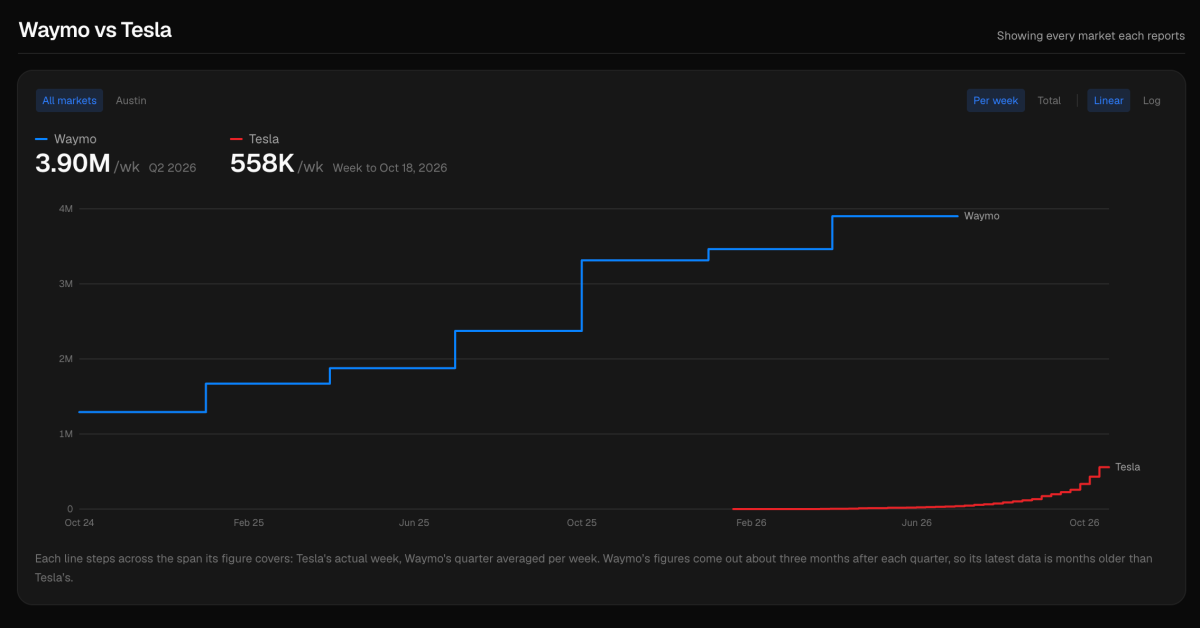
Waymo vs Tesla driverless miles per week, all markets (Credit: Robotaxi Tracker) Elon Musk says Tesla’s Robotaxi race against Waymo “was never a real contest” after Tesla’s driverless fleet logged 438,000 miles in Austin in a single week, edging past Waymo’s 406,000 weekly average in the city. That’s one city, one week, and a Waymo figure that’s four months old. Across the US, Waymo still drives about seven times more driverless miles than Tesla every week. Where the chart comes from The chart going around comes from Robotaxi Tracker, a community project that pulls driverless mileage from each company’s own reports: Tesla’s weekly Robotaxi safety report and Waymo’s quarterly Safety Impact data hub. Jason Scharf posted the Austin view on X with the comment that “the battle for Autonomous Austin might already be over.” Musk replied overnight: “It was never a real contest.” The Austin data is real –albeit with some caveats. In the week ending October 18, Tesla reported 438,000 miles with no safety monitor aboard in Austin, up 30% from the week before. Waymo averaged about 406,000 miles a week in Austin in the second quarter. But the tracker’s own caption explains the catch. Tesla’s figure is its latest week. Waymo’s is an average of April through June, because Waymo publishes about three months after each quarter ends. So Musk is comparing Tesla’s best week ever to Waymo’s spring. The national picture isn’t close Switch the same chart to “All markets” and the story flips. Waymo averaged 3.90 million rider-only miles per week in Q2 2026. Tesla did 558,000 miles in its best week. Waymo’s Phoenix, Bay Area, and Los Angeles markets each drive more miles per week on their own than Tesla’s entire network. Cumulative numbers are even more lopsided. Waymo has logged 271.3 million rider-only miles since 2020, including 50.7 million in Q2 alone, as we covered when Waymo released its latest safety data. Tesla has 3.11 million driverless miles since January 22, 2026. Waymo drove more than that in a single week. And Tesla’s total leans almost entirely on one city: Tesla Robotaxi marketDriverless miles, week to Oct 18Austin438,000Dallas94,841Houston7,288Tampa6,131Orlando6,008Miami5,626 Austin accounts for 79% of Tesla’s weekly driverless miles. Houston, Tampa, Orlando, and Miami combined did about 25,000 miles. Waymo’s smallest tracked market, Atlanta, averaged 250,000 a week in Q2. Tesla flooded Austin with Cybercabs The Austin surge has an obvious cause. Tesla launched public Cybercab rides in Austin on September 3. According to Robotaxi Tracker’s count of the Texas DMV automated-vehicle list, Tesla now has 463 Cybercabs registered in Texas, 337 of them added in the last 30 days. That’s 48% of the 970 autonomous vehicles Tesla has registered in the state. Tesla isn’t hiding the strategy. On the Q3 earnings call last week, Ashok Elluswamy, Tesla’s head of AI software, said the company wants to “swarm Austin with Cybercabs everywhere.” Musk said the Austin Cybercab fleet had grown “by a factor of 10” in about a month. So Tesla dumped hundreds of new, company-owned cars into one metro and the miles went up. That’s fleet deployment. It doesn’t show the software can do what Waymo does in 15 cities, and Tesla can’t repeat it everywhere at once. Still limited by safety, by Tesla’s own admission The bigger problem is what the cars are allowed to do. On the same earnings call, Elluswamy described the service as constrained by the software, not by regulators. He said that if there’s “the slightest possible risk at all,” Tesla doesn’t take it on, and that the limits are “technology driven” for now. Service hours only recently stretched from 9 p.m. toward 2 a.m., and he listed highways, “higher speed roads,” 24/7 operation, and more weather conditions as things Tesla still has to unlock. You can see those limits in the rides. Tesla Robotaxis don’t take highways, and riders report they avoid at-grade railroad crossings. In September, a rider had a 10-minute Cybercab trip in Austin turn into a 70-minute detour because the car drove south through East Austin until it found a bridge over the rail line, instead of taking MoPac. That matters for this comparison, too. Miles is a flattering metric when your car takes the long way. A trip that should cover a few miles and instead loops across town logs a lot more mileage for the same rider. Waymo, meanwhile, has been taking riders on freeways in Phoenix, San Francisco, and Los Angeles since November 2025. Electrek’s Take Credit where it’s due: Tesla’s driverless miles are growing fast, 30% in a single week, and Austin now has a real Tesla fleet carrying the public without anyone in the driver’s seat. A year ago, that wasn’t the case. But “never a real contest” is a strange thing to say when you’re behind by 7x on weekly miles and 87x on cumulative miles, and your one win depends on comparing your newest week to your rival’s data from last spring. What stands out to us is the type of autonomy Tesla is deploying. In 2020, Musk wrote that “Waymo is impressive, but a highly specialized solution,” and that Tesla’s approach was “a general solution.” For years, Tesla fans dismissed Waymo as a geofenced system that only worked in mapped areas with lots of restrictions. Now look at Tesla’s Robotaxi: geofenced, no highways, avoiding railroad crossings, taking 70 minutes for 10-minute trips, and limited by hours because the software isn’t ready for anything with “the slightest possible risk.” By Musk’s own old definition, that’s a highly specialized solution. Waymo is the one driving on freeways now. Robotaxis still need electricity, and so does your EV. If you drive electric, pairing it with home solar can cut your fuel costs to nearly zero. With electricity rates up almost 10% last year and expected to keep climbing, going solar is one of the best ways to protect yourself against rising costs. And with lease and PPA options, you can do it with zero upfront cost and start saving immediately. If you want to find the best deal, check out EnergySage. It’s a free service with hundreds of pre-vetted installers competing for your business, so you save 20 to 30% compared to going it alone. No sales calls until you pick an installer. Get your free quotes here. FTC: We use income earning auto affiliate links. More.
Musk declares Tesla Robotaxi win over Waymo, but Waymo still drives 7x more
Full Article
Original Source
Read the full article at Electrek →KhanList aggregates and links to publicly available news content. We do not host full articles from third-party sources. Always verify important information with original sources.