
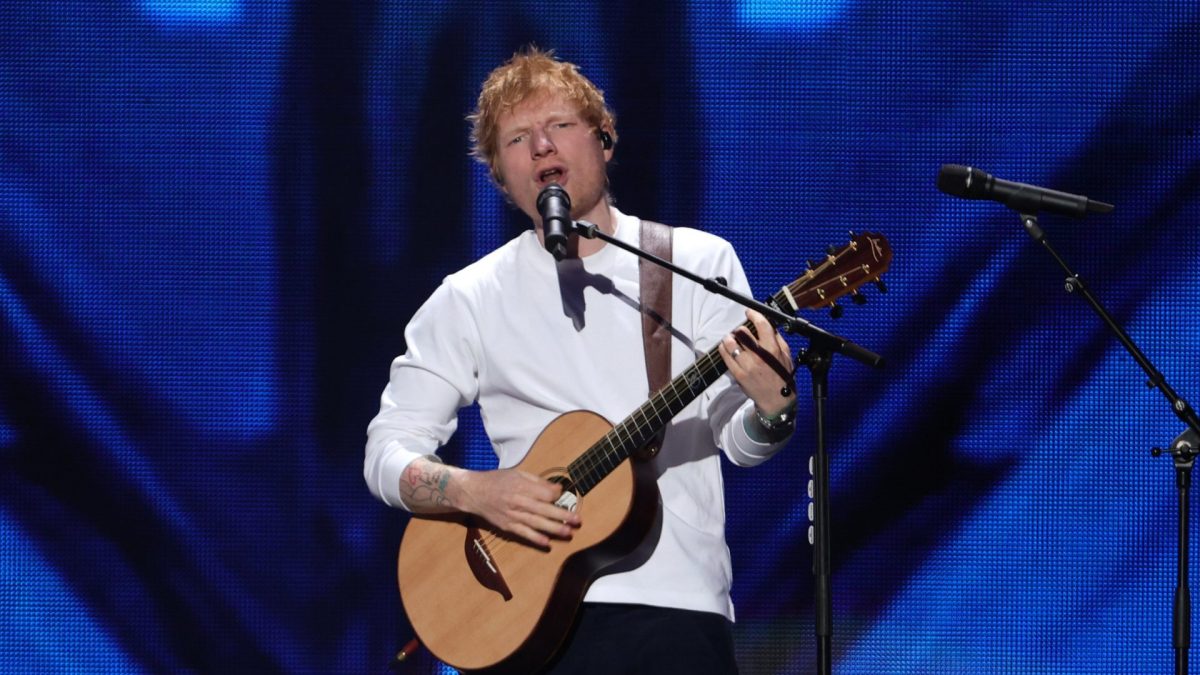
“Come mothers and fathersThroughout the landAnd don’t criticizeWhat you can’t understandYour sons and your daughtersAre beyond your command” In 1964, Bob Dylan’s lyrics to “The Times They Are A-Changin’” challenged the established order, captured the shifting mood in America and inspired the youth movement that led to the enormous political and social upheaval of the 1960s. More than 60 years later, we find that the times are also a-changing, and not necessarily in a good way. The Seattle-born rapper Macklemore has been dropped as a support act on Ed Sheeran’s US tour over expressing support for Palestine during his performance in New Jersey. In a short political discourse, he proclaimed “Free Palestine”, and went on to perform his song “Hind’s Hall”, an explicitly pro-Palestinian protest song, against a backdrop of images from the conflict in Gaza. Understanding the particular sensitivities of his stance, he followed this up by addressing the audience: “To all of my Jewish brothers and sisters: criticism of Israel, criticism of apartheid, being against genocide, is in no way a criticism of you”. But this was not sufficient for the owners of stadiums where the tour was heading, and they insisted that Macklemore was removed from the bill. Robert Kraft, one owner, said his stadium would “not provide a platform for hate speech”. The other support acts then dropped out in solidarity with Macklemore, and Sheeran became the subject of denunciation from other musicians for continuing with the tour. This is such a painful and characteristic story of our times. It encompasses repression, intolerance, cancellation, castigation, outrage, and, not least, a violation of an artist’s right to speak up for what they believe in. Where would we be if musicians were not allowed to voice political views? Never mind Bob Dylan. Marvin Gaye would have been cancelled for “What’s Goin’ On” (a direct challenge to America’s political establishment). Billie Holiday’s 1939 song “Strange Fruit” confronted the horror of racism in the US. Sam Cooke sang “A Change is Gonna Come” an anthem of the Civil Rights movement. Bob Marley told us to “Get Up, Stand Up”, while Public Enemy’s “Fight the Power” gave a voice to rebellion. And many, many more besides. There is a rich strand of popular music that draws its energy from protest, from injustice, from opposition to authority. The question, I suppose, is whether Macklemore is part of that tradition, and his forthright views have fallen foul of the mores of the age. Or maybe he’s just a publicity-minded provocateur who’s conveniently telling his own truth. But that, to an extent, is immaterial. It’s not about whether Macklemore is right in what he says; it’s whether he has a right to say it. Whereas the 1960s were characterised by a newly-discovered liberty – free markets, free love, and free speech – we now live in a much more censorious and restrictive age, where we are so quick to disapprove, perpetually on a hair-trigger to take offence. Not only that, but people in the public eye are firmly told to stay in their lane. What does Macklemore know about the historical sweep of Middle East politics? Just shut up and play your music. But politics doesn’t exist in a separate dimension. It is part of everything we do, and all that we are as a society. It is connected to the songs we write, the films we make, the books we read and the things we laugh about. Artists don’t observe what’s going on through the lens of a smartphone. They live it, and reflect it back to us through their work. So, in this tale of our times, I’m not asserting that Macklemore is the Bob Dylan de nos jours. I’m not even saying that he’s making a valuable contribution to public discourse. But his right to say what he believes is inseparable from Dylan’s. And we, likewise, are free to disagree, boo, and – the greatest revenge of all – not buy his records or go to his concerts. The difficulty comes with the cancellation of artists and musicians for their political views. “Free Palestine” is not, in itself, hate speech, no matter what Robert Kraft says. It should not be treated as antisemitic merely because it is politically contentious or makes some people uncomfortable, any more than support for Israel is a disavowal of Palestinian suffering. Either way, Macklemore is as entitled to have his voice heard as you and I, and the fact that he’s been prevented from doing so should make us all worried. As the man himself sang in “Hind’s Hall”: “You can’t twist the truth, the people out here united/Never be defeated when freedom’s on the horizon.”
Musicians in the 1960s used to stand for something – Ed Sheeran should be ashamed
Full Article
Original Source
Read the full article at Inews →KhanList aggregates and links to publicly available news content. We do not host full articles from third-party sources. Always verify important information with original sources.